

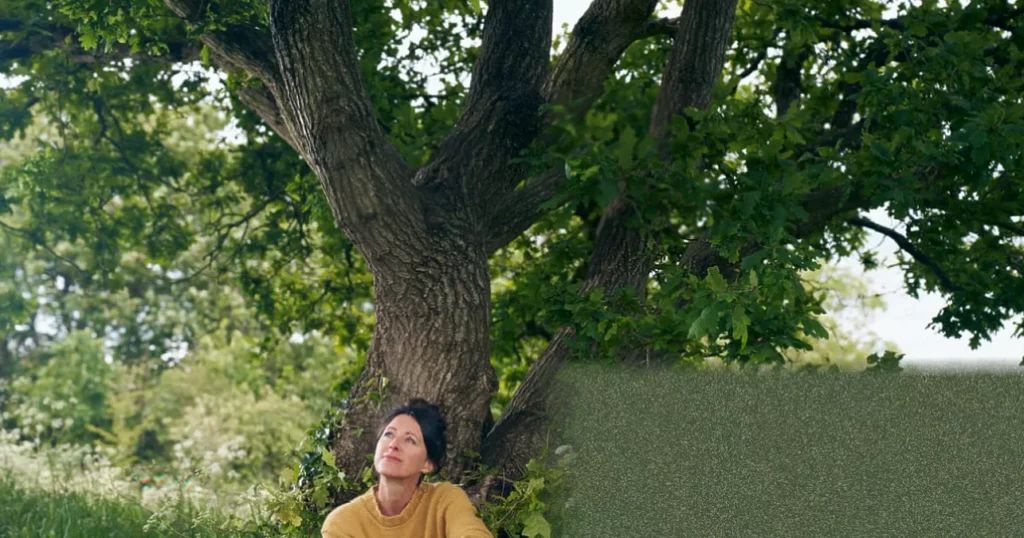
When Natalie Fee found herself burned out after a decade of campaigning against plastic pollution, she did not book a retreat or see a therapist. Instead, she sat down under an oak tree on an urban hill behind her flat in Clevedon, near Bristol, and decided to meditate there every day for a year. The idea, she admits, was “slightly crazy” – but by the time the winter solstice of 2024 rolled around, she had completed the challenge and emerged with a resilience and sense of playfulness she had not felt since childhood.
The burnout years
Fee had spent ten years running a non-profit organisation focused on tackling the UK’s plastic waste crisis. Her efforts led to major policy wins: the government banned plastic cutlery and polystyrene takeaway packaging, while supermarkets agreed to stop selling plastic cotton buds. But the cost was high. Exhausted and transitioning away from full-time activism, she cut her working week to three days. “Looking for more calm in my life,” she recalls, she began to wonder what it would be like to meditate under the same tree every day for a full year.
Burnout, as researchers define it, is a state of emotional, physical and mental exhaustion caused by prolonged stress. It can lead to depression, anxiety, irritability and a diminished sense of self-worth, as well as cognitive effects such as difficulty concentrating and memory problems. Fee’s decision to turn to nature is supported by a growing body of evidence: studies consistently show that spending time in natural environments – even for ten to twenty minutes a day – can reduce stress, lower cortisol levels and improve mood. The practice of combining meditation with time outdoors, sometimes called forest bathing (shinrin-yoku), is now used in NHS pain clinics to promote healing and grounding.
Under the oak
The tree Fee chose is an oak – a species deeply rooted in British culture and ecology. There are two native varieties in the UK, the English oak and the Sessile oak, both known for supporting a vast array of wildlife. A single English oak is estimated to host more than 2,300 species of animals and fungi, the highest biodiversity of any native tree. Historically, oaks have been regarded as symbols of strength and longevity, featuring in Druidic rituals and folklore as “portal” trees offering sanctuary. Fee’s tree stood on grassland that, in winter, appeared barren. She began her year on the winter solstice of 2023 – the shortest day – a moment traditionally seen as a turning point toward the return of light.
The first few months were tough. “There was a lot of rain and I was buffeted by storms and intense winds,” she says. She took a small square of sheepskin to sit on, and sometimes a hot-water bottle. The routine was simple: ten minutes of sitting still and looking around, then twenty to thirty minutes of meditation, followed by writing notes and a poem at home. Those early winter poems, she says, feel “quite introspective”. Some days she questioned why she was doing it, but she was determined to stick with the challenge.
Through the seasons
Spring brought a dramatic shift. “It was as though someone had pressed play,” Fee says. Daffodils appeared, then forget-me-nots. The grassland that had seemed lifeless exploded into colour. Buttercups arrived overnight, and with them the first crickets, whose songs filled the air. The arrival of swifts – migratory birds that travel from Africa to the UK in late April – marked the deepening of spring. “All this sitting in stillness refined my senses,” she says. “I’d return home glowing most days.”
By summer, the meadow itself appeared to be resting, but Fee initially struggled to slow down. She was still working, making music and writing poetry, and found herself exhausting herself during the day. “I realised this was about reconnecting with nature, so I should do what nature was doing,” she says. Making an effort to slow down, she noticed a change: everything felt calmer under the tree, and her meditation became clearer. One day she opened her eyes to find a deer standing in front of her – until a dog ran past and the deer took off.
The health benefits became tangible. Fee says her backache disappeared. Her sense of peace and awe “skyrocketed”. She felt a happiness she had not experienced since childhood and rediscovered a sense of playfulness. Psychologists note that nature connectedness is associated with increased happiness, reduced stress and greater life satisfaction. Trees, in particular, can evoke feelings of awe and wisdom, which calm the nervous system.
Her perception of time also changed. “Previously I would try to control things,” she says, “but I had become more patient and trusting of their natural timing.” On a late summer day, the swifts were unusually active, holding what she calls a “screaming party”. The next day they were gone – as if they had been announcing their departure. Swifts are now on the UK’s Red List of Birds of Conservation Concern, their numbers declining. By autumn, the winds had picked up and the leaves began to turn.
Completion and reflection
Fee ended her challenge on the winter solstice of 2024, exactly one year after she began. On her final visit, she brought her guitar and sang her thanks to the tree for offering sanctuary. “The challenge was complete and I had a newfound resilience,” she says. She was also relieved to be able to travel and see family again. “You don’t need to go far to find a spot in nature where you can sit and reflect,” she adds. “Nature knows what you need, and is always ready to offer it – you just need to be quiet enough to receive it.” She still visits the tree most days, though she admits she skips the rainy ones.
The UK discards an estimated 100 billion pieces of plastic packaging every year, and organisations such as Surfers Against Sewage and Friends of the Earth continue to campaign for reductions. Fee’s own activism contributed to tangible bans, but her year under the oak taught her that rest and observation can be just as transformative as action. For her, the tree became more than a spot to meditate – it became a measure of time, a teacher of patience and a source of the quiet joy she thought she had lost.