

Close Menu
    Useful
    • About Us
    • Contact Us
    • Advertise With Us
    • Health Explainers
    • Our Editorial Team
    Facebook
    HealthNewsDaily.co.uk
    • Home
    • NHS

      Girl’s family agrees to £28m NHS settlement for brain injury at birth

      4 June 2026

      Patient spends £62,851 on height increase surgery to 6ft despite agonising and potentially fatal side effects

      3 June 2026

      Four in five frail pensioners missing essential NHS checks due to regional disparities

      3 June 2026

      Critical care patients at King’s College Hospital given new rooftop garden

      31 May 2026

      Resident doctors in England plan four-day June walkout

      27 May 2026
    • Health Policy

      Palestine badge ban for NHS staff mooted to tackle antisemitism

      5 June 2026

      Government stops short of promising no further aid cuts in letter to parliamentary committee

      3 June 2026

      Anti-abortion activists in NSW signal push to further restrict abortion access

      3 June 2026

      Health officials urged to probe fatalities connected with illicit diet injections

      3 June 2026

      Trial overhaul to provide prostate cancer screening for black men

      2 June 2026
    • Mental Health

      Young ketamine addict told mum he could not go on before fatal agony, inquest told

      5 June 2026

      Federal workers suffer trauma after Trump administration’s unlawful sackings

      3 June 2026

      2026’s monk mode: manosphere trick or imperative

      2 June 2026

      Husband’s rare condition leaves him unable to produce sperm

      31 May 2026

      Diagnosis halted monthly rage attacks that had been tearing my family apart

      31 May 2026
    • Wellness & Lifestyle

      Personal trainer identifies exercise that increases calorie burn without longer workouts

      5 June 2026

      Prince William’s period perspective at odds with two-dad family, says father

      5 June 2026

      Person sat beneath an oak tree daily for a year

      5 June 2026

      The daily fatigue trigger most people miss

      5 June 2026

      Doctor names vitamin deficiencies most strongly linked to greying hair

      4 June 2026
    • Disease & Prevention

      Alzheimer’s diagnosis for former Channel 4 newsreader Jon Snow

      5 June 2026

      Smartphone demand drives deforestation behind Ebola outbreaks

      5 June 2026

      British Heart Foundation to close about 150 charity shops

      5 June 2026

      Ebola outbreak hits pregnant women hardest

      4 June 2026

      High alert issued to GPs and nurses for UK Ebola cases

      4 June 2026
    • Treatment & Research

      High street bank installs defibrillators and bleed control kits in 605 branches

      5 June 2026

      AI-developed vaccine undergoing human trials effective against all Covid strains

      5 June 2026

      Men over 50 face recurring rectal foreign body incidents

      4 June 2026

      Melinda French Gates gives $10m to improve America’s menopause care

      4 June 2026

      New ovarian cancer treatment approved for NHS, first in decades

      4 June 2026
    HealthNewsDaily.co.uk
    • NHS
    • Health Policy
    • Mental Health
    • Wellness & Lifestyle
    • Disease & Prevention
    • Treatment & Research
    Home » Treatment & Research » Men over 50 face recurring rectal foreign body incidents
    Treatment & Research

    Men over 50 face recurring rectal foreign body incidents

    Sophie HargreavesBy Sophie Hargreaves4 June 2026
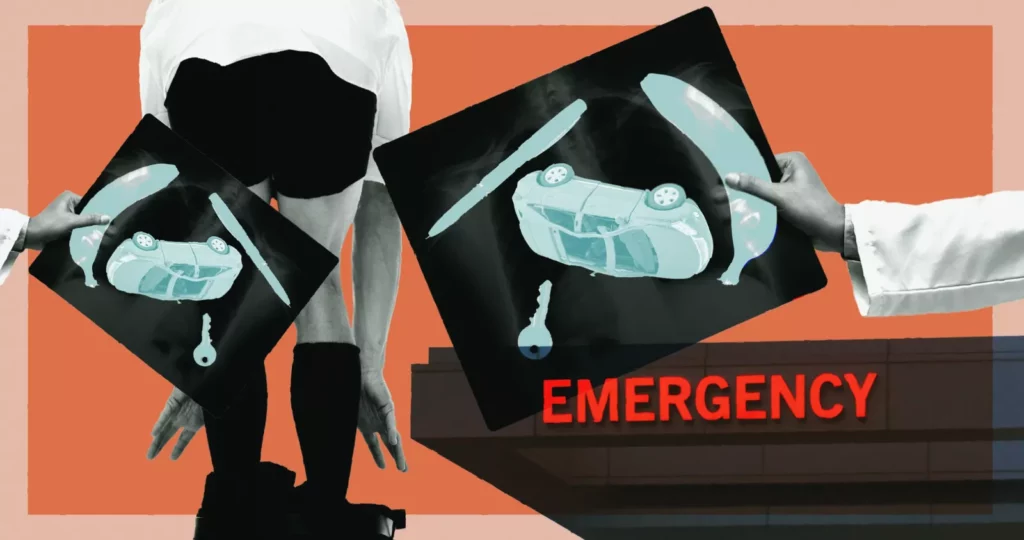
    A hospital A&E department waiting area with clinical equipment visible

    The NHS has spent more than £3 million over the past five years removing foreign objects from patients’ rectums, new figures reveal. Data obtained by Erobella under a Freedom of Information request shows that in 2025 alone, 505 people were admitted to hospital for this reason, with the health service estimated to have spent £429,250 last year extracting items at a cost of £850 per procedure. The total for the half-decade stands at roughly £3,172,200.

    Behind the headline figure lies a pattern that clinicians say is more common than many realise. Dr Lawrence Cunningham, a GP with nearly 40 years of experience, recalls a patient in his fifties who shuffled into his surgery complaining of tummy pain. “It took nearly an hour of gentle questioning before he admitted the truth,” Dr Cunningham says. “He had a glass jar stuck up his bottom that he couldn’t get out himself.” The man was sent straight to A&E.

    The mechanism that lands so many people in this predicament is simple. The internal anal sphincter — a muscle that cannot be consciously controlled — contracts to hold in bowel contents. If an object without a flared base is pushed too far in, the sphincter can contract and pull it deeper into the rectum, making removal impossible without medical help.

    A problem that skews older and male

    While women also experience this — 111 attended hospital last year — the figures show the issue disproportionately affects men. Of the 505 admissions in 2025, 393 were male. A third of those men were over 50, and 26% were aged 31 to 50. Overall, 25% of all admissions were men aged 51 or older. Historical data from the decade 2010 to 2019 shows men accounted for 85.1% of cases, with admissions peaking in the second and fifth decades of life. Over that period, the NHS removed approximately 3,500 foreign bodies at an average annual cost of £338,819.
    An illustrated diagram of the internal anal sphincter muscle contraction mechanism

    Why older men are disproportionately affected

    Sex educators and those who work closely with older men point to a convergence of factors that make the over-fifties particularly vulnerable to these incidents. April Maria, an accredited sex educator and intimacy coach who works with Hot Octopuss, says the key driver is a maturing sense of sexuality. “It’s not about these men being adventurous, but more about them becoming more comfortable with themselves and their bodies over time,” she explains. “As people get older, there’s less pressure to perform or fit into a rigid idea of what sex ‘should’ look like, and more openness to exploring what actually feels good.”

    That exploration often coincides with the onset of erectile dysfunction. According to Bupa, more than a third of men in their fifties and nearly half in their sixties are affected. “They start exploring parts of their body that might bring them more pleasure if they are struggling to get it from their penis,” April Maria adds. Estimates suggest around 4.3 million men in the UK are affected by erectile dysfunction, a figure projected to rise globally.

    Melissa Todd, a sex worker and dominatrix who has worked in the industry for around 30 years, says she regularly receives requests from men in their fifties and beyond for anal play. “They usually want fingers or strap-ons up there, rather than anything too rogue, but it’s definitely not rare,” she says. “A lot of these men are very ‘ordinary’ on paper — married, professional, fairly traditional — but turn up after thinking about it for years. They’re curious. Some have heard about prostate stimulation and want to see what the fuss is about, others just say it’s something they’ve always wondered about but never had the chance — or the confidence — to try.”
    A collection of inappropriate household items commonly used for anal exploration

    The prostate gland is sometimes called the male G-spot, and prostate massage is explored for potential benefits including improved erectile function through increased blood flow, relief from chronic prostatitis, and enhanced sexual pleasure. But Todd believes a deeper existential shift drives the timing. “There’s a sense of ‘why not now?’ – whether that’s because relationships have changed, life’s settled down, or they’re just more aware that time isn’t endless. They’ve experienced big life changes, bereavements or redundancies. It feels less like a sudden new interest and more like something that’s been quietly on their mind for years, finally getting its moment.”

    Where it goes wrong, experts say, is in the execution. April Maria points to a “lack of proper education around anal sex”. She notes that it is “either completely skipped over or reduced to stereotypes, and it’s often labelled as something that sits within the ‘gay sex’ category, when in reality, people of all sexualities explore anal play. Because of that, most people are left to learn through porn or trial and error, which isn’t safe when anal sex has some strong do’s and don’ts.”

    Dr Cunningham adds that older men in particular often fail to do their homework. “There’s a real reluctance to go out and buy proper equipment that’s actually designed for this, so they end up improvising with stuff that’s completely unsuitable,” he says. “Older men are much less likely to talk openly about sexual health or get advice first. That generation didn’t grow up with easy access to this kind of information the way younger people do now.”

    A medical theatre room prepared for surgical removal under anaesthetic

    The range of objects that end up lodged is extraordinary. Dr Cunningham says he has seen or heard of “household items through to purpose-made adult toys”, with the most common being bottles, light bulbs, and various bits from the kitchen drawer. Colleagues in A&E have told him about mobile phones, remote controls, and even small tools. The list from hospital records elsewhere includes vibrators, salad tongs, live ammunition, a peanut butter jar, a World War One bomb retrieved in France, and even living animals such as eels and hamsters. The unifying factor is an absence of a flared base to prevent the object from being drawn in by the sphincter.

    Risks and what to do

    Dr Cunningham warns that the consequences of leaving an object in place or attempting DIY removal can be severe. “The biggest risk is perforation of the bowel wall, which can be life-threatening,” he says. “Sharp objects or too much force during DIY removal attempts can cause tears, which then lead to serious infections. Internal bleeding is another big worry, particularly with glass or metal objects. Infection’s a real risk too, especially if the object’s been there for hours or days. There’s a lot of bacteria in the bowel, and if that gets into the bloodstream, you’re in real trouble. I’ve seen patients who’ve waited days out of sheer embarrassment, and it’s become a much bigger problem than it needed to be.”

    His advice is unequivocal: go straight to A&E. “Once you’re at hospital, it depends on the object and how far up it’s gone. Sometimes the A&E team can get things out manually, but quite often patients end up going to theatre to have it removed safely under anaesthetic – especially if the object has sharp edges or has travelled too far up. The key message is don’t try to sort it out yourself – the sooner you get proper help, the simpler the removal tends to be.”

    A&E
    Share. Facebook Twitter LinkedIn WhatsApp Telegram
    Sophie Hargreaves
    Sophie Hargreaves

    Health Correspondent
    Sophie Hargreaves covers medical research, new treatments, disease outbreaks and prevention for Health News Daily. She holds a Master's degree in Health Sciences from the University of Leeds and has spent several years translating complex medical science into clear, accessible reporting for a general audience. Sophie focuses on the latest clinical trials, NICE and MHRA approvals, vaccination programmes and emerging health threats, always with an eye on what these developments mean for people in the UK.
    · MSc Health Sciences (University of Leeds), science communication volunteer, medical research literacy
    · Clinical trials and drug approvals (NICE, MHRA), cancer screening programmes, vaccination and outbreak response, women's health (endometriosis, PCOS, menopause), weight management treatments, AI in diagnostics

    Related Posts

    Treatment & Research

    High street bank installs defibrillators and bleed control kits in 605 branches

    5 June 2026
    Treatment & Research

    AI-developed vaccine undergoing human trials effective against all Covid strains

    5 June 2026
    Treatment & Research

    Melinda French Gates gives $10m to improve America’s menopause care

    4 June 2026
    Treatment & Research

    New ovarian cancer treatment approved for NHS, first in decades

    4 June 2026
    Join Our Community & Win

    Each month we select one lucky follower to receive a prize from our partners. Follow us on our social channels for your chance to win.

    • Facebook
    Latest
    Disease & Prevention

    Alzheimer’s diagnosis for former Channel 4 newsreader Jon Snow

    5 June 2026
    Wellness & Lifestyle

    Personal trainer identifies exercise that increases calorie burn without longer workouts

    5 June 2026
    Treatment & Research

    High street bank installs defibrillators and bleed control kits in 605 branches

    5 June 2026
    Disease & Prevention

    Smartphone demand drives deforestation behind Ebola outbreaks

    5 June 2026
    Health Policy

    Palestine badge ban for NHS staff mooted to tackle antisemitism

    5 June 2026
    Mental Health

    Young ketamine addict told mum he could not go on before fatal agony, inquest told

    5 June 2026
    News Categories
    • NHS
    • Health Policy
    • Mental Health
    • Wellness & Lifestyle
    • Disease & Prevention
    • Treatment & Research
    Help
    • About Us
    • Contact Us
    • Advertise With Us
    • Health Explainers
    • Our Editorial Team
    About Us
    About Us

    Health News Daily provides trusted UK health news, covering NHS updates, medical research, public health and wellbeing with clear and reliable reporting.

    Facebook
    • Cookie Policy
    • Privacy Policy
    • Complaints Policy
    • Corrections Policy
    • AI Disclosure Policy
    • Editorial Policy & Ethics
    • Accessibility Statement
    • Medical Disclaimer
    • Terms & Conditions
    • Sponsored Content Disclosure
    • Copyright Notice
    © 2026 Healthnewsdaily.co.uk. All rights reserved.

    Type above and press Enter to search. Press Esc to cancel.