

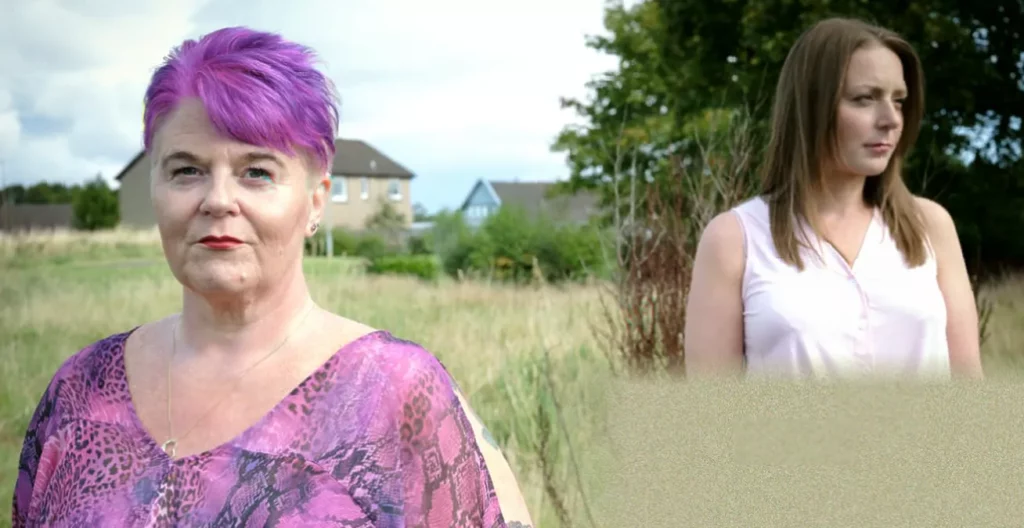
A mother’s rage smashed her car into the garage door three times. Laura Daly, then six years old, sat silently in the back seat, her head flopping forwards with each impact as she watched her mother, Wendy, reverse and ram the family car into the Hampshire home’s garage door again and again. On the seventh smash the door contorted just enough for Laura to squeeze under, get inside and fetch the keys. “Nothing would’ve stopped me,” Wendy Barker, now 56, recalls of that moment. “It was like I was watching myself.”
The childhood trauma that followed became a defining memory for both mother and daughter. Laura, now 37, remembers overhearing “big, fiery” arguments between her parents before her mother received treatment. “I’d feel sad because she’d be crying – I hated seeing her so upset,” she says. “Mum was hard work at points. I’d sometimes overhear her shouting at Dad and think, this is unfair.” Barker says she would “say nasty things, and felt unable to stop, then afterwards think: that was awful. Then the tears and depression came, I’d spend a week apologising – then it’d start all over.” Her arms are covered in large, colourful tattoos that hide self-harm scars from when things got really bad, and above one is inked Maya Angelou’s words: And still I rise.
For two decades Barker sought an explanation for behaviour she could not control. She described herself as a “coiled spring” – until she had an outburst of anger, screaming and tears, the tension would not subside, no matter how much meditation she tried. “As soon as I had my period, it started building all over again,” she says. Doctors initially suspected bipolar disorder. “I was Jekyll and Hyde,” Barker says. But the exact timing of her symptoms – which she tracked – suggested otherwise. Like clockwork, for a week a month her symptoms vanished, only to reappear for the following three weeks.
Diagnosis: a condition almost no doctor had heard of
That pattern – severe mood swings, irritability, extreme depression, anxiety, fatigue and overwhelm occurring during the luteal phase of the menstrual cycle (the one to two weeks before menstruation) and resolving within days of the period starting – is the hallmark of premenstrual dysphoric disorder, or PMDD. Medical experts believe it is caused by the way the brain reacts to hormonal changes, typically triggered by fluctuating levels of progesterone, and potentially oestradiol and testosterone. It is a heightened sensitivity to normal hormonal shifts, not a psychological issue. The disorder is distinct from the far milder PMS: PMDD leads to debilitating psychological and physical symptoms that significantly disrupt daily life, work and relationships. Some describe feeling like a completely different person each month.
Despite its severity, PMDD only officially became a diagnosable disorder in 2013 when it was added to the Diagnostic and Statistical Manual of Mental Disorders (DSM-5). The World Health Organization recognised it in 2019, and it is also included in the International Classification of Diseases (ICD-11). The diagnostic criteria require at least five symptoms – including significant mood disturbance, irritability, depression or anxiety – during the luteal phase, with symptoms improving after menstruation begins. Yet the path to diagnosis remains extraordinarily long. Research indicates that on average it takes 12 to 20 years to receive an accurate PMDD diagnosis, with many individuals seeing an average of six different medical providers before being correctly identified. The condition is frequently misdiagnosed as PMS, depression, anxiety, bipolar disorder or personality disorders. Current research indicates that PMDD affects up to one in 20 women of reproductive age, though just 1.6 per cent have a formal diagnosis. That translates to approximately 824,000 women in the UK. A third of those diagnosed have attempted suicide.
Barker’s breakthrough came when she saw an episode of the BBC daytime show Kilroy featuring Dr Katharina Dalton, the British physician who coined the term premenstrual syndrome. Dalton said Barker had postnatal depression but added: “I think you also have something else. … It’s premenstrual dysphoric disorder.” That three-word diagnosis, given in 2000, made Barker one of Britain’s first cohort of women to be diagnosed. “It was like a light went on,” she says. She later found treatment with consultant gynaecologist Professor John Studd, a pioneer in menopause and hormone therapy, who trialled oestrogen implants. “It was the only thing that worked – my symptoms disappeared,” Barker says. Yet the NHS refused to fund the treatment because PMDD was classed as a syndrome rather than a disease. Barker ended up paying £600 every six months to travel from Hampshire to London for a new implant at her own expense. Her daughter once lent her £1,000 to get one fitted.
‘Soul-destroying’: the impact on families
The guilt that mothers with PMDD carry is immense. Brighton counsellor Tamsin Taylor, known as the PMDD Therapist, says these women are often “riddled with guilt”. “It’s a brutal condition,” she says. “These women are really suffering.” Because PMDD is not curable and there is no single proven treatment, Taylor helps clients with the psychological impacts. Treatments vary in effectiveness – antidepressants (SSRIs), contraceptives, hormone therapy, GnRH analogue injections, and in rare cases surgery – but what all patients need, she says, is “love and support in a non‑judgmental environment”. Dr Louise Newson, a women’s health expert, says PMDD often follows postnatal depression and warns that “women are even sectioned through misdiagnosis”. She treats the condition with hormone treatment, including testosterone, progesterone or oestrogen, and argues that antidepressants do not address the underlying root cause. “I once prescribed them myself for PMDD – until I learned how transformational it is to replace those missing hormones,” Newson says. “It’s currently a health condition understood more by women than health professionals.”
Jenny Fairhurst, 41, from Crewe, noticed symptoms after having her second child. “I felt like I was behind glass – watching my kids play but unable to feel joy or join in,” she says. “I felt dead inside. I’d snap with explosive outbursts at my partner and children for the smallest things.” Then came “immense guilt”. One doctor dismissed it as “normal hormonal mood swings”, leaving her feeling “dejected and unheard”. After tracking her symptoms – “Day 22 was always my crash day” – another GP finally listened. “It was such a turning point. I felt validated.” She discovered that taking the antidepressant Fluoxetine during the luteal phase helped level out the most intense symptoms. Her son, now 10, understands the child-appropriate language she has used to describe the disorder. “He knows in the run-up to my period that everything’s a bit harder for Mummy,” Fairhurst says. “What’s been so lovely is, I’ll be lying on the sofa and he’ll sense I’m struggling, and say, ‘Are you OK? Are you feeling sad and getting your period?’, and envelop me in a big hug. I think it’s taught him real empathy.”
Even medical professionals are blindsided. Dr Milli Raizada, 40, a GP and women’s health expert, was diagnosed with PMDD six years ago – and had never heard of it. She flew off the handle at her mother-in-law over a throwaway comment and knew it was time to act. When she saw a gynaecologist, she burst into tears and said, “I’m probably wasting your time but I feel like I can’t cope.” The doctor replied, “You’ve got PMDD.” She said, “What’s that? And I’m a GP!” She was prescribed Zoladex, inducing a chemical menopause, which has side effects making long-term use unsustainable, but has helped for now. Her marriage ended in divorce, though her relationship with her children – now 12 and 10 – has improved. “They now understand how my cycle works,” she says. Raizada is clear on what needs to happen: “Better training. More research. Stop sidelining women’s health.”
New research released this year shows PMDD can markedly affect trust and intimacy for both those with the syndrome and their partners. In Taylor’s experience, the partner tends to bear more of the brunt than the children. “Women are fiercely protective of their children. Much of the guilt I hear is that they’ve overstepped with their partner. It can tear apart relationships,” she says. Yet some families report a different outcome. Laura Daly says her mother’s PMDD has actually brought them closer together. “Mum’s absolutely my best friend,” she says. “We live on the same street, I see her all the time.” Now Barker and her children joke about the garage incident, with the children teasing about their reluctance to get into a car with her. “I can talk to my mum about anything because of how open she’s been about everything she’s been through,” Daly says. “I’m so very proud of her.”
To address the gap in support, Phoebe Williams, 28, recently founded the PMDD Project, the UK’s first charity solely dedicated to premenstrual dysphoric disorder. Williams began experiencing symptoms at about 15, and by 22 understood something was wrong. She had been dismissed by doctors repeatedly – one said she was “being dramatic and should just crack on”; another nearly misdiagnosed her with bipolar without asking about her cycle. A male doctor admitted he had never heard of PMDD but promised to research it. “He phoned me the next day and said, yep, that’s exactly what you have.” The charity aims to educate medical professionals, get PMDD on the healthcare curriculum, create a helpline, and run an employer accreditation scheme for flexible working accommodations. The renewed Women’s Health Strategy for England has acknowledged PMDD as a priority, though concerns remain over funding.