

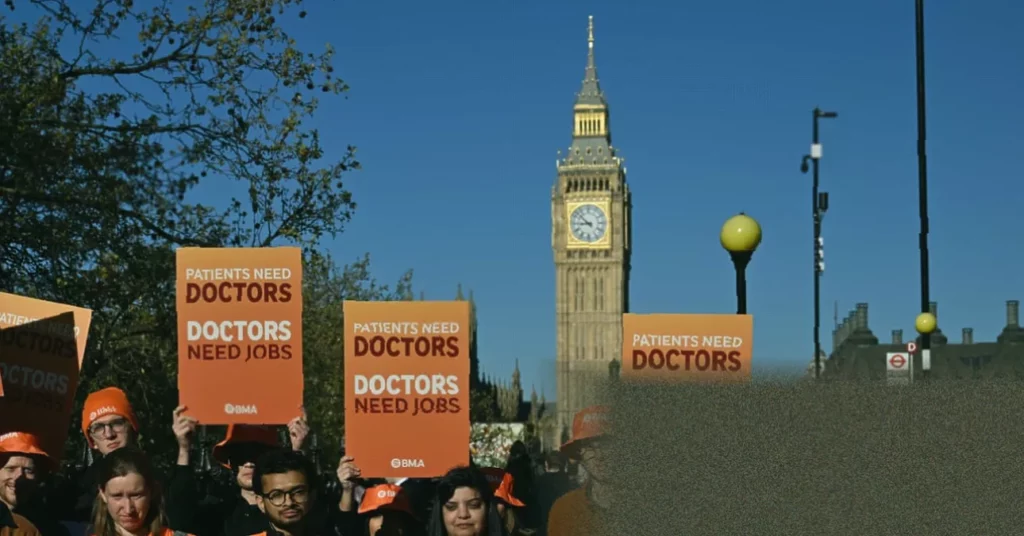
Resident doctors in England will stage a four-day strike next month, the sixteenth walkout since their long-running dispute began, as the British Medical Association accused the new health secretary of failing to break the deadlock over pay. The BMA has warned that a further stoppage in July will follow unless progress is made towards its demands.
Strike dates and expected disruption
The industrial action will run from 7am on Monday 15 June until 6.59am on Friday 19 June – a 96-hour stoppage. It is the latest in a series of strikes that began with the first walkout in March 2023. NHS England will be forced to reschedule tens of thousands of diagnostic tests, outpatient appointments and operations, as has happened during previous rounds of action. Since the end of 2022, at least 1.7 million healthcare appointments have been cancelled or postponed because of industrial action across the health service.
BMA demands: pay restoration and training places
The union, which represents about 55,000 of England’s 75,000 resident doctors, is demanding a pay increase that makes up for what it says is a 26% loss in the real-terms value of salaries since 2008-09. Some independent analyses have put the real-terms decline closer to 21% over the same period, while other measures suggest a smaller drop of around 6-7%. The BMA, however, maintains the 26% figure as the basis for its claim. Dr Jack Fletcher, chair of the BMA’s resident doctors committee, said the union had hoped that the appointment of James Murray as health secretary on 14 May would herald a fresh approach. “Sadly, we have run up against the same unwillingness to move we encountered under Mr Streeting,” he said. “We cannot be asked to negotiate in good faith for weeks, only to be told there is nothing left to negotiate about on pay and no further details at this stage on jobs.”
Alongside the pay claim, the BMA is urging the NHS to expand dramatically the number of specialty training places available to resident doctors, describing the current situation as a “jobs bottleneck”. In a recent year, nearly 40,000 applicants competed for training posts across the UK, raising concerns about poor workforce planning and the risk of losing doctors who are unable to progress to the careers they want. The BMA argues that without concrete commitments from the government to create more training positions, the dispute will remain unresolved.
Government’s position and counterarguments
James Murray, who succeeded Wes Streeting as health secretary last month, rejected the BMA’s pay claim as “unrealistic, unaffordable and unsustainable”. He expressed disappointment that the union had “refused to consider further discussions about how to strengthen the deal on the table” and had “rushed once again to unnecessary and unreasonable strike action”. Murray pointed to what he described as a 33.4% pay rise for resident doctors over the last four years – the highest anywhere across the public sector. “These are simply not grounds for yet more strike action, which patients do not support, puts further pressure on other staff and costs the NHS hundreds of millions of pounds,” he said.
Under Wes Streeting, the government had offered a 4.9% increase in average basic pay for 2026-27, which officials claimed would have made resident doctors 35.2% better off than four years earlier. That offer also included 1,000 additional training places, though these were later withdrawn because of the rising costs of industrial action. The government has since introduced the Medical Training (Prioritisation) Bill, which aims to prioritise UK medical graduates for foundation and specialty training places, partly in response to increased competition from overseas-trained doctors. Previous offers have included creating 4,000 more specialty training places – 1,000 of them brought forward – alongside measures such as reimbursement for exam fees and an increase in the less-than-full-time allowance.
The pay award for 2025-26 gave resident doctors a 5.4% uplift, comprising a 4% rise plus a £750 consolidated payment, which the government described as the highest in the public sector that year. For 2026-27, the government accepted the independent pay review body’s recommendation of a 3.5% increase for doctors and dentists. Despite these uplifts, some analyses suggest that average real-terms earnings for resident doctors in 2025-26 remain between 4% and 10% lower than levels seen in 2010-11.
The dispute began with a stoppage in March 2023, and after 11 rounds of strikes the BMA accepted a deal in September 2024 that was intended to start a journey towards pay restoration. However, further action – including a six-day strike over the Easter period in 2025 – has continued. The cumulative cost of the strikes to the NHS has been estimated to exceed £3 billion, with a single six-day walkout costing well over £250 million. Research on patient outcomes has produced mixed findings: one study found no average increase in inpatient mortality for emergency patients during strikes, but noted worse outcomes for Black patients in hospitals more exposed to the action. Dr Fletcher said the union had given Murray “a genuine opportunity to break this logjam with fresh energy and ambition” and accused him of offering “vagueness on new jobs and no further money on the table”.