

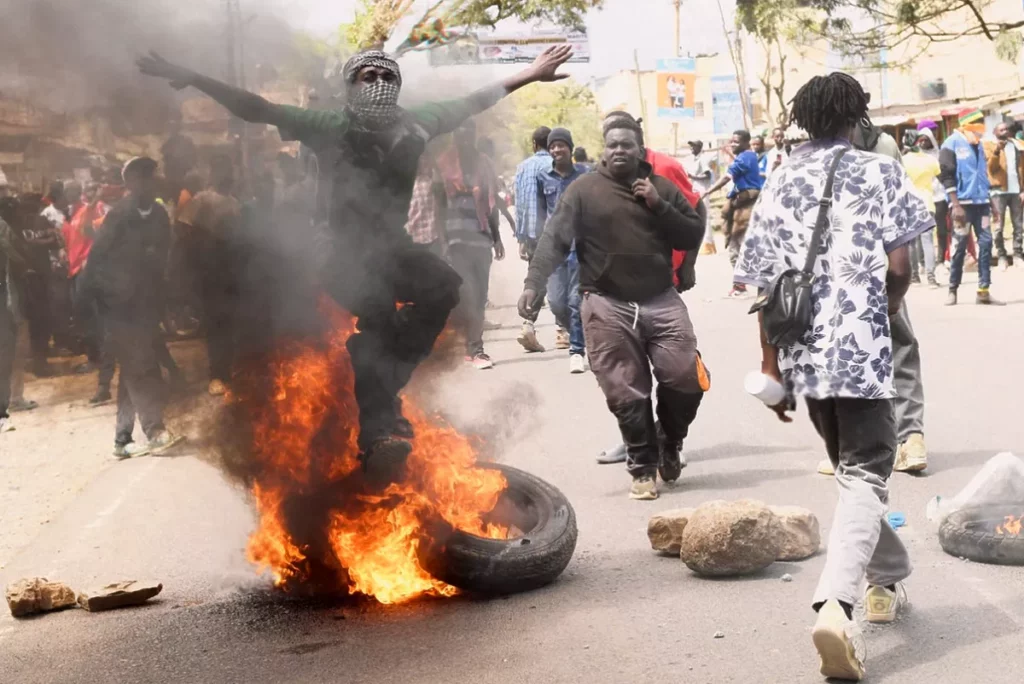
Two people have died after protests erupted in central Kenya against plans for a US-backed Ebola quarantine facility, with demonstrators clashing with police in the town of Nanyuki on Monday.
The deaths were confirmed to local media by protest organiser Patrick Wahome and a security source. The violence broke out as residents and local leaders took to the streets near Laikipia Air Base, where the facility is planned, burning tyres and erecting road barricades. Protest organisers have demanded the facility be permanently shut down by 9 June.
Why the Quarantine Plan Sparked such Fury
At the heart of the unrest is deep public suspicion over a facility that many Kenyans believe is designed to quarantine American citizens exposed to Ebola, rather than fly them back to the United States. The Trump administration requested the facility, and Kenyan President William Ruto approved it. US officials said it would be a 50-bed unit intended to treat Americans exposed abroad during the growing outbreak in Central Africa, and was scheduled to become operational last Friday.
The specific fears are rooted in the nature of the disease itself. The current outbreak is caused by the Bundibugyo strain of Ebola, a rare variant for which there are no approved vaccines or targeted antiviral treatments. Existing vaccines target the Zaire strain. The outbreak has already hit the Democratic Republic of Congo and Uganda hard, with the World Health Organization (WHO) recording over 1,200 suspected and confirmed cases and at least 241 deaths as of late May. The WHO declared the outbreak a Public Health Emergency of International Concern on 16 May, and the Africa Centres for Disease Control and Prevention has also classified it as a Public Health Emergency of Continental Security.
For residents of Nanyuki, the question is blunt: why should Kenya host a quarantine centre for Americans if the same facility is considered too dangerous for US soil? The Kenya Medical Practitioners, Pharmacists and Dentists Union has issued a 48-hour strike notice, accusing the government of betrayal and of “importing an international health crisis.” The union argues the US is unwilling to accept Ebola-exposed individuals on its own territory and that Kenya should not become a “dumping ground.”
Suspicion has been fuelled by visible US military activity. Flight-tracking data shows two US Air Force C-17A Globemaster III transport aircraft landed at Laikipia Air Base in late May, aircraft typically used for rapid deployment and aeromedical evacuation. A US military C-130 transport plane also flew into Nanyuki on Friday, and residents reported seeing military aircraft heading towards the base over the weekend.
Legal action has added a layer of suspense. Kenya’s High Court temporarily suspended the project on Friday, 29 May, after the Law Society of Kenya and the Katiba Institute filed a lawsuit arguing the facility poses grave health risks to a public already served by a fragile health system, and that the agreement lacked transparency and public participation. The court barred the government from admitting, transferring, or facilitating the entry of any individuals exposed to or infected with Ebola under the arrangement. The case is scheduled for a hearing on Tuesday, 2 June. Notably, President Ruto made no mention of this court order when he defended the plan on Monday night.
Even within the US system, there were reportedly reservations. Some officials at the US Centers for Disease Control and Prevention (CDC) advised against the plan, citing concerns about the standard of care compared to US facilities and potential difficulties in recruiting staff for Ebola response activities.
Government Defends Plan Amid Mounting Pressure
President William Ruto pushed back against the criticism on Monday night, insisting the facility is part of a broader national emergency preparedness strategy, not a special arrangement for the United States. “We are a responsible government. We know what we are doing,” he declared, urging Kenyans not to panic.
Ruto revealed he approved the plan after a direct request from President Donald Trump, citing decades of cooperation between Kenya and the US on major health crises, including HIV/AIDS, COVID-19 and Ebola. He argued the facility was not unique and claimed similar health preparedness centres already exist across Kenya. Health Minister Aden Duale has also stated the centre is for “everyone” and not exclusively for US nationals.
The government points to its own preparedness efforts as evidence of its seriousness. The Ministry of Health has trained over 2,200 healthcare workers in outbreak response and case management. It has established four dedicated Ebola testing laboratories and activated isolation and holding facilities in referral hospitals and border locations. Surveillance and screening have been intensified at airports and land crossings, with around 3,000 people screened daily. A cross-border simulation exercise is scheduled to assess operational readiness. Prime Cabinet Secretary Musalia Mudavadi is overseeing the national response.
The broader context of US-Kenya health relations is complex. The US has historically been a major supporter of public health in Kenya, but recent cuts to US foreign assistance in early 2025 have reportedly disrupted the country’s health system. The proposed $13.5 million for the Ebola facility from the US State Department, announced by Secretary of State Marco Rubio, comes against this backdrop. Furthermore, a “cooperation in threat reduction biological engagement programs” agreement, originally signed in 2015 and renewed in 2022, has laid the groundwork for deep biological defence cooperation between the two nations. That agreement reportedly gives the US government significant control over projects, tax exemptions for imported goods, and protection from lawsuits—details that have only deepened local anxieties.
Despite official reassurances and preparations, Kenyan authorities insist no Ebola cases have been detected inside the country. But the court order remains in place, the doctors’ union is on strike notice, and the High Court is scheduled to hear the legal challenge on Tuesday.