

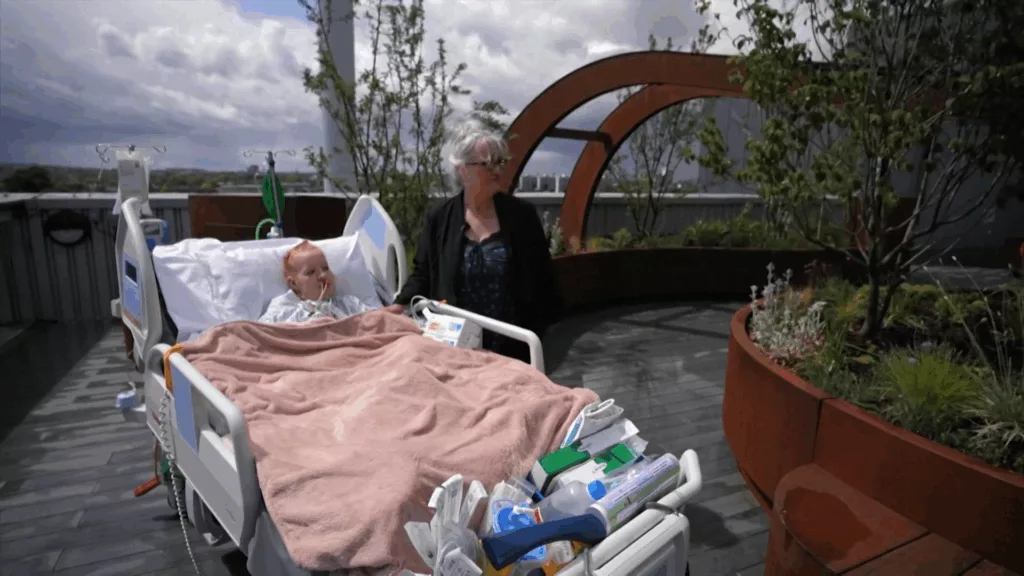
King’s College Hospital has opened a revolutionary rooftop critical care ward, a pioneering outdoor intensive care unit designed to allow the most seriously ill patients to receive full life support while surrounded by nature.
First patient: ‘I forgot what it’s like to be outside’
The first patient to use the new facility was 29-year-old Hollie Allan, who had been receiving critical care inside the hospital. She described the experience as “lovely and sunny” and said that being outside gave her a “boost to keep going”. For Hollie, the moment marked more than a change of scenery. “I forgot what it’s like to be outside,” she said.
Dr Tom Best, Clinical Director of King’s Critical Care, explained that patients like Hollie often spend weeks or months undergoing intensive treatment in a clinical environment. The constant exposure to machines, alarms and artificial light can trigger frightening hallucinations or delirium, a condition that can significantly delay recovery. The rooftop garden is intended to break that cycle.
A fully equipped intensive care ward, open to the sky
Situated on the roof above the hospital’s existing critical care unit, the garden can accommodate up to six beds. Each bed position is served by specially designed weatherproof medical cabinets that are integrated into the landscaping. These cabinets provide seamless access to power, data and medical gases – including oxygen – meaning patients on ventilators, invasive monitoring and full life support can receive exactly the same level of care outdoors as they would inside.
The design is the result of collaboration between landscape architect Professor Nigel Dunnett of the University of Sheffield – who passed away in April 2026 at the age of 63 – and three-time RHS Chelsea Flower Show gold medallist Sarah Price. Their planting strategy features native species, aromatic plants such as rosemary, sage and oregano, and tactile plants like lamb’s ear, all chosen to encourage sensory engagement. There is no stagnant or running water in the garden, a deliberate measure to mitigate the risk of environmental pathogens.
Moving a critically ill patient to the roof is not undertaken lightly. Each transfer involves a rigorous, individualised clinical risk assessment, with full next-of-kin awareness, comparable to standard moves between hospital departments. The clinical team is also working to ensure that patients with resistant organisms are not automatically denied access.
Healing through nature – for patients, families and staff
Research cited by the hospital indicates that time spent in nature can reduce delirium, lower blood pressure, reduce stress and improve recovery outcomes. Dr Best said the project aims to “treat the whole person”, caring for the mind as well as the body. Many patients report that their first experience outdoors marks a turning point in their recovery, and can accelerate healing times. For long-term patients, the garden offers a calming contrast to the enclosed clinical environment, lifting spirits and increasing motivation for rehabilitation.
The space is also designed to provide a tranquil area for families to spend time with loved ones, offering respite from the intensity of the ward. Hospital staff, particularly those working in intensive care, can use the garden as a place to decompress, with the aim of helping to mitigate burnout.
Funding for the project came largely from a £2 million donation by King’s College Hospital Charity, with additional support from the hospital trust. The charity’s goal is to improve patient experience and foster innovation.
A research facility and a model for the future
The rooftop ward is not only a clinical and therapeutic space but also a research facility. The critical care team will study how exposure to sunlight, fresh air and greenery affects blood pressure, stress levels and overall patient wellbeing. The research will investigate whether access to the garden improves recovery times, reduces length of stay, and leads to better long-term physical, cognitive and psychological outcomes. Benefits for families and staff in managing stress will also be examined.
The garden forms the final phase of the King’s Critical Care Centre, one of the largest bespoke intensive care facilities in the UK and possibly Europe. The centre itself is a 60-bed unit built above an existing surgical block, supporting more than 5,000 patients and 15,000 loved ones each year. The expansion project began with a business case in 2010.
Doctors believe the rooftop garden could serve as a model for other hospitals globally, contributing to broader public health strategies that emphasise holistic care environments. The initiative follows other significant developments at King’s, including a 24/7 helipad funded by charity, the Willowfield Building – a modular outpatient facility completed in 2022 – and the wider design of the Critical Care Centre, which features soft lighting, calming artwork, floor-to-ceiling windows overlooking Ruskin Park, and patient-controlled environments with touchscreen tablets for communication and monitoring.
The garden is now operational, integrating advanced medical technology into a living landscape, and offering the most vulnerable patients something they otherwise rarely experience: the open air.