

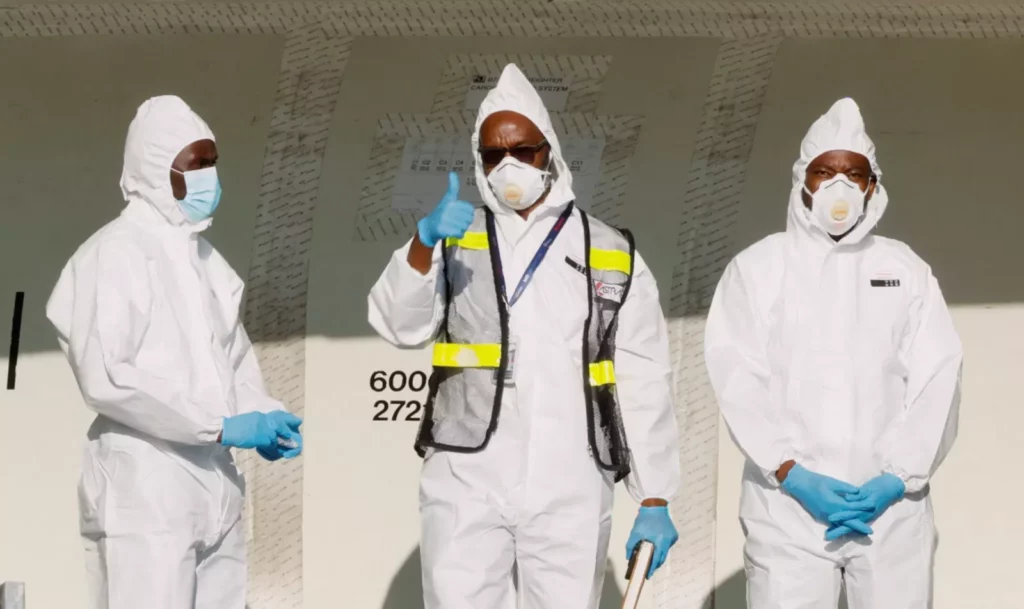
NHS staff across England have been placed on high alert for a potential outbreak of the Ebola virus, with hospitals, GP surgeries and clinics instructed to check stocks of personal protective equipment (PPE) and be ready to isolate suspected cases at a moment’s notice. The UK Health Security Agency (UKHSA) has issued an urgent public health message to all healthcare providers following the spread of the deadly Bundibugyo strain of Ebola in central Africa. Although the risk to the general British public is assessed as low and no cases have been recorded in the UK during this outbreak, the alert warns that preparations must be in place should a returning traveller display symptoms.
The UKHSA has already placed posters at major airports and railway stations advising passengers arriving from the Democratic Republic of Congo (DRC) and Uganda to seek medical advice if they develop symptoms. The agency says it continues to monitor the situation closely, describing the probability of an imported case as low and emphasising that the virus is not airborne, meaning transmission in a community setting is “extremely unlikely”.
Outbreak in Central Africa
The current outbreak is driven by the Bundibugyo virus (BDBV), a rare strain of Ebola first identified in Uganda in 2007. Previous outbreaks of this strain have had case fatality rates of between 30 and 50 per cent. The World Health Organization (WHO) declared the outbreak a Public Health Emergency of International Concern on 17 May, reflecting the risk of cross-border spread and the need for a coordinated international response.
According to the UKHSA, the Bundibugyo variant has caused hundreds of cases and at least 62 confirmed deaths in the DRC and Uganda. The WHO has reported 344 confirmed cases in the DRC, including 60 deaths, while Ugandan authorities have confirmed 15 cases and one death, with infections concentrated in the Kampala and Wakiso districts. The outbreak is centred on the Ituri Province of the DRC, with further cases in North Kivu and South Kivu provinces. The WHO assesses the risk at the national level in the DRC as very high and regionally high, though global risk remains low.
The outbreak is unfolding in a context of significant insecurity, a humanitarian crisis and limited healthcare infrastructure in affected areas of the DRC. There are currently no approved vaccines or specific treatments for the Bundibugyo strain, unlike the more common Zaire strain. The WHO estimates that a vaccine tailored to this variant could take six to nine months to develop; three candidate vaccines are in development and clinical trials are being advanced with international partners.
How Ebola Spreads and the Precautions Required
Unlike Covid-19, Ebola is not transmitted through airborne particles. The virus spreads through direct contact with the blood, secretions or other bodily fluids of an infected person, or through contact with contaminated environments or materials. Crucially, infected individuals who do not yet have symptoms are unlikely to transmit the virus.
Symptoms typically appear between two and 21 days after exposure, with an average onset of eight to ten days. Early signs include fever, malaise, muscle pain and headaches. The UKHSA alert notes that some patients may not present with a fever at all. As the illness progresses, symptoms can include rash, nausea, vomiting, diarrhoea, abdominal pain, and in many fatal cases, multi-organ failure, neurological symptoms and external or internal bleeding.
Medical staff have been told to consider Ebola in any acutely unwell patient who has a history of fever and has travelled from the DRC or Uganda within the previous 21 days. If a suspected case presents, the NHS alert instructs staff to “move the patient immediately to an empty room” and to “restrict the number of staff in contact with the patient” while ensuring that relatives and visitors do not enter the room. Infection prevention and control teams must confirm they hold adequate stocks of PPE and that relevant staff are trained in its correct use for assessment and treatment. The alert also requires that clinical services have pathways in place for managing suspected Ebola virus disease (EVD) cases within their setting, and that any suspected cases are reported to the local UKHSA department.
The UKHSA routinely issues urgent public health messages in response to emerging infectious disease threats; the most recent such alert before this one was broadcast during the deadly meningitis B outbreak in Kent.
UK Preparedness and Funding Concerns
Imported Ebola cases are extremely rare in the UK. Since 1976, there have been only four confirmed cases: one laboratory-acquired infection in 1976, and three healthcare workers who returned from West Africa during the 2014–2016 epidemic. All four recovered, and there have been no cases of domestic transmission. During that earlier epidemic, a nurse returning to Glasgow from Sierra Leone was treated for the disease, and three other healthcare workers were cared for at London’s Royal Free Hospital.

The UKHSA has activated its Returning Workers Scheme to monitor the health of individuals travelling from the UK to Ebola-affected areas for work. The UK has also launched the Multi‑Hazard Research Network (MHRN) to provide rapid expert advice and evidence on emerging outbreaks, including the current one. The government has pledged up to £20 million in new funding to support containment efforts in the DRC, including strengthening disease surveillance, supporting frontline health workers and improving infection prevention and control. An additional £5 million has been committed to research into new treatments and diagnostics for the Bundibugyo species.
Public health experts have warned, however, that the UK’s reduced spending on the World Bank and WHO’s Pandemic Fund is hampering the response to outbreaks such as Ebola. Doctors from the campaign group Healthy World, Secure Britain said the UK had committed less than 5 per cent – about £20 million – of what it previously spent to tackle Ebola. In November 2015 alone, government documents showed Britain had committed £427 million to tackle Ebola and early recovery.
Professor Kirsty Le Doare, an expert in vaccinology and immunology at City St George’s, University of London and a member of the campaign group, said: “Helicoptering in and out of a country when an outbreak happens won’t work. The UK must lead by accompanying surveillance with funding, infrastructure and laboratory capacity. This will provide a pipeline for current vaccine technology that can be upscaled for future pandemics – one that may affect the UK in the way Covid-19 did.” Dr Derek Sloan, an infectious diseases specialist at St Andrews University and UK‑Med, added: “This outbreak, along with the recent Hantavirus cases on a cruise ship and meningococcal meningitis infections in the UK, shows how important it is that we stay vigilant and use effective public health tools to protect our populations. Infectious disease outbreaks such as these in our interconnected world cannot be dismissed as someone else’s problem.”