

Close Menu
    Useful
    • About Us
    • Contact Us
    • Advertise With Us
    • Health Explainers
    • Our Editorial Team
    Facebook
    HealthNewsDaily.co.uk
    • Home
    • NHS

      Girl’s family agrees to £28m NHS settlement for brain injury at birth

      4 June 2026

      Patient spends £62,851 on height increase surgery to 6ft despite agonising and potentially fatal side effects

      3 June 2026

      Four in five frail pensioners missing essential NHS checks due to regional disparities

      3 June 2026

      Critical care patients at King’s College Hospital given new rooftop garden

      31 May 2026

      Resident doctors in England plan four-day June walkout

      27 May 2026
    • Health Policy

      Palestine badge ban for NHS staff mooted to tackle antisemitism

      5 June 2026

      Government stops short of promising no further aid cuts in letter to parliamentary committee

      3 June 2026

      Anti-abortion activists in NSW signal push to further restrict abortion access

      3 June 2026

      Health officials urged to probe fatalities connected with illicit diet injections

      3 June 2026

      Trial overhaul to provide prostate cancer screening for black men

      2 June 2026
    • Mental Health

      Young ketamine addict told mum he could not go on before fatal agony, inquest told

      5 June 2026

      Federal workers suffer trauma after Trump administration’s unlawful sackings

      3 June 2026

      2026’s monk mode: manosphere trick or imperative

      2 June 2026

      Husband’s rare condition leaves him unable to produce sperm

      31 May 2026

      Diagnosis halted monthly rage attacks that had been tearing my family apart

      31 May 2026
    • Wellness & Lifestyle

      Personal trainer identifies exercise that increases calorie burn without longer workouts

      5 June 2026

      Prince William’s period perspective at odds with two-dad family, says father

      5 June 2026

      Person sat beneath an oak tree daily for a year

      5 June 2026

      The daily fatigue trigger most people miss

      5 June 2026

      Doctor names vitamin deficiencies most strongly linked to greying hair

      4 June 2026
    • Disease & Prevention

      Alzheimer’s diagnosis for former Channel 4 newsreader Jon Snow

      5 June 2026

      Smartphone demand drives deforestation behind Ebola outbreaks

      5 June 2026

      British Heart Foundation to close about 150 charity shops

      5 June 2026

      Ebola outbreak hits pregnant women hardest

      4 June 2026

      High alert issued to GPs and nurses for UK Ebola cases

      4 June 2026
    • Treatment & Research

      High street bank installs defibrillators and bleed control kits in 605 branches

      5 June 2026

      AI-developed vaccine undergoing human trials effective against all Covid strains

      5 June 2026

      Men over 50 face recurring rectal foreign body incidents

      4 June 2026

      Melinda French Gates gives $10m to improve America’s menopause care

      4 June 2026

      New ovarian cancer treatment approved for NHS, first in decades

      4 June 2026
    HealthNewsDaily.co.uk
    • NHS
    • Health Policy
    • Mental Health
    • Wellness & Lifestyle
    • Disease & Prevention
    • Treatment & Research
    Home » Disease & Prevention » Smartphone demand drives deforestation behind Ebola outbreaks
    Disease & Prevention

    Smartphone demand drives deforestation behind Ebola outbreaks

    Sophie HargreavesBy Sophie Hargreaves5 June 2026
    Dense Congo basin rainforest with cleared patches visible from above

    The days of small, contained Ebola outbreaks are over. For decades after the virus was first identified in 1976, the disease typically infected a few hundred people at most before burning out. That pattern has now been broken. The 2014 West African epidemic infected more than 28,000 people across 10 countries on three continents. The current eruption, caused by the Bundibugyo strain, has already spread across the Democratic Republic of the Congo and into Uganda, prompting the World Health Organization to declare a Public Health Emergency of International Concern on 17 May 2026. As of 2 June, the DRC had recorded 321 confirmed cases and 48 deaths in Ituri, North Kivu and South Kivu provinces, while Uganda reported 15 confirmed cases and one death. The conventional explanation for this shift points to larger and more interconnected human populations. But a more fundamental driver is at work: the remaking of the ecology in which Ebola circulates, driven in large part by the world’s insatiable demand for the minerals that power the modern tech economy.

    From Remote Spillovers to Widespread Outbreaks

    Most of the time, Ebola viruses live harmlessly in animal hosts, widely understood to be bats. In places such as the DRC, whose borders encompass 60% of the world’s second-largest rainforest, virus-laden bats usually come into contact with only a few people in remote locations, producing small outbreaks that quickly fizzle out. People who live alongside these bats also acquire a degree of immunity through repeated exposure: one survey found that nearly 20% of forest-dwelling people in Gabon have developed immune defences against Ebolavirus. That delicate equilibrium is shattered when the trees in which bats roost are cut down. The bats do not disappear; instead they crowd into the fragments of forest that remain, bringing them into far closer proximity to humans and sharply increasing the chances of encounters with their virus-laden blood, saliva and excreta. A 2025 analysis showed that for every percentage point increase in deforestation across Central Africa, the incidence of malaria and Ebola spikes by 20% to 40%. The 2014 epidemic was preceded by the loss of 85% of forest cover in the south-west corner of Guinea, where the outbreak began. The current outbreak of Bundibugyo Ebola fits the pattern: satellite data analysed by Global Forest Watch recorded a record loss of 1.5 million acres of Congo basin rainforest in 2024, the year before the first cases appeared.

    The Mineral Frontier: Deep Forest Intrusion

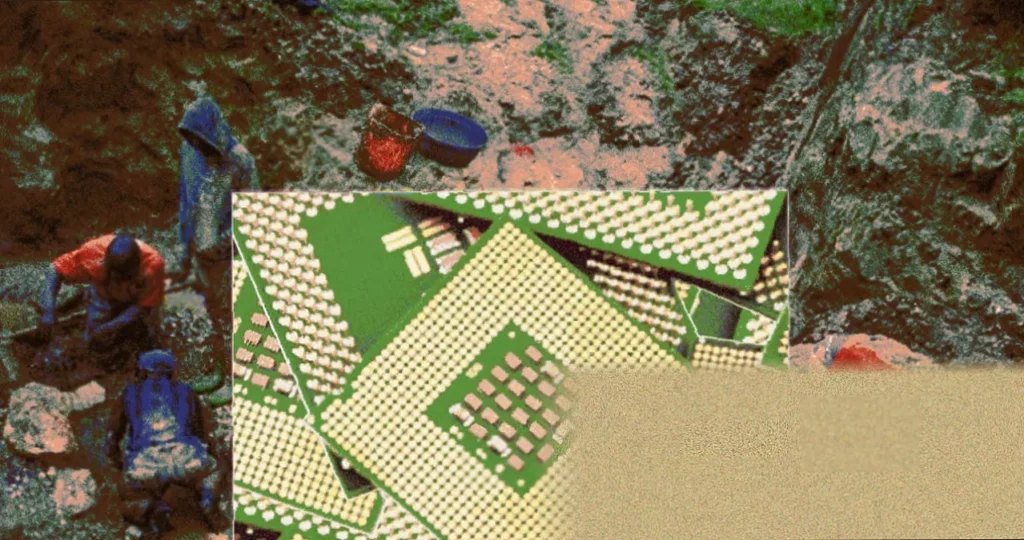
    Humanity has cleared forests for fuel and farming for millennia, but in the DRC a new driver of deforestation has emerged that is tied less to survival than to the peculiar demands of the global economy. The Norwegian University of Life Sciences economist Malte Ladewig has identified the growing allure of so-called “artisanal” mining — local people digging for gold, coltan and cobalt and selling their finds into an informal network of smugglers and intermediaries. Artisanal mining already employs an estimated two million people in the DRC, including more than 380,000 in the eastern provinces alone. In some areas surveyed by Ladewig, over 30% of local households now depend on it. The DRC is the world’s top producer of cobalt, holds 48% of global reserves and accounted for 72% of global production in 2021. It is also Africa’s largest copper producer and rich in tantalum, a critical mineral for semiconductors and smartphones. Yet because of political instability and armed conflict, most of the country’s mineral wealth — valued at $24tn — remains untouched by commercial mining. Global demand for the “3TG” minerals (tungsten, tin, tantalum and gold) that go into everything from electric-vehicle batteries to medical devices is expected to triple in the coming years. The United States has taken steps to secure access: in 2018 the Trump administration suspended rules against so-called “conflict minerals”, and last year signed an agreement with the DRC exchanging security guarantees for mineral supplies.

    The result for people living in mineral-rich forests is a stark choice. Subsistence farming has become harder because of erratic rainfall linked to climate change, declining soil fertility, and markets disrupted by conflict. Ladewig found that artisanal mining has become a “widespread livelihood activity” in eastern DRC, drawing in over 30% of households. But the hunt for minerals alters the ecology of Ebola in particularly dangerous ways. Farmers pushing into forests tend to nibble at the edges. Miners, by contrast, plunge deep into the forest core. The rising price of minerals — gold doubled last year in response to the president’s tariffs — attracts people from across the region, including many who lack the acquired immunity of long-term forest-dwellers. Far from settled areas and agricultural markets, they sustain themselves by hunting, bringing human bodies and those of animals into intimate contact. If their prey include animals harbouring Bundibugyo Ebola, any pathogen they pick up can spread rapidly in makeshift mining towns with notoriously poor sanitation and little health infrastructure. Within ten years, every hectare of forest lost directly to mining can cause a further 28.4 hectares of deforestation as farmland and settlements expand to support the miners.

    Whether artisanal mining triggered the current epidemic is unknown. What is known is that the first cluster of fatal cases emerged in Mongbwalu, a swelling mining town in north-eastern DRC littered with unregulated gold mining areas. The scientist Matthew Hansen, who tracks global forest change using satellite data from NASA and the US Geological Survey, zoomed into Mongbwalu on his map covering 2000–2025 during a video call. Wobbly lines of bright blue — indicating areas newly deforested in 2025 — radiated out of the town to the west and south. “Wow,” he said, looking at the pattern. “There is a ton of mining around here. Holy shit.”

    In the midst of deadly outbreaks it is understandable that experts and policymakers focus on how to respond and how to prepare. But for novel pathogens such as Bundibugyo, which can elude standard diagnostic tests and for which there is no licensed vaccine, no level of preparedness can squash them before they begin their exponential spread. The only pillar that can is the one that receives the least attention: preventing the broken ecologies that drive novel pathogens into human populations in the first place. That will mean paying far more attention to the health of ecosystems such as the forests of the Congo basin, and to how the minerals they contain end up inside the smartphone tingling in your pocket.

    Public Health
    Share. Facebook Twitter LinkedIn WhatsApp Telegram
    Sophie Hargreaves
    Sophie Hargreaves

    Health Correspondent
    Sophie Hargreaves covers medical research, new treatments, disease outbreaks and prevention for Health News Daily. She holds a Master's degree in Health Sciences from the University of Leeds and has spent several years translating complex medical science into clear, accessible reporting for a general audience. Sophie focuses on the latest clinical trials, NICE and MHRA approvals, vaccination programmes and emerging health threats, always with an eye on what these developments mean for people in the UK.
    · MSc Health Sciences (University of Leeds), science communication volunteer, medical research literacy
    · Clinical trials and drug approvals (NICE, MHRA), cancer screening programmes, vaccination and outbreak response, women's health (endometriosis, PCOS, menopause), weight management treatments, AI in diagnostics

    Related Posts

    Disease & Prevention

    Alzheimer’s diagnosis for former Channel 4 newsreader Jon Snow

    5 June 2026
    Disease & Prevention

    British Heart Foundation to close about 150 charity shops

    5 June 2026
    Disease & Prevention

    Ebola outbreak hits pregnant women hardest

    4 June 2026
    Disease & Prevention

    High alert issued to GPs and nurses for UK Ebola cases

    4 June 2026
    Join Our Community & Win

    Each month we select one lucky follower to receive a prize from our partners. Follow us on our social channels for your chance to win.

    • Facebook
    Latest
    Disease & Prevention

    Alzheimer’s diagnosis for former Channel 4 newsreader Jon Snow

    5 June 2026
    Wellness & Lifestyle

    Personal trainer identifies exercise that increases calorie burn without longer workouts

    5 June 2026
    Treatment & Research

    High street bank installs defibrillators and bleed control kits in 605 branches

    5 June 2026
    Health Policy

    Palestine badge ban for NHS staff mooted to tackle antisemitism

    5 June 2026
    Mental Health

    Young ketamine addict told mum he could not go on before fatal agony, inquest told

    5 June 2026
    Wellness & Lifestyle

    Prince William’s period perspective at odds with two-dad family, says father

    5 June 2026
    News Categories
    • NHS
    • Health Policy
    • Mental Health
    • Wellness & Lifestyle
    • Disease & Prevention
    • Treatment & Research
    Help
    • About Us
    • Contact Us
    • Advertise With Us
    • Health Explainers
    • Our Editorial Team
    About Us
    About Us

    Health News Daily provides trusted UK health news, covering NHS updates, medical research, public health and wellbeing with clear and reliable reporting.

    Facebook
    • Cookie Policy
    • Privacy Policy
    • Complaints Policy
    • Corrections Policy
    • AI Disclosure Policy
    • Editorial Policy & Ethics
    • Accessibility Statement
    • Medical Disclaimer
    • Terms & Conditions
    • Sponsored Content Disclosure
    • Copyright Notice
    © 2026 Healthnewsdaily.co.uk. All rights reserved.

    Type above and press Enter to search. Press Esc to cancel.