

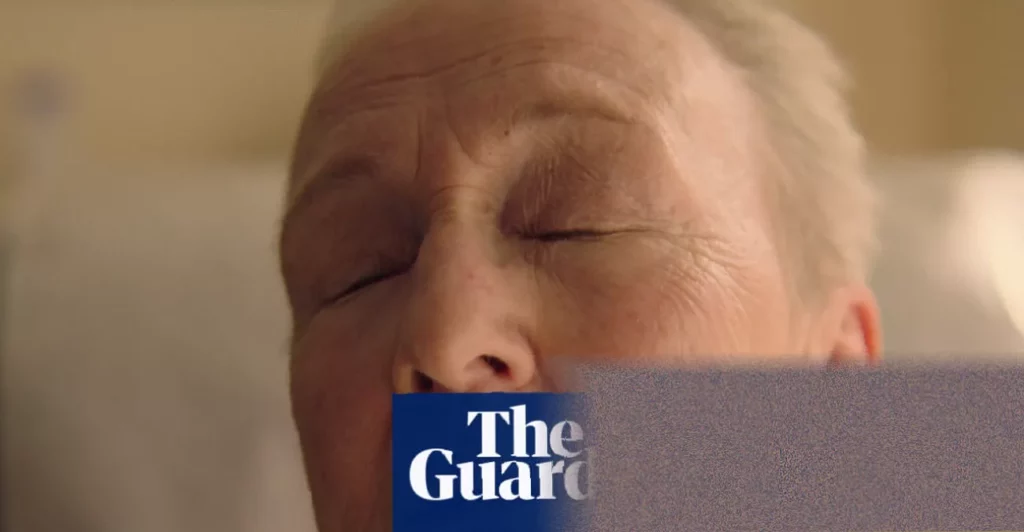
When a middle-aged man named Steve arrives at her home, elderly Ruth playfully flirts with him – until he reveals he is already married and has come to take her to her new home in a retirement community. The true shock, however, comes moments later: when staff there refer to Steve as Ruth’s son, the realisation dawns on her as starkly as it does on the audience. Ruth, played by the American stage icon Kathleen Chalfant, has no memory that she has a son, let alone that she is leaving the home she has lived in for decades. This is the devastatingly understated opening to Familiar Touch, writer-director Sarah Friedland’s debut narrative feature, which charts one woman’s journey into the fog of dementia with extraordinary tenderness and never a drop of sentimentality.
A World of Disorienting Details
Before Steve’s arrival, Ruth’s disorientation is revealed in small, telling moments. She treats the washing-up rack as if it were a toast caddy, a seemingly trivial error that speaks volumes about her cognitive state. Yet her long-term memory remains intact: she can effortlessly recite the recipe for a scrummy-sounding borscht, a dish from her past as a professional cook. The film, with audacious economy, unveils these clues only when necessary. This is not a tragedy of a lost self, but a “coming-of-(old)-age” drama that honours the persistence of character even as memory frays.
The Son Who Arrives as a Stranger
Steve, played by voice-acting veteran H Jon Benjamin (known for Archer and Bob’s Burgers) in an intentionally stilted, almost mechanical performance, appears at Ruth’s door. She flirts with him, mistaking him for a potential suitor, until he gently explains he is married and has come to take her to her new residence. The moment staff at the retirement community refer to him as her son, the truth hits both Ruth and the audience with equal force. She has no recollection of this man, her own child. The move itself becomes a source of black comedy and surprising dignity: Ruth, still full of “piss and balsamic vinegar” as one critic put it, invades the home’s kitchen and takes over the plating of scrambled eggs and fruit salad for the residents, a reminder of her former professional life. It is one of the film’s most amusing sequences, but also a poignant indication of her stubborn, undimmed spirit.
Sensory Memory and Social Subtlety
Friedland, whose background as a choreographer infuses the film with a palpable sense of physicality, creates one of its most affecting moments in a swimming pool. A carer holds Ruth and swishes her rhythmically back and forth like a relaxed infant, while the soundtrack gradually conjures the remembered sounds of a day at the beach – gulls, calliope music and childish shrieks of delight. The scene is theatrical and terpsichorean, a testament to the director’s ability to use movement and sensation to convey emotion. The film never treats Ruth’s cognitive shift as a great tragedy or a sentimental reduction to a sweet old lady. Instead, she remains spiky, a minx in her soignée short-haired way. There is even a hint of racist suspicion in the way she initially treats the Black carer Vanessa (Carolyn Michelle Smith, whose credits include House of Cards and Luke Cage), offering to set her up on a date with her brother who “supports civil rights.” Later, Ruth overhears Vanessa and doctor Brian (Andy McQueen, from The Chi and And Just Like That) having a polite, coded conversation about how their own elderly parents are not being looked after in a quasi-country club facility like this. These are the tiny, devastating touches that elevate the film beyond a simple drama of ageing.
Kathleen Chalfant’s Masterclass in Restraint
Friedland’s finest achievement, however, is her casting of Kathleen Chalfant. The veteran American stage actress delivers an astonishingly nuanced, considered and graceful performance that is the film’s bedrock. It is a portrayal that requires no prosthetics, no showy speeches, no dramatic weight fluctuations – just proper craft and actorly skill. Chalfant conveys Ruth’s confusion, her flashes of wit, her moments of sharpness and her deep vulnerability through the smallest of gestures and the subtlest of facial expressions. The actress, who won the Orizzonti section Best Actress award at the Venice Film Festival for her work, brings a lifetime of theatrical discipline to the screen. Critics have described her performance as “towering” and marked by “luminous restraint.” It is the kind of understated work that often goes unrecognised by awards bodies precisely because it lacks the obvious signifiers of transformation. But for anyone watching, it is a masterclass in empathy and precision – a reminder that the truest acting is often the quietest.
From Choreography to Care: Friedland’s Vision
Sarah Friedland’s transition from choreographer to narrative filmmaker is not a leap but a natural extension. Her previous films focused on dance, and Familiar Touch – the title itself a nod to physical sensation – is deeply rooted in the body. Friedland drew on her own experience of caring for relatives with dementia and working in a care home earlier in her career, giving the film an authenticity that no amount of research could replicate. The production itself was a collaborative, empathetic process: principal photography took place at the Villa Gardens retirement community in Pasadena, California, and residents participated in a filmmaking workshop and appear as actors in the film. World-premiering at the 81st Venice International Film Festival on 3 September 2024, the film took home the Lion of the Future for best debut feature and the Orizzonti awards for Best Director and Best Actress. It later screened at New Directors/New Films at Lincoln Center, Film Forum, MoMA’s “Contenders” series, and the Roxie Theater, before its US theatrical release on 20 June 2025 by Music Box Films. At the Gotham Awards, it was nominated for Best Feature and Breakthrough Director, and at the Independent Spirit Awards it won the Someone to Watch Award while Chalfant was nominated for Best Lead Performance and the film was nominated for the John Cassavetes Award. Yet for all its accolades, the film’s greatest triumph is its refusal to sentimentalise dementia. Instead, it offers a humane, humour-speckled and deeply compassionate portrait of an octogenarian woman navigating the bewildering terrain of a mind that is both fading and fiercely alive.