

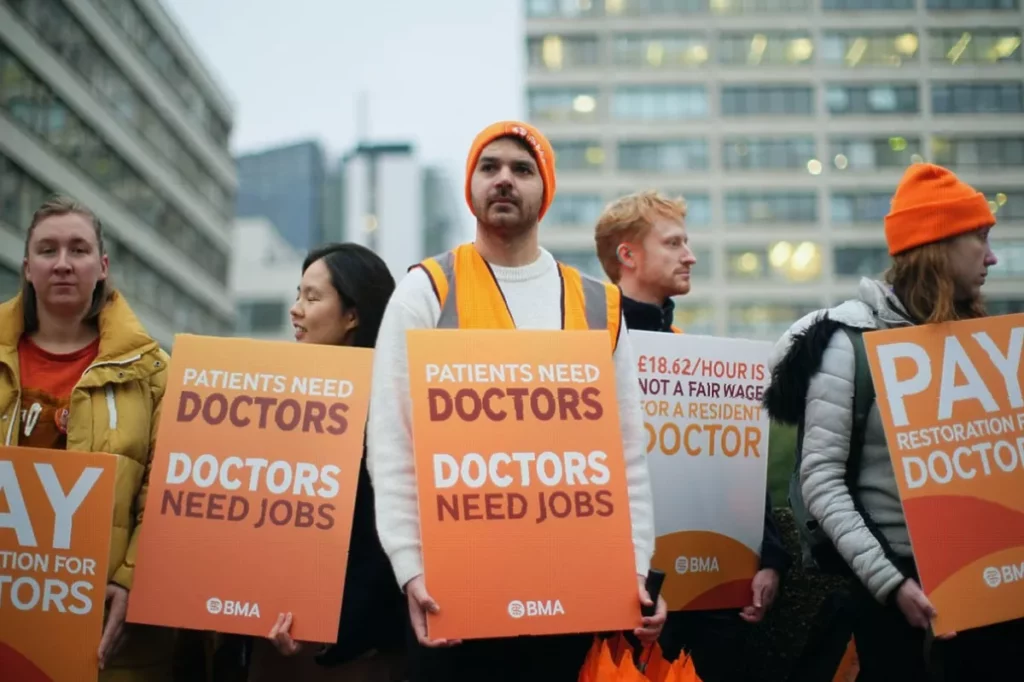
Resident doctors in England are set to walk out for four days from Monday morning despite the government’s insistence that it has been holding talks with the British Medical Association (BMA) on improving other parts of the deal. A government spokesperson expressed disappointment that the industrial action is going ahead even as those conversations continue, and urged the union to keep negotiating on the non-pay elements to make the package “as strong as possible for their members”.
The strike, which begins at 7am on Monday, June 15 and runs until 6:59am on Friday, June 19, marks the 16th round of industrial action by resident doctors since 2023. It comes at a time when the NHS is braced for what officials have described as a “triple whammy” of pressures: the walkout itself, an expected heatwave across the UK, and the start of the football World Cup, with England’s first match scheduled for the Wednesday of that week. NHS leaders have asked the public to continue seeking care as normal, stressing that hospitals remain open with contingency plans in place. Patients are advised to attend all booked appointments unless contacted directly, to use NHS 111 online for urgent but non-life-threatening issues, and to call 999 or attend A&E only for genuine emergencies.
Talks on other aspects of the deal
The government’s disappointment centres on what it sees as a missed opportunity to resolve the dispute without further disruption. While the BMA’s core demand is a pay rise to restore salaries to 2008 levels – the union estimates a 26% increase is needed to reverse a 20% real-terms cut since then – the government has pointed to recent pay awards it says already address that. Officials cite an average pay rise of 28.9% over the last three years, a further proposed 4.9% for the current year, rising to 7.1% for the lowest-paid resident doctors, and a deal accepted by the BMA’s resident doctors committee in September 2024 that included an additional 4.05% for 2023/24, backdated to April 2023.
It is the “other aspects of the deal” – the elements beyond pay – that the government now says it is willing to discuss. These cover working conditions, contractual arrangements, and non-financial terms that could improve the day-to-day experience of resident doctors. The BMA, which is phasing out the term “junior doctor” in favour of “resident doctor”, has argued that conditions have deteriorated alongside pay, and that restoring morale requires more than a salary increase. The government has not detailed exactly what improvements it is offering, but the spokesperson emphasised that talks on these issues have been taking place and should continue even as the strike begins.
Call for continued dialogue
“I would urge them, even today, to continue that conversation with us about the other aspects of the deal, other than pay, and make that as strong as possible for their members,” the spokesperson said. The appeal comes despite the BMA’s decision to proceed with the strike after negotiations broke down following the September 2024 pay deal. The union remains in dispute over what it describes as the erosion of pay since 2008, and it has rejected government claims that the latest offers are sufficient. The broader context includes industrial action across the NHS in recent years, with nurses, ambulance workers and consultants also striking over pay and conditions.
Impact on the NHS and patients
The cumulative effect of repeated walkouts has been substantial. Since late 2022, at least 1.7 million healthcare appointments have been rescheduled because of industrial action. The financial cost has been estimated at around £300 million, with some assessments putting the total price tag since March 2023 as high as £3 billion. There is some evidence that during strike periods patient flow through emergency departments can improve, probably because elective care is postponed, freeing up inpatient beds. But officials stress this does not offset the overall disruption, and the NHS continues to struggle with waiting lists. The waiting list for elective treatment in England was 7.39 million in April 2025, rising to 7.22 million in April 2026, while the 18-week treatment target has not been met since 2016. Accident and emergency departments have seen record attendances in some months, with 12-hour waits remaining a serious problem, and performance against the 62-day cancer waiting time standard has also deteriorated.
Benefit for doctors and patients
The government’s insistence on continuing talks about the non-pay elements is framed as a route to a stronger overall deal. According to the spokesperson, “that would be for the benefit of resident doctors and all of us as patients”. The implication is that improving conditions – whether through better rostering, training support, or workload management – could help retain staff, reduce burnout, and ultimately improve patient care. The BMA has not publicly rejected the idea of negotiating on these issues, but the union has made clear that pay restoration remains its primary goal. The government, for its part, has suggested that a package combining the recent pay offers with enhancements to working conditions could deliver a settlement that satisfies both sides – though it has acknowledged that the strike will go ahead as planned.