

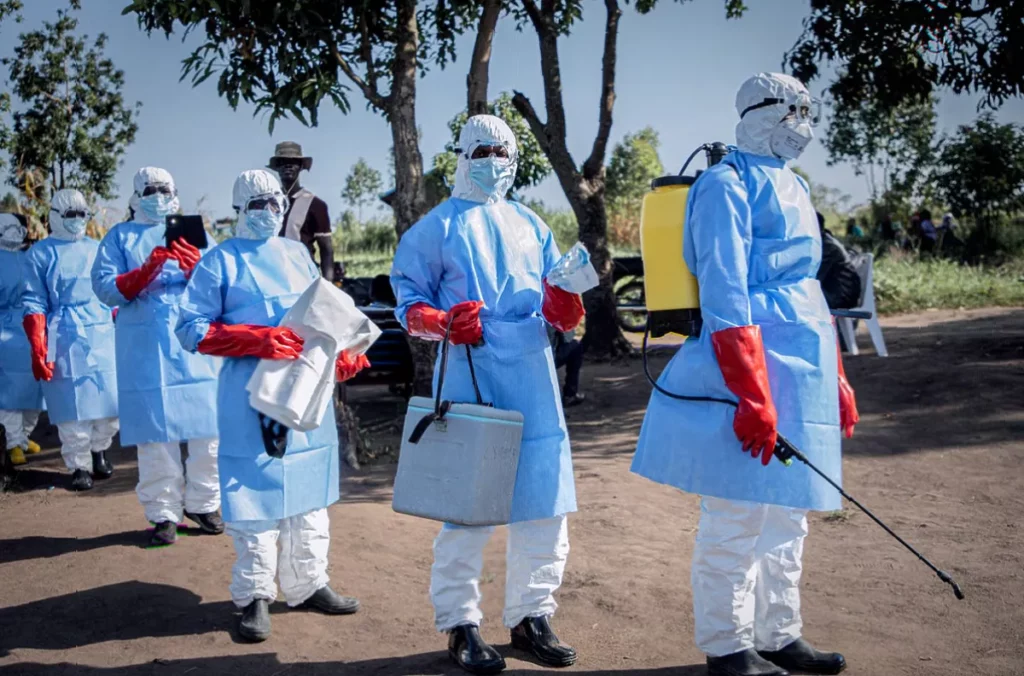
Hospitals in Bunia are overflowing, with patients spilling into yards and fields as the city finds itself at the epicentre of a rapidly escalating Ebola outbreak that officials fear could become the worst in history. At Elykia private hospital, several buildings have been given over entirely to Ebola care but are already full, and temporary treatment tents erected across the garden are also at capacity. A construction team is now working to set up a new health centre in a nearby field. “Case numbers are rising significantly, it’s going super fast,” Karen Ruts, an intensive care nurse at Elykia, told The Independent. “We’re getting more and more positive test results and the labs are struggling.”
The facility is currently caring for 40 confirmed cases alongside testing suspected patients. In the ten days since Médecins Sans Frontières (MSF) arrived to assist with the response, 60 people have died. As of June 12, 2026, the outbreak had resulted in 676 confirmed cases and 136 deaths in the Democratic Republic of the Congo, up from 635 cases and 127 deaths previously reported. An additional 19 cases and two deaths have been recorded in Uganda, with the virus also detected in Kampala. Ituri Province, where Bunia is located, remains the worst-affected region, accounting for 515 cases within the DRC. The outbreak has also spread to North Kivu and South Kivu provinces.
Outbreak Spreads Across Provinces and Borders
The current outbreak is caused by the rare Bundibugyo strain of the Ebola virus, which has historically killed between 30 and 50 per cent of those infected. There is no licensed vaccine or specific treatment for this strain; care is limited to supportive measures such as rehydration and pain management. “We can only do symptom care, so rehydrate them or treat pain,” said Ruts. The disease typically begins with a “dry phase” of fever, headache, muscle pain and weakness, progressing to a “wet phase” of severe vomiting and diarrhoea. In severe cases it leads to bleeding, organ failure and death. Because these symptoms can easily be mistaken for other illnesses, many people do not seek help, hampering containment efforts.
Investigators believe the virus may have been circulating for weeks, possibly months, before the outbreak was officially declared on 15 May. They are examining the funeral of Pastor Paluku Makundi Denis, who died on 4 February, as a potential “patient zero” and an early super-spreader event. Unsafe burial practices — with mourners reportedly touching the remains — may have significantly amplified transmission. One report suggests the first patient may have presented to a hospital in Rwampara in late January, infecting eight healthcare workers before dying. The US Centers for Disease Control and Prevention (CDC) has warned that if containment efforts fail, this outbreak could surpass the 2014–2016 West Africa epidemic — the deadliest on record, which killed 11,000 people — with more than 20,000 cases within months.
Among the dead are two babies from a Bunia orphanage, one of whom contracted Ebola from a mother who died in late May. Healthcare workers are at high risk, with a significant number of cases among them, and Ruts noted that a disproportionate number of patients are women because they are more likely to take on caring roles. “I don’t think we’re at the peak yet but we need to stop the transmission,” she said. “As an intensive care nurse I have already seen a lot, but this disease is quick, nasty and brutal. You admit people and the next day they’re dead. Even the young.”
International Response and the Fight Against Mistrust
The international community has mobilised a major response aimed at containment. The US State Department announced an additional $20 million on 12 June, bringing total direct US support to more than $220 million (£164 million). The funds are earmarked for preparedness in neighbouring countries including Burundi, Kenya, Rwanda and South Sudan. An international emergency plan worth $518 million is in place to scale up surveillance, contact tracing, lab testing and treatment centres. The European Union has allocated $17.4 million in humanitarian funding. However, the response has been undermined by cuts to international aid, according to health officials. On Tuesday, UK development minister Jenny Chapman admitted that foreign aid reductions — including from the UK — had weakened the response infrastructure. Experts say the dismantling of agencies such as USAID has stripped back rapid response capabilities built over years, though the US Department of State has stated that changes to USAID have not affected Ebola management programmes — a claim contested by some aid workers.
The gravest challenge facing responders, however, is not a lack of resources alone — it is widespread misinformation and a profound breakdown of trust between local communities and health authorities. One in three people in affected areas do not believe the Ebola virus is real. Some communities insist the outbreak is fabricated, linked to spiritual causes, or deliberately spread by international non-governmental organisations. This mistrust, exacerbated by years of conflict and neglect, has prevented people from reporting cases and adopting protective behaviours. Treatment centres have been set on fire by protesters demanding to bury bodies themselves, allowing infected patients to flee. Hospital teams are now engaged in intensive community outreach to rebuild trust and correct false narratives. Ruts described a nurse who tested positive but still visits other patients to encourage them: “That’s so beautiful to see.” Yet the work is slow and dangerous. The outbreak is unfolding across the conflict-affected provinces of Ituri, North Kivu and South Kivu, where numerous armed groups operate, roads are poor, borders are porous, and large displaced populations are vulnerable. A fragile health system already buckling under years of instability is now struggling to cope with a virus that is highly infectious through direct contact with blood, bodily fluids or contaminated materials.
“They get really weak quickly until they can’t move anymore. Some people get confused, the whites of their eyes bleed. When it goes fast it’s really hard to keep them alive,” said Ruts. Yet more terrified people arrive for testing each day, with relatives scared to leave “because they might not see them again”. She added: “It’s heartbreaking.”