

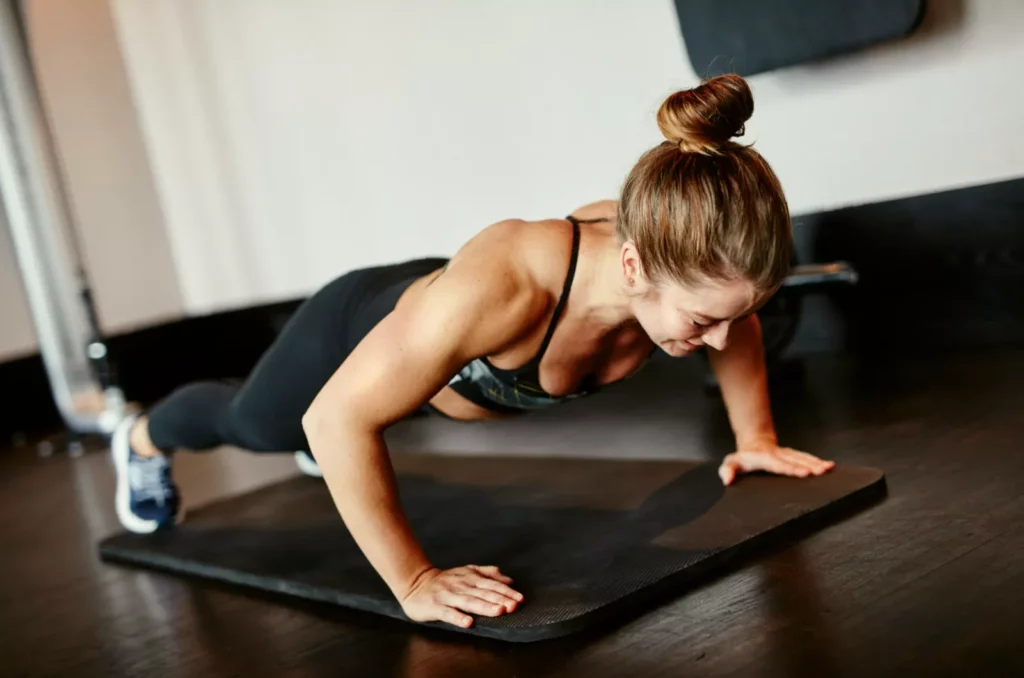
Push-up numbers vary significantly by age and gender, with the average man in his twenties capable of between 20 and 43 repetitions in a single set, while a woman of the same age typically manages 15 to 29. But personal trainers warn that these figures should serve only as rough benchmarks, not absolute measures of fitness, because technique matters far more than the tally on the scorecard.
Age-based benchmarks
Personal trainer Joseph Webb told us that the number of push-ups a person can perform depends on “form, bodyweight, training history, and physical limitations”. He provided target ranges for men and women across the decades, with an “excellent” band representing stronger overall fitness.
For men in their twenties, an average score is between 30 and 43 push-ups; the excellent band is 30 to 54 or more. For women in their twenties, the average range is 15 to 29, with excellent performance between 14 and 48 or more.
In the thirties, men should aim for 20 to 34 on average (excellent: 22 to 44 or more) and women for 10 to 24 (excellent: 10 to 39 or more).
For those in their forties, average targets are 15 to 28 for men (excellent: 15 to 39 or more) and 6 to 19 for women (excellent: 6 to 34 or more).
In the fifties, men average 10 to 24 push-ups (excellent: 10 to 34 or more) and women between 3 and 14 (excellent: 3 to 25 or more).
For men aged 60 and over, the average range is 6 to 19 (excellent: 6 to 29 or more). Women in that age bracket average 1 to 12 push-ups (excellent: 1 to 24 or more).

Fitness data from other sources suggests that across all adults the average is roughly 12 to 18 strict push-ups in a single set, with men typically falling between 15 and 25 and women between 8 and 15. More granular benchmarks break down performance into excellent, good, average and below-average categories. For example, a man aged 20 to 29 who can complete 45 or more push-ups is in the excellent bracket, while fewer than 20 is below average. A woman of the same age needs 35 or more for excellent and fewer than 15 for below average. Timed tests also exist: the UK Royal Marines require 60 push-ups in two minutes, and a two-minute test for civilians suggests 65 reps for a 20-year-old, dropping to 40 for those aged 70 or older.
Fellow trainer Scott Harrison said that age does not have to be a limiting factor. “A lot of people say that when you get older, everything’s a bit harder. It’s not if you’ve been doing it since your twenties, and you’ve carried it on,” he explained. “If you’ve looked after yourself for all those years, you’ll be just as good in your forties, in your fifties, and in your sixties as you were in your twenties.”
Why push-ups are a reliable fitness measure
Push-ups are considered an excellent barometer of upper-body strength and core stability. They engage multiple muscle groups — chest, shoulders, triceps, core, glutes and upper-back stabilisers — making them a near-full-body movement. Research has linked push-up capacity to reduced risk of cardiovascular disease. A study published in JAMA Network found that men able to perform more than 40 push-ups had a significantly lower risk of cardiovascular events over ten years compared with those who could manage fewer than ten. Even completing 11 or more push-ups was associated with a reduced risk, leading researchers to suggest the exercise as a simple, cost-effective tool for assessing cardiovascular health.
Beyond heart health, push-ups build functional strength for everyday tasks — lifting heavy objects, opening doors, pushing yourself back up after a fall. They help correct postural imbalances, can alleviate lower back pain, and promote joint flexibility and stability. Resistance training of this type also contributes to bone density, lowering the risk of osteoporosis, and boosts metabolism by increasing muscle mass. Strength training has been linked to better mental well-being through the release of endorphins and may help older adults combat insomnia, improving sleep quality.
The single most important element, however, is proper form. “A slow, full-range push-up with a neutral spine is far more valuable than chasing a big number with poor mechanics,” Webb said. “This simply leads to poor posture and inevitable injury.” He stressed that if someone cannot yet perform a push-up with solid technique, a perfect kneeling push-up is “a huge and meaningful achievement” and should be the first goal. “Use age-based benchmarks as targets, not evaluations,” he added. “Build strength gradually, safely, and in context with the rest of someone’s physical profile.”
Harrison echoed that view, noting that even Simon Cowell’s reported 1,000 push-ups daily — impressive though it sounds — may be excessive. Doing that many, even split into sets of 100, would be “very painful on your joints eventually, causing repetitive strain injuries”, he said. He described exercise as a “non-negotiable” practice: “Every week, from now until the day you leave the planet, you should exercise, especially if you don’t want a frame around your toilet when you’re older, or a seat in your bath. You still want to dance on the beach, walk through the forest, play with the grandkids and walk up and down the stairs without being out of breath.” Even a ten-minute workout adds to the “pension pot of life”, he said, and walking — underrated but effective — counts too.

How to improve: a six-week plan
Scott Harrison devised a six-week progression plan built on the principle of quality over quantity. In weeks one and two, start each session with a set of push-ups that feels manageable and stop “before your form starts to dip”. Then complete two or three more sets at a number you know you can complete well. If full push-ups are too difficult, raise your hands on a stair, kitchen counter or bench, or drop to your knees. “Move slowly, and controlled with some time under tension, especially on the way down, and keep your body in a straight line,” he advised.
In weeks three and four, when the push-ups may start to feel easier, open each workout with a stronger set where you really push yourself, then follow it with a few easier sets at a repeatable number of reps. If you have been using raised hands, consider lowering them slightly. “Focus on controlled reps rather than rushing to hit high numbers,” Harrison said.
For weeks five and six, aim to improve your best set by just one or two reps at a time. Slowing the lowering phase or pausing briefly at the bottom makes the push-ups harder without putting extra strain on your joints. Throughout the six weeks, rest well between sets and stop if your technique slips. “Push-ups work your chest, arms, shoulders, and core together, so good form really matters more than how many you can do,” Harrison said. “Stick with this plan, and most people notice a clear improvement in both strength and confidence by the end.”
Proper form begins with a high-plank position: hands slightly wider than shoulder-width, body in a straight line from head to heels, core engaged and glutes squeezed. Elbows should be tucked at roughly a 30- to 45-degree angle from the body — an arrow shape rather than flared out. Lower the chest slowly towards the floor while inhaling, keeping the body straight, then exhale as you push back up to full arm extension. Beginners can start with wall push-ups or incline push-ups on an elevated surface, before progressing to knee push-ups and eccentric push-ups that emphasise the lowering phase. For those who already have a solid base, adding variations such as diamond push-ups, decline push-ups, or plyometric moves increases the challenge.
Muscle mass naturally declines from the thirties onwards, and strength training becomes increasingly important to slow that loss, maintain independence, and reduce fall risk. The NHS recommends at least two sessions of muscle-strengthening activity per week. But as Joseph Webb put it, “push-ups are an excellent barometer of upper-body strength and core stability, but quality always beats arbitrary quantity”.