

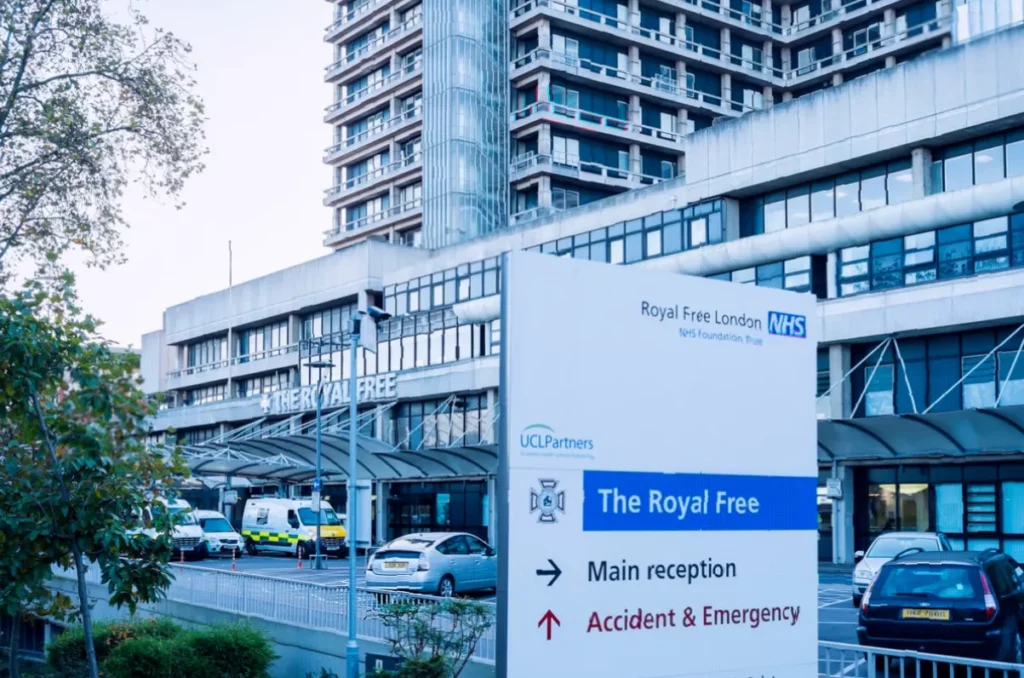
Royal Free London NHS Foundation Trust is facing significant financial strain from the costs of industrial action, as junior doctors prepare to strike next week across its three major north London hospitals. The trust, which runs the Royal Free Hospital in Hampstead, Barnet Hospital, and Chase Farm Hospital in Enfield, is particularly exposed because its three busy emergency departments cannot close during strikes, forcing the trust to procure additional staff at premium rates.
‘We control industrial action costs very tightly’
Speaking at last week’s board meeting, Vicky Clarke, the trust’s chief financial officer, acknowledged the challenge. “We control industrial action costs very tightly, but as a really big group with three busy emergency departments, we’re heavily impacted, because we can’t close those A&Es during a period of industrial action and need to procure additional support during that time,” she said. Clarke, who was appointed chief finance officer at Royal Free London in January 2022 after serving as deputy chief finance officer at University College London Hospitals NHS Foundation Trust, made the comments as the trust braces for a fresh wave of walkouts.
Why A&E departments cannot close during strikes
The obligation to keep emergency departments fully operational during industrial action is a legal and clinical necessity. Under NHS guidance and the terms of the trust’s licence with NHS England, A&E services must maintain a “life-preserving care model” at all times. Unlike elective surgery or outpatient clinics, which can be postponed or rescheduled, emergency care for life-threatening conditions – heart attacks, strokes, severe injuries, and acute illness – cannot be deferred. The Royal Free London’s three A&Es serve a large and diverse catchment area across north London and Hertfordshire, and any closure would effectively redirect patients to already-overstretched neighbouring hospitals, risking dangerous delays.
To meet this obligation during strikes, the trust must pay “additional premiums” to secure the doctors, nurses, and support staff needed to keep A&E safe. In its July 2023 financial report, the Royal Free London NHS Foundation Trust recorded a deficit of £26.1 million, with industrial action explicitly cited as a contributing factor because of these premium payments for temporary cover. The financial impact is compounded by the fact that strikes often last multiple days: the upcoming junior doctors’ walkout is scheduled from 15 to 19 June 2026, and a previous five-day strike ran from 27 June to 2 July.
Research into the effect of strikes on patient flow in emergency departments has shown that on certain strike days, throughput can actually improve – probably because the cancellation of elective procedures frees up inpatient beds, reducing the number of patients waiting in A&E for admission. However, trusts and clinicians caution that this is a temporary and unsustainable side effect, not an argument in favour of industrial action, as the underlying capacity pressures remain.
The impact on patients and services
The cost to patients is severe. Across the NHS between 2022 and 2024, roughly one million elective appointments and procedures were cancelled because of strikes. The Royal Free London trust itself has previously cancelled more than 6,500 patient appointments during a single period of industrial action. Delays to cancer treatment have been a particular concern, with clinicians diverted from planned care to cover urgent and emergency departments.
The strike next week forms part of a long-running dispute between the government and the British Medical Association (BMA) over pay and working conditions. The BMA has been locked in dispute with the government since May 2025, arguing that consultant pay in England is around 26% lower in real terms than in 2008/09. Resident doctors – the term the BMA now uses for junior doctors – voted overwhelmingly to strike, with a re-ballot in January showing 93.40% voting yes. The union is calling for urgent engagement and a “credible pay offer” to avert further walkouts.
The BMA is not alone. The Royal College of Nursing (RCN) has conducted industrial action ballots, opening a postal ballot on 6 October 2022. Nurses have rejected government pay awards, with the RCN reporting that 91% of members in England and Wales voted against a 3.6% pay award for 2025/26. The RCN has stated that any industrial action would follow a “life-preserving care model” with derogations to maintain safe staffing levels. The GMB union has also been active: its members rejected the same 3.6% pay award, with 67% voting against. The GMB has campaigned for a 15% restorative pay increase (or £2 per hour), arguing that a 3% increase is an “insult” after a decade of real-terms cuts. Unite the Union has balloted members over pay and conditions, highlighting that offers below inflation constitute real-terms pay cuts that worsen recruitment and retention crises. Unite has also raised concerns about the privatisation of services, as seen in the dispute involving pathology staff at the trust.
Cost control under pressure
The overall financial burden of industrial action on the NHS has been enormous. The health service estimated that strikes had cost around £1.5 billion by the end of 2023. Direct costs for a single round of junior doctor walkouts have been put at roughly £100 million. The government has ordered a spending freeze and instructed the NHS to absorb the £300 million cost of recent resident doctors’ strikes from existing budgets – meaning trusts must find savings elsewhere.
For the Royal Free London, that balancing act is becoming increasingly difficult. Clarke’s pledge that the trust “controls industrial action costs very tightly” reflects the reality that, with three open A&E departments, there is little room for manoeuvre. The trust must pay the premium rates for temporary cover or accept the greater risk of unsafe emergency services.