

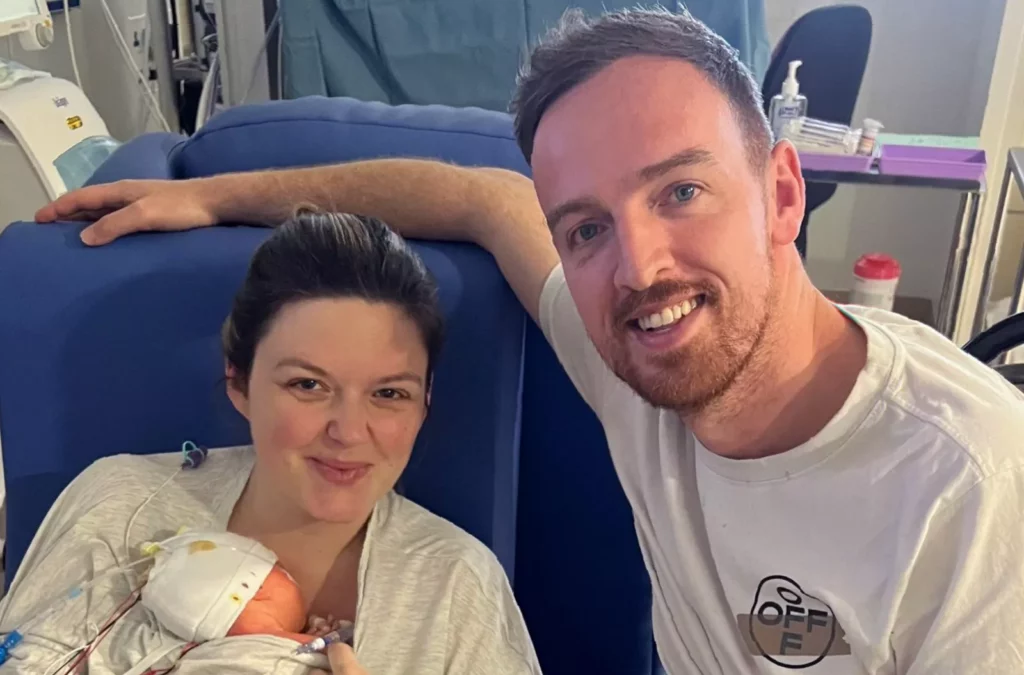
A young mother required a hysterectomy after losing more than five litres of blood due to a life-threatening pregnancy condition that went undiagnosed before birth, despite her having known risk factors.
Chloe Robinson, 32, was rushed into emergency surgery following an emergency caesarean section for her daughter Poppy in July 2024 at Burnley Hospital. Medical staff, she recalled, descended into “emergency and panic” as uncontrollable bleeding from an undetected case of Placenta Accreta Spectrum (PAS) drained her body. Surgeons performed a hysterectomy to stop the haemorrhage. Mother and baby survived, but Ms Robinson said the ordeal delivered “shock after shock” – and that an earlier diagnosis would have allowed her to psychologically prepare for the trauma.
Ms Robinson had a previous caesarean section and was diagnosed early in her pregnancy with placenta praevia, a low-lying placenta that can cover the cervix. Both factors significantly raise the risk of PAS. She says she experienced intermittent bleeding throughout the pregnancy, but said medics dismissed it: “They said, you’ve got a low-lying placenta, sometimes it bleeds. It was all dismissed.” The condition was not spotted during an ultrasound, and she said she did not receive further checks.
An internal investigation by East Lancashire Hospitals NHS Trust later acknowledged the failure to diagnose PAS antenatally. The trust apologised, stating that an earlier diagnosis would have “psychologically prepared” Ms Robinson for the possibility of a hysterectomy. Pete Murphy, chief nurse and executive lead for maternity services at the trust, said the condition “requires specialist assessment and careful antenatal diagnosis” and confirmed the trust was working to strengthen early identification, referral and management for women at risk of PAS.
What is Placenta Accreta Spectrum?
PAS occurs when the placenta grows too deeply into the wall of the womb, meaning it does not separate easily during delivery. When doctors attempt to remove the placenta after birth, a woman with the condition can haemorrhage within minutes. The spectrum ranges from abnormal adherence (accreta) to deep invasion into the uterine muscle (increta) and, in the most severe form, complete perforation of the uterine wall (percreta), which carries a higher fatality rate.
The condition is rare but its incidence is rising, largely due to the growing rate of caesarean sections. According to the campaign group Action for Accreta, PAS now affects one in every 272 births in the UK. Other estimates, drawn from UK obstetric surveillance studies, suggest an incidence of around 4.2 per 10,000 maternities – a figure that has more than doubled in recent years. The most significant risk factors are a history of prior uterine surgery – particularly caesareans, with risk increasing with each operation – and placental implantation over a surgical scar. Additional risk factors include placenta praevia, advanced maternal age (35 or above), assisted reproductive technologies such as IVF, and other uterine surgeries such as myomectomy or repeated curettage.
Why PAS is often missed
A major challenge with PAS is that it often produces no noticeable symptoms during pregnancy. While routine ultrasound scans can detect the condition, they are not always reliable. Action for Accreta warns that PAS can be difficult to detect on ultrasound, and even advanced imaging such as MRI cannot always confidently confirm or rule it out. Expert sonographers can achieve higher detection rates – 80 to 90 per cent – but this requires specialist training and experience. Screening is typically recommended between 26 and 28 weeks of gestation, although some specialist centres can diagnose it as early as 13 to 16 weeks.
The consequences of missed diagnosis are stark. Action for Accreta reports that 61 per cent of women with PAS go undiagnosed before delivery. Among them, 64 per cent require major emergency surgery and 30 per cent undergo emergency hysterectomies. Undiagnosed PAS is associated with 73 per cent more blood loss than when the condition is identified antenatally. Fewer than one in ten cases of PAS that occur without placenta praevia are detected before birth, the campaign group says.
The NHS does not currently record comprehensive data on PAS, making it difficult to track the condition and its outcomes. Action for Accreta is campaigning for national recording of PAS within the MBRRACE-UK maternal mortality surveillance system, alongside updated professional guidelines and a national training programme for maternity units. The campaign has gathered more than 100 survival stories from affected families and secured cross-party parliamentary support.
Other cases highlight diagnostic gaps
Kimberley Littler, 40, from Glasgow, had three previous caesarean sections and was already in a high-risk category for PAS. She was only diagnosed after she asked the sonographer directly whether she had the condition. The question triggered an urgent transfer, an eight-hour operation, a hysterectomy and a neonatal admission that she believes saved her life. “I could have been dead,” she said. “My three girls could have been motherless if it wasn’t spotted.” She stressed that sonographers need better training to spot PAS to avoid “unnecessary death and unnecessary trauma.”
Katie Buckingham, 34, from Surrey, was suspected of having PAS throughout her pregnancy. When she delivered her daughter Tilly in a planned caesarean under general anaesthetic in February 2025, she was told it was not PAS because her placenta appeared “whole”. A week later she suffered a secondary haemorrhage, a uterus infection and developed sepsis, requiring further surgery to remove tissue and blood clots. The products removed were never sent to histology – the only way to confirm a PAS diagnosis. She continued to be unwell, and at six weeks postpartum, retained placenta was found, leading to another serious operation. A specialist consultant later confirmed it was likely PAS after all. Ms Buckingham said she felt “abandoned” and “mentally broken”: “What I needed was not just treatment each time I collapsed into a crisis. I needed joined-up care, specialist understanding, and somewhere to feel safe.”
Expert calls for improved screening
Dr Chineze Otigbah, an obstetrician and fetal medicine expert at Queen’s Hospital, Romford, said: “It’s not the condition that kills, it’s what happens when you try and mess around with it.” She argued that screening women early in pregnancy and flagging those at higher risk – such as women who have had previous caesareans – could prevent the need for emergency hysterectomies and massive blood loss.
The Royal College of Obstetricians and Gynaecologists (RCOG) is updating its clinical guideline on PAS and placenta praevia. Dr Alison Wright, president of the RCOG, said: “PAS can cause serious complications during pregnancy and birth, so early detection and appropriate clinical management is vital. Our understanding of this condition has grown significantly in recent years and the upcoming RCOG clinical guideline on PAS and placenta praevia, expected to publish in June, reflects the most up to date evidence and provides advice on the management and care of women with these conditions. This guidance aims to support teams to deliver the highest standard of care to every woman affected.” The revised guideline is expected to cover atypical presentations and cases of PAS that occur without placenta praevia for the first time.
Donald Peebles, national clinical director for maternity at NHS England, said: “Placenta accreta spectrum is rare, but when it does happen it can lead to very heavy bleeding, which is why identifying women at higher risk early in pregnancy is so important. Maternity teams are supported by clear clinical guidance to spot the warning signs and, where needed, refer women to specialist NHS centres with experienced multidisciplinary teams and access to critical care. Our focus is on making sure every woman receives safe, expert and compassionate care throughout their pregnancy and labour.”