

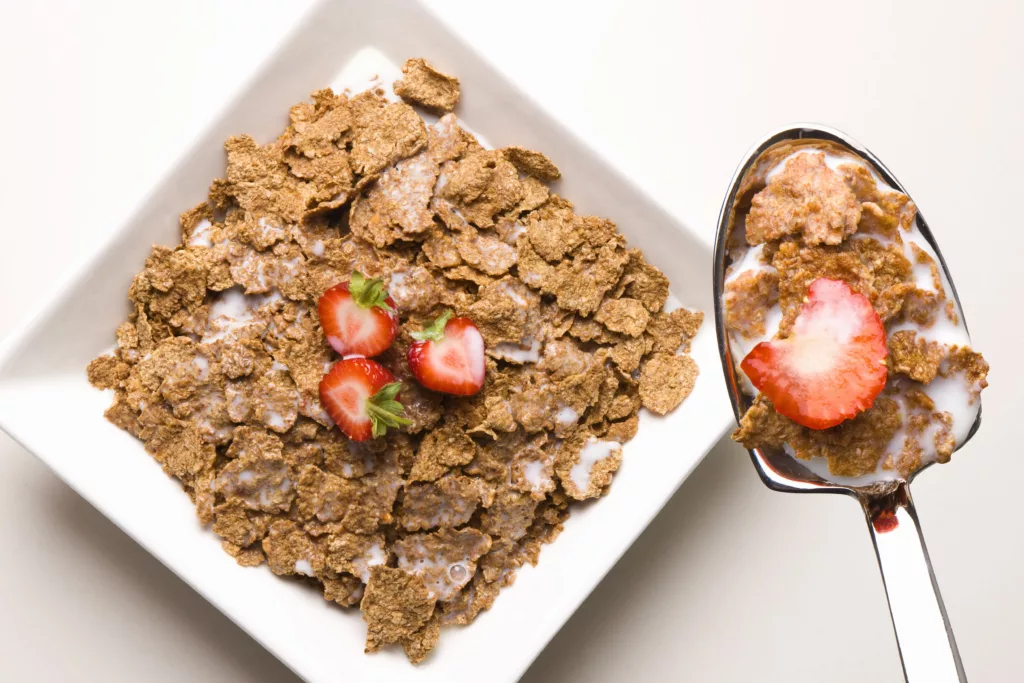
Bran flakes could be labelled junk food under new Labour proposals that would overhaul how the government decides which products are healthy, with ministers planning to count naturally occurring sugars against breakfast cereals for the first time.
The proposed changes to the UK’s Nutrient Profiling Model (NPM) would reclassify fibre-rich cereals such as bran flakes as “less healthy” – a category that attracts advertising and promotion restrictions designed for high-fat, salt or sugar (HFSS) products. Although bran flakes are high in fibre, low in saturated fat and fortified with essential vitamins, the presence of glucose derived from natural sources such as corn or wheat starch – used to improve taste – could tip them over the threshold under the updated scoring system.
How ‘free sugars’ would change the rules
The crux of the reform is a shift from measuring “total sugars” to “free sugars” in the NPM. Free sugars include all added sugars, but also those naturally present in fruit juices, smoothies, purées, syrups – and, critically, sugars released from natural ingredients during processing. The Scientific Advisory Committee on Nutrition (SACN) and the World Health Organization (WHO) have both recommended reducing free sugar intake, and the government argues the current model, developed by the Food Standards Agency in 2004–2005 and last updated in 2018, no longer reflects modern dietary guidance.
Under the existing rules, the sugars in bran flakes derived from corn or wheat starch are treated as part of the food’s total sugar content but not specifically penalised as free sugars. The updated model would classify those naturally occurring sugars as free sugars, meaning a cereal that currently passes the healthy threshold could be reclassified as less healthy. The same logic would apply to plain yogurts containing real fruit, some pasta sauces (where manufacturers might be forced to reduce tomato content to comply), and dairy products – particularly lactose-free alternatives – because lactose is a naturally occurring milk sugar. Dairy UK has warned that the proposals risk pushing consumers toward sugar-free soft drinks rather than nutrient-rich dairy products, potentially harming British farmers.
The recalibration also affects how fibre is scored: the NPM 2018 already adjusted fibre scoring to align with adult recommended intakes, allowing high-fibre foods to earn more positive points. However, the new emphasis on free sugars means that even cereals with strong fibre credentials could be dragged into the less-healthy category if their free sugar content exceeds the revised thresholds.
Industry warns of wasted reformulation efforts
Food manufacturers have reacted with alarm. Kellogg’s, whose brands include bran flakes and All-Bran, has been among the most vocal. Dean O’Brien, managing director of Kellogg’s UK, said the proposals “have the potential to unintentionally undo years of work and investment by food companies to encourage healthier choices”. He pointed out that under current rules all of the company’s children’s cereals and four of its five best-sellers are deemed healthy. “However, under the newly proposed plans, cereals such as bran flakes, which are high in fibre and low in saturated fat, would be reclassified as less healthy,” O’Brien said. Kellogg’s says it has spent the past decade reducing sugar by 27 per cent and salt by 22 per cent across its cereals, and has cut sugar in All-Bran by 17 per cent.
The Food and Drink Federation (FDF), which represents the wider industry, warns that disruptive new regulations could harm reformulation efforts. FDF members have collectively reduced salt by 31 per cent, sugar by 30 per cent and calories by 24 per cent over the past decade, and since 2021 have cut sugar by 19 per cent, salt by 18 per cent and calories by 17 per cent across their products. Industry sources accused ministers of “moving the goalposts”, with one telling The Telegraph that “the ink was barely dry” on previous rules designed to encourage healthier products before the new model threatened to reclassify them as less healthy again. Trade bodies argue the new model is too blunt and could unfairly classify nutrient-dense products as unhealthy, rendering previous reformulation investment “money down the drain”.
The concerns extend beyond breakfast cereals. The FDF and Dairy UK have pointed out that products widely perceived as healthy – such as plain yogurt with fruit and lactose-free milk – could be swept up in the reclassification, undermining public health messaging that encourages fibre-rich and dairy-rich diets. Official figures show that 96 per cent of Britons fail to consume the recommended 30g of fibre per day, a statistic that industry figures argue makes it counterproductive to penalise high-fibre options.

Government defends update as long-overdue
The government has defended the proposals, insisting that the existing NPM is based on nutritional guidance that is more than two decades old and no longer fit for purpose. “The new model shifts the focus from total sugars to free sugars and promotes diets higher in fibre,” a government spokesman said. The reforms are part of a broader strategy to tackle childhood obesity and poor diets, with restrictions already in force: a ban on TV and online advertising of HFSS products before 9pm came into effect in January 2026, alongside a full ban on online advertising at all times. The updated NPM would underpin those restrictions as well as future promotion curbs.
“Obesity and poor diets rob children of the best possible start in life and this is about supporting parents to raise the healthiest generation of children by restricting the advertising and promotion of junk food,” the spokesman added. Government analysis suggests that applying the updated model could deliver significant health and economic benefits, including a reduction in childhood obesity cases.
The consultation on applying the new NPM to food policy closed on June 17, 2026. Health organisations and experts have broadly supported the update, arguing that the previous model allowed some high-sugar products to be classified as healthy, potentially misleading consumers. They say the changes close loopholes and align policy with scientific evidence on free sugars, even if it means some traditionally healthy-sounding products face reclassification.