

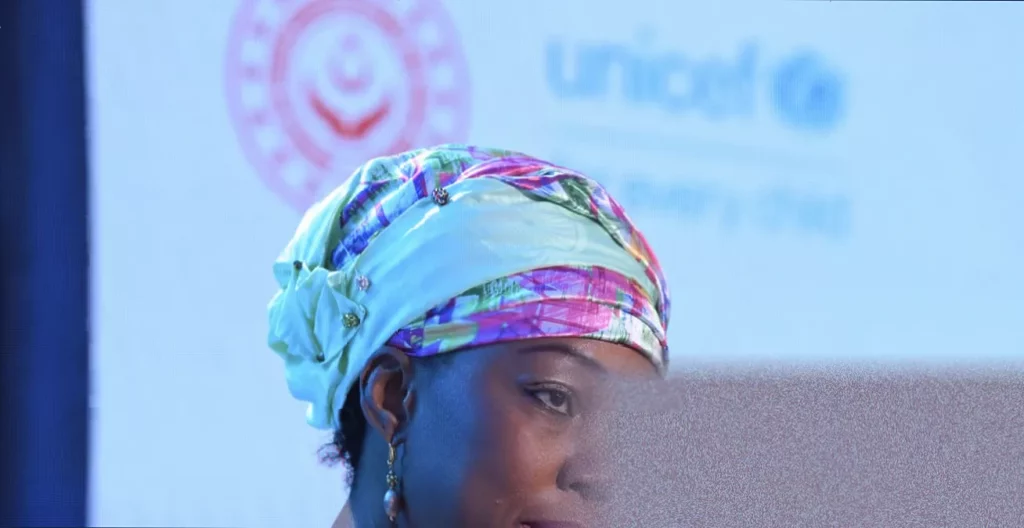
Fatima Maada Bio, the first lady of Sierra Leone, has denied supporting female genital mutilation but insists she will not publicly condemn the practice until she sees “reliable data” demonstrating the extent of the harm it causes.
In an exclusive response to the Guardian, Mrs Maada Bio, who is also president of the Organisation of African First Ladies for Development (Oaflad), said she is “not using her voice to campaign either in favour of or against circumcision”. She added that, as a circumcised woman herself, she expected to see evidence before taking a stance. The remarks have drawn sharp criticism from health professionals, survivors and human rights activists who warn that her position risks undermining years of advocacy against FGM in a country with one of the highest rates of the practice in the world.
Denial and conditional stance
Mrs Maada Bio told the Guardian she is “not in favour of any form of circumcision that is forced upon an individual”. She insisted that initiation into the Bondo Society, the secretive cultural group that performs FGM through female practitioners known as soweis, should be voluntary and restricted to adults aged 18 and above. However, she stopped short of condemning FGM outright. “I am not using my voice to campaign either in favour of or against circumcision,” she said, adding that she expects reliable data on the harms of the practice in Sierra Leone.
The first lady has previously stated that she does not consider FGM harmful, telling the BBC in a 2019 interview that she had not seen proof or statistics of its dangers. Her latest comments echo that position, with the added demand for what she describes as “reliable data”. Sierra Leone’s national survey data already shows that 83% of women aged 15–49 have undergone FGM, a decline from 90% in 2013. Of those cut, 71% were subjected to the practice before the age of 15. Health consequences documented in medical literature include infertility, chronic pain, infections, increased risk of HIV transmission, anxiety, depression, birth complications and, in some cases, death.
Critics argue that the first lady’s demand for data disregards existing evidence and the 2012 UN General Assembly resolution calling for a global ban on FGM, which describes it as a grave violation of human rights. They also point to a July 2025 ruling by the Economic Community of West African States (Ecowas) court of justice, which declared FGM “one of the worst forms of violence against women” that “meets the threshold for torture”. The court ordered Sierra Leone to enact legislation criminalising the practice, a directive the government has not yet followed.
Concerns raised by activists
More than 20 signatories — including health professionals, survivors, human rights activists and politicians — have written an open letter to Oaflad, dated 10 June, demanding clarification on Mrs Maada Bio’s public statements. Among the signatories are Amy Smythe, Sierra Leone’s former minister of gender and children’s affairs, and Isha Dyfan, a human rights lawyer and UN expert. The letter warns that “perceptions of support for FGM, whether direct or indirect, risk undermining years of advocacy … and creating misalignment with national, regional and international commitments”.
Ranya Kargbo, a senior UN professional and FGM survivor who signed the letter, expressed particular concern about a recent public appearance by the first lady in which she was filmed telling soweis “not to be afraid of anything and that she stands with them”. Kargbo said: “When you are in a leadership position, your words matter. When she said to the soweis not to be afraid of anything and that she stands with them, those were powerful words from the highest office in Sierra Leone. When somebody says that, it means ‘I have all the resources and support, do what you want’. It is an absolute slap in the face for all of us.”
Mrs Maada Bio has defended her remarks, telling the Guardian they were taken out of context and were “intended to encourage dialogue and reassure women who felt marginalised”. Her comments have already had practical consequences: the first lady was removed from the speaker lineup at an event organised by CELD and Wolfson College after a coalition of survivors and activists, led by The Five Foundation, argued her stance undermines global efforts to end FGM.
Broader comments on the anti-FGM campaign
In a series of social media posts, Mrs Maada Bio has publicly criticised prominent anti-FGM campaigners. Last week, she shared on her Facebook page, which has more than 600,000 followers, an article from the BMJ Journal of Medical Ethics titled “Harms of the current global anti-FGM campaign”. The article, published in September 2025, argued that a “ubiquitous ‘standard tale’ obscures the diversity of practices, meanings and experiences among those affected” by cutting. Critics say the article risks normalising FGM by questioning trauma, equating the practice with other surgeries and framing anti-FGM narratives as external impositions.
In the same Facebook posts, Mrs Maada Bio named several campaigners — including Nimco Ali, an independent UK government adviser for tackling violence against women and girls, and Anita Koroma, founder of Girl Child Network Sierra Leone — writing “they do nothing for our country” and, in another post, calling them “scammers”. She told the Guardian these comments were not “directed at survivors of circumcision or those genuinely working to improve the lives of women and girls”. She added: “My criticism has been directed at individuals whom I believe have misrepresented my position and sought to create a narrative that does not reflect my actual views.”
The first lady’s “Hands Off Our Girls” campaign, launched in December 2018, focuses on combating gender-based violence, child marriage and teenage pregnancy. That campaign was instrumental in the passage of Sierra Leone’s 2024 bill banning child marriage, a milestone in gender equality. Yet since her husband, President Julius Maada Bio, was elected in 2018, she has consistently refused to condemn FGM. The president himself signed the Child Rights Act 2025 into law in October last year, but the act contained no provisions addressing FGM — despite the Ecowas court ruling issued a few weeks earlier, which came after President Bio became chair of the regional bloc. He has never publicly acknowledged the ruling.
The controversy has also extended beyond FGM. Southwark council this week confirmed it had repossessed a council flat in London that Mrs Maada Bio had been renting for her children, who are British citizens. The first lady, a former film producer and actor who fled to the UK as a teenager to escape a child marriage, had faced criticism for continuing the tenancy while living in Sierra Leone.