

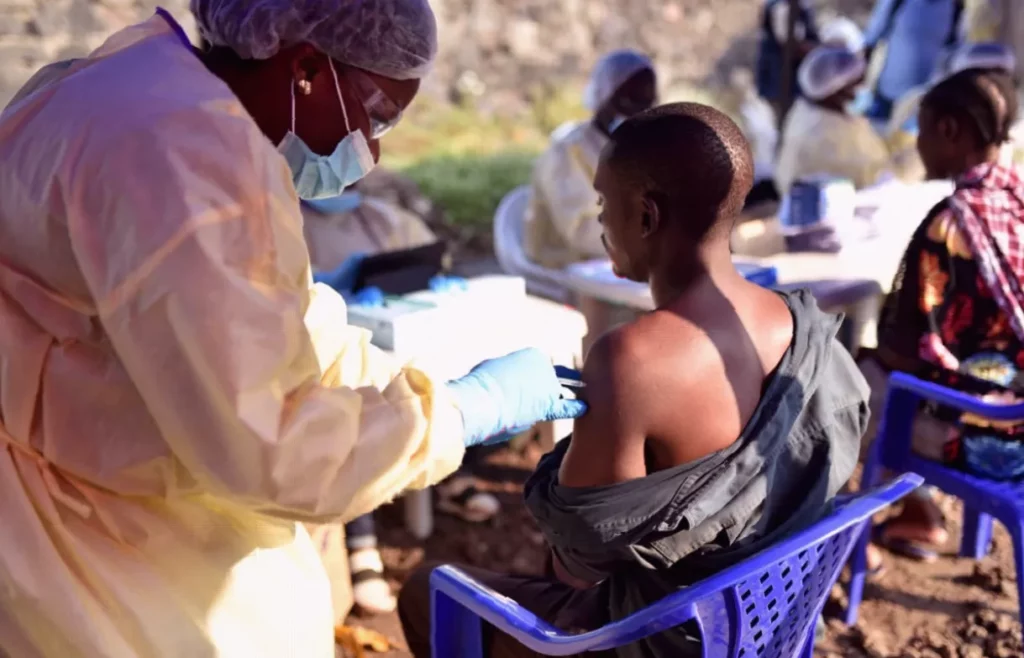
UK public health experts are now on the ground in central Africa, reinforcing multinational efforts to contain an Ebola outbreak caused by the Bundibugyo virus that has already killed nearly 200 people in the Democratic Republic of Congo and crossed into Uganda.
The seven-strong team from the UK Public Health Rapid Support Team (UK-PHRST), part of the UK Health Security Agency (UKHSA), arrived this week to bolster the response alongside the World Health Organization and other international partners. Four specialists have been deployed to Eastern DRC to support WHO field operations, while a risk communication and community engagement expert is based at the WHO country office in Kinshasa, an epidemiologist has been sent to the Republic of Congo to help with regional preparedness, and a data modelling expert is providing remote analytical support.
The deployment draws on the UK-PHRST’s core mission: to work with low- and middle-income countries to stop infectious disease outbreaks before they become broader health emergencies. The team was created after the devastating 2014–2015 West Africa Ebola epidemic and is funded by the Department of Health and Social Care’s Official Development Assistance budget. Over the past nine years it has undertaken more than 50 deployments involving over 100 people, including ten missions to Eastern DRC during the 2018–2019 North Kivu outbreak.
Expertise tailored to a complex outbreak
The specialists bring skills that are critical for a virus for which there is no licensed vaccine or specific treatment. Unlike the Zaire ebolavirus, the current Bundibugyo strain forces responders to rely almost entirely on public health measures. The UK team includes experts in epidemiology, risk communication and community engagement (RCCE), infection prevention and control (IPC), and data modelling.
Epidemiologists on the ground are tracing chains of transmission in Ituri Province, which accounts for 738 of the 808 confirmed cases reported in DRC as of 16 June 2026. Their work is made harder by insecurity, highly mobile populations linked to cross-border mining, and the presence of large refugee communities. The epidemiologist stationed in the neighbouring Republic of Congo is helping to strengthen surveillance along the porous border, where the risk of further cross‑border spread is high – Uganda has already reported 19 confirmed cases and two deaths, with the most recent infections recorded on 5 June.
Risk communication and community engagement specialists are working to build trust and correct misinformation, a vital task in a region where suspicion of health workers and burial practices can fuel transmission. The WHO declared the outbreak a Public Health Emergency of International Concern on 17 May 2026, underscoring the need for clear, culturally appropriate messaging.
Infection prevention and control experts are focusing on frontline health workers, who were among the first to fall ill when the outbreak began in May 2026 in Bunia Health Zone. Previous Bundibugyo virus outbreaks have shown case-fatality rates of between 25% and 50%, and without specific treatments every biosecure procedure – from safe burials to the disinfection of treatment centres – is a frontline defence.
The data modelling specialist, working remotely, is providing real-time projections of outbreak trajectories, helping responders decide where to allocate scarce resources. This analytical work is supported by the UK’s broader Multi-Hazard Research Network, which has already begun feeding social and behavioural science research into the response.
Beyond the deployment: UK funding and research
The deployment is part of a wider British commitment that includes up to £21 million to support the government-led Ebola response in DRC, aimed at strengthening disease surveillance, protecting frontline workers, and improving access to care. An additional £5 million has been earmarked for the research and development of new treatments and rapid diagnostics specifically for the Bundibugyo virus.
UKHSA, in partnership with the National Institute for Health and Care Research, has also renewed and expanded the academic partnership that underpins the UK-PHRST. The London School of Hygiene & Tropical Medicine now leads a new multi-institutional consortium to provide scientific expertise.
Dr Edmund Newman, Director of the UK-PHRST and an Honorary Professor in Global Outbreak Response at the London School of Hygiene & Tropical Medicine, said the deployment “will help strengthen the existing response to the Ebola outbreak in the DRC and across the region”. A virologist by training, Newman has a doctorate in molecular virology of HIV and more than a decade of experience responding to high-consequence viruses, including Ebola in West Africa and Marburg in Uganda, and previously worked with the European Mobile Laboratory project in Guinea in 2014.
The risk to the UK population from the current outbreak is considered low. UKHSA routinely monitors global threats, and the NHS maintains specialist centres and established procedures for managing any potential cases. Enhanced travel screening and public health measures are in place for travellers returning from affected areas.