

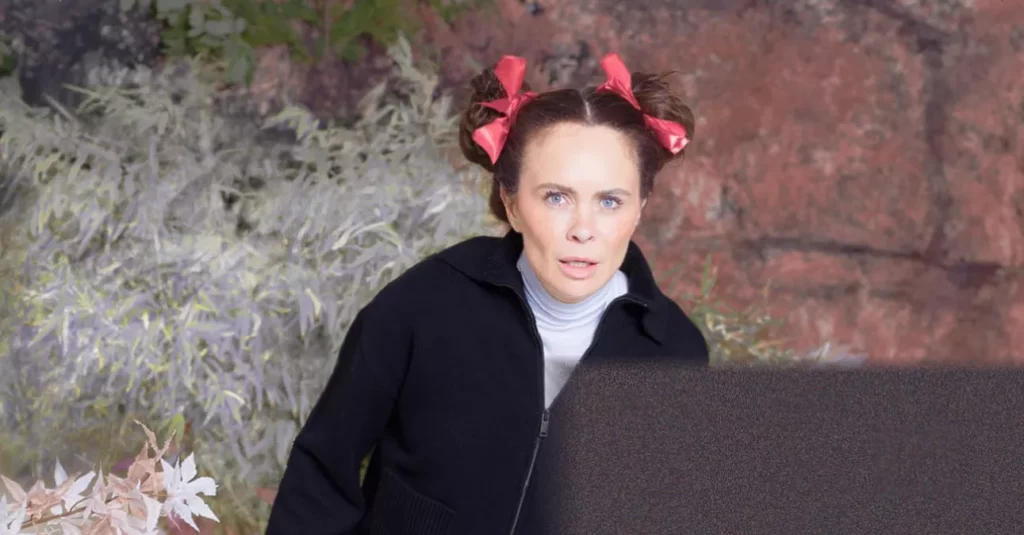
As a child, Joanne McNally stood on a rockery in her schoolyard and told a circle of girls a story: her birth parents had died in a plane crash and she was the sole survivor, which explained why she was adopted. It was not true. But it was, as she recalls, her first little one-woman show – a moment that gave her a taste for having an audience, even if the origin story she invented was pure fantasy.
Childhood and the search for belonging
Born on 7 May 1983 in County Roscommon, McNally was adopted as a baby and raised in Killiney, County Dublin, by her adoptive parents, Frank and Pat. She has described the experience of adoption as “wild”, likening it to being “spat out of a spaceship naked in the woods”. She has an older adopted brother. Her adoptive father died when she was a teenager.
Growing up, she was always well turned out – much like her Aunt Joan, a single, child-free woman who wore fur coats and pearl earrings and flew constantly. McNally remembers feeling sorry for Joan for having no children; only later did she realise Joan was leading a glamorous, aspirational life. As a small child in knee-high socks and a white polo neck, McNally was loud and flirtatious, giggling at strangers. But from as far back as she can remember, she thought she was fat. When the other children played mummies and daddies, she was always cast as the daddy. In school musicals she played the boys’ roles. “I wasn’t an attractive teenager,” she has said. While she had some luck with lads, she felt more like a “personality hire” and wanted to be more desirable.
In her late twenties, she began searching for her birth parents and eventually connected with her birth father, Kevin. She discovered she had four half-brothers – Conor, Paddy, Finbar and Ronan – and described the reunion as “wild”, noting a striking resemblance between them. She had wondered whether her birth parents might be from a showbiz dynasty; instead, her birth father told her: “I think you’re just your own thing.”
The spiral of bulimia and the breakdown
Once she hit her twenties, McNally threw herself into Dublin’s social scene. She and her friends were big drinkers, loving three-day benders and clubbing. She was working as a publicist – first in PR for a youth agency and later alongside influencer James Kavanagh – and they were “living the brand”, wearing bicycle locks as necklaces and backward baseball caps. But behind the fun, her bulimia was spiralling out of control.
She has spoken openly about an eight-year battle with both bulimia and anorexia, a period that cost her jobs, relationships and friendships. In her late twenties, she took a job at a mental health charity, thinking the change would help. But the solitude of a quieter role – one email a day – sent her “absolutely nuts”. In that isolation, she let the eating disorder take over. She sometimes slept at the charity’s office to avoid her housemates.
In her early thirties, she reached a breaking point. “I decided I would totally succumb to the mental breakdown so that no one would expect anything from me,” she has said. She quit her job and moved into her mother’s attic, cocooned at the top of the house, living “like a mental patient”. She underwent treatment, including being admitted as a psychiatric patient. Recovery was difficult, she has explained, because “recovery to me just meant getting fat”, and she was not ready for that. Nonetheless, the breakdown presented her with a fork in the road: she had no mortgage, no children, and the financial freedom to explore what she should be doing with her life.
The physical toll of bulimia has been lasting. She still has teeth pulled and filled because vomiting damages enamel and gums. “Bulimia is really bad for you,” she has said. “I still get teeth pulled out and filled in because being sick messes you up.” The illness also drove her to an anonymous blog she called Eat the Pastry, about her experiences with the disorder, which later led to a newspaper column for the Irish Daily Star.
Aside from a desire to be desired, she has said the root of her bulimia was deep dissatisfaction. She was trying to get validation from being thin because another part of her – the part that wanted to perform – was not being expressed. That changed when her friend Una McKevitt, a director, wrote a play called Singlehood and asked McNally to be in it. “Once I stood on stage, it felt as if I was home,” she has said. The play was going well, she was making a little money writing, and suddenly she had a real reason to get better.
Finding the stage and the comedy career
Initially she thought she would go into theatre, but then she crossed paths with comedian PJ Gallagher, who saw her perform in Singlehood and was sure she should try stand-up. He invited her to support him on his 2015 “Concussion” tour across Ireland, giving her significant early exposure. Had he not been so encouraging, she has said, there is no way she would have stepped on stage at a comedy club. She was subsequently signed by the Irish comedy agency Lisa Richards.
Her breakthrough one-woman show, Bite Me, premiered at the Dublin Fringe Festival in 2016 and candidly explored her experiences with bulimia and eating disorders. It earned nominations for Best Performer, Best Production and the First Fortnight Award, and later transferred to the Edinburgh Festival Fringe and the Vault Festival in London. She also co-wrote and performed Separated at Birth with Gallagher, a show about their shared experiences of adoption that sold out Dublin’s Vicar Street.
Her subsequent tour, Prosecco Express, began in 2022 and became a global hit, with sold-out dates across the UK and Ireland including multiple nights at Vicar Street and the London Palladium. Variety tipped her as a comedy “One to Watch”. The show was crowned Ticketmaster IE’s Comedy Event of the Year. Her current tour, Pinotphile, continues to sell out, with dates extending into 2026 across the UK, Ireland, the US and Canada.
Television and radio work followed: she co-hosted RTÉ2’s Republic of Telly, appeared on The Late Late Show, BBC Northern Ireland’s The Blame Game, Women on The Verge and Taskmaster. She is a team captain on the TLC panel show Unacceptable, hosted by Ed Gamble alongside Richard Ayoade, where comedians defend outrageous opinions. On BBC Sounds, she presents Joanne McNally Investigates, which has explored topics such as “Who Replaced Avril Lavigne?” and “Do Furbys Spy On Us?”
Her biggest success, however, came from podcasting. In March 2021 she launched My Therapist Ghosted Me with Vogue Williams – the title referring to her therapist allegedly ceasing all contact with her. The podcast quickly became a chart-topper in Ireland and the UK, winning “Best Podcast” at the Global Awards 2022 and “Podcast Champion” at the 2023 British Podcast Awards. It has millions of listeners per month and has toured live across the UK, Ireland, Australia and the US. McNally has said the pandemic gave them a trapped audience, everyone inside and on their phones needing company. It was only after lockdown restrictions lifted, when she was doing a gig in a club in Greenwich, south London, and four girls asked for a photo, that she realised the podcast was reaching well beyond her own bubble.
On stage, she describes herself as “feral” – and the crowds are boozy because she is a boozer. She has had a couple of stage-stormers, and “kerfuffles” involving handbags falling off balconies. But in general, she says, the audience is funny and sweet. One woman from Kilkenny comes to her Christmas show every year, takes a photo, and the following year presents her with a snowglobe containing the picture. Comedy, she reflects, attracts a certain type of character, and she has met many adopted comics over the years. “Really, doesn’t everyone want to be accepted by the tribe?” she has said.
If you told the insecure 18-year-old she would be doing comedy for a living, her jaw would be on the floor, McNally has said. But the little girl in the schoolyard, standing on a rockery and telling stories to an audience of girls, would not be surprised. That child was obsessed with Annie the orphan and knew her destiny was treading the boards – being loud, telling stories on stage, where she belongs.