

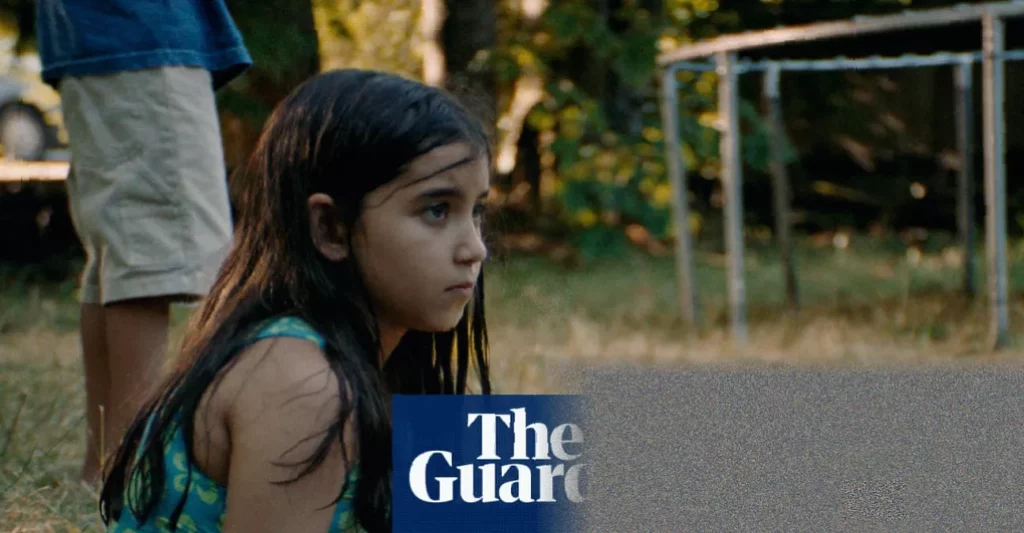
Canadian filmmaker Sophy Romvari’s debut feature, Blue Heron, is an autofictional work that probes the painful legacy of family trauma and the behavioural condition of her older brother. The film, which premiered at the Locarno Film Festival in 2025 and has since drawn near-universal acclaim, resists the conventions of Hollywood drama. Instead, it confides its agony to the viewer with an almost whispered intimacy, refusing to amplify its real-life tragedy into spectacle.
Romvari, born in Victoria, British Columbia in 1990 to Hungarian parents who emigrated a year before her birth, has long used her own life as raw material. Her short film Still Processing (2020)—which explored her family’s grief over the deaths of her two older brothers—won awards at the Toronto International Film Festival and became available on streaming platforms such as Mubi and the Criterion Channel. Blue Heron builds on that earlier work, but shifts focus to a different sibling: a deeply troubled older brother named Jeremy. The film is structured metatextually, with past and present collapsing into one another in a striking final “coup de cinéma” that blurs the line between memory, filmmaking and fiction.
Autofiction and the Fragility of Memory
The film is explicitly autobiographical, but Romvari leans into the subjective and unreliable nature of memory. The narrative follows eight-year-old Sasha—played by Eylul Guven—who, in the mid-1990s, moves with her two younger brothers and older half-brother Jeremy (Edik Beddoes) to a new house on Vancouver Island. Their Hungarian parents, played by Iringó Réti and Ádám Tompa, switch to their mother tongue when they do not want the children to understand them. The family has moved frequently, and the reasons for their peripatetic existence slowly become clear. The adult Sasha, a filmmaker played by New York writer and comic Amy Zimmer, appears in flashforward scenes, videoing a panel of social workers who discuss Jeremy’s case as if it were a cold case file. Romvari used real psychological and social worker reports for these sequences, and interviewed actual social workers, providing them with a case file based on her brother’s situation.
Family Fractures and Gendered Burden
Jeremy’s behaviour is destructive and threatening. At one point he vows to burn the house down; he is frequently brought home by police in handcuffs. A child psychiatrist identifies his condition as oppositional defiant disorder, though the film itself refrains from naming it explicitly, preserving a sense of mystery. The impact on the family is deeply and insidiously gendered. Sasha, a girl of about seven or eight, is acutely upset by Jeremy’s actions in a way that her younger brothers are not. Their mother, who is Jeremy’s biological parent from a previous relationship, is forced into the role of disciplinarian—the “bad cop”—while their father retreats into work. The mother’s resentment simmers beneath the surface, directed at the unspoken assumption that Jeremy is her burden alone. Romvari, the youngest of four siblings, draws on her own experience of growing up in a Hungarian immigrant household on Vancouver Island, a setting that adds another layer of dislocation to the family’s struggles.
The Unanswered Question at the Heart of Jeremy’s Disruption
At the centre of Blue Heron lies a baffling, insoluble mystery: what caused Jeremy’s condition? The film does not offer a tidy answer. Instead, it wrestles with the hurt and rage that Sasha—and, by extension, Romvari—feels both towards Jeremy and on his behalf. She is anguished by the lasting unhappiness he has inflicted on the family, yet also furious with the society and social services that provided insufficient support, and with a universe that inexplicably afflicted him. The film questions whether it makes sense to search for a cause, or whether attention should instead be paid to the consequences of Jeremy’s actions. Edik Beddoes, a first-time performer, plays Jeremy with a disquietingly opaque, smug smirk that may mask deep fear and unhappiness—or may mask nothing at all. The character’s opacity, like the condition itself, remains unresolved. Romvari’s use of actual social worker reports and a documentary-style aesthetic reinforces the sense that this is not a puzzle to be solved, but a wound to be witnessed. Blue Heron is scheduled for UK and Irish cinemas from 26 June 2026, distributed by Conic Films, with Q&A screenings in London and Bristol. It arrives carrying seven Canadian Screen Award nominations—including best motion picture, best director and best original screenplay—and a 98% positive rating on Rotten Tomatoes, cementing Romvari’s reputation as a significant new voice in cinema.