

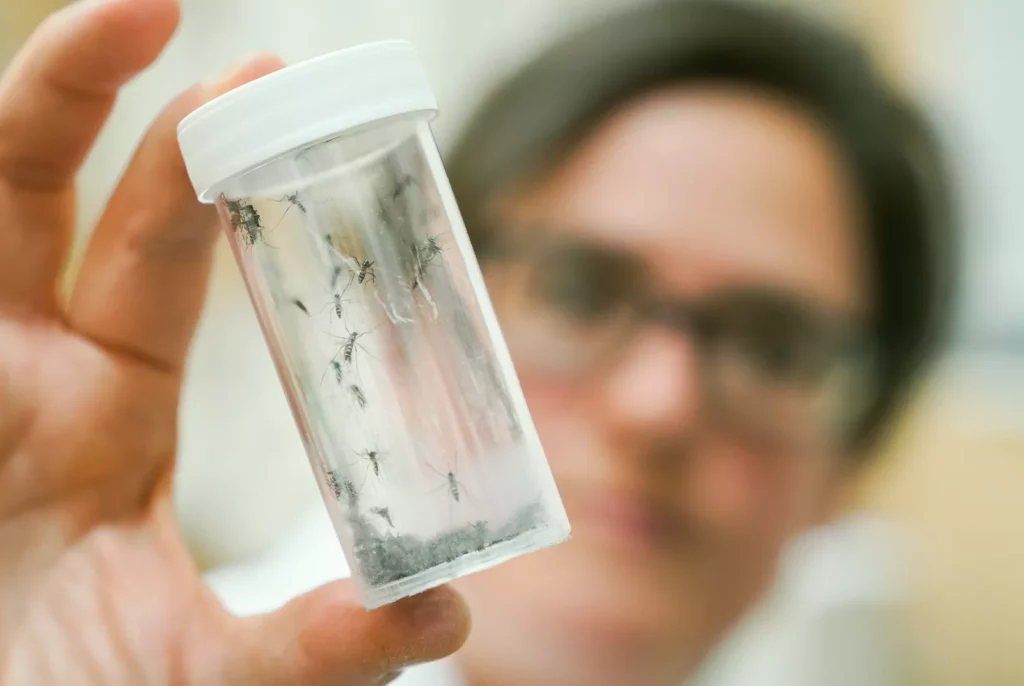
More than half a million sterile mosquitoes are being released across the Washington D.C. metropolitan area this summer, part of a targeted effort to suppress populations of invasive insects capable of spreading diseases such as West Nile virus, dengue, chikungunya and Zika.
The Maryland-based company Bee Safe Mosquito Control is deploying 600,000 non-biting male mosquitoes, known as “ZAP males,” between June and September. The males are infected with a naturally occurring gut bacterium called Wolbachia, which disrupts reproduction without harming humans. When these sterile males mate with wild, uninfected females, the resulting eggs fail to hatch, effectively sterilising the females for the rest of their lives.
“When they mate with the female, they actually cause that female to then become infertile for the rest of her life,” Todd Montgomery, owner of Bee Safe Mosquito Control, told WTOP this week. “She’s going around laying eggs that will never hatch.”
The company is targeting the Asian Tiger mosquito (Aedes albopictus), an invasive species native to Southeast Asia that has become common around Washington D.C. The species is a known vector for encephalitis, dengue, yellow fever, eastern equine encephalitis, LaCrosse encephalitis and dog heartworm, according to the University of California-Riverside. On its website, Bee Safe Mosquito Control notes that removing this non-native invader will not have a negative impact on the ecosystem.
How Wolbachia sterilises female mosquitoes
The method relies on a phenomenon called cytoplasmic incompatibility, driven by Wolbachia bacteria that occur naturally in many insect species. Male mosquitoes are reared in a lab and infected with a specific strain of Wolbachia. They do not bite humans and pose no health risk to people or animals. Once released, these males seek out wild females of the same species. The bacteria do not alter the mosquitoes’ DNA — the ZAP males are not genetically modified, a key distinction from other experimental approaches that have faced public opposition.
When a Wolbachia-infected male mates with an uninfected wild female, the bacteria interfere with the fertilisation process, rendering the eggs inviable. The female remains sterile for the rest of her life, even if she mates again with uninfected males. The effect is permanent because Wolbachia disrupts the cellular mechanisms needed for embryo development. Because the method is species-specific, the released males only mate with Asian Tiger mosquito females, leaving beneficial insects such as bees and butterflies unaffected.
The ZAP males are supplied by MosquitoMate, a Kentucky-based company that has received nationwide approval from the Environmental Protection Agency to use the mosquitoes as a biopesticide. The EPA has evaluated the data and determined that the product is unlikely to harm the environment or pose unreasonable risks to humans. State and local authorities have also approved the release in the Washington D.C. metropolitan area.
Broader applications and international success
Bee Safe Mosquito Control is not the first to deploy this technique. The method has seen success in South America, Singapore and Australia, where studies have reported reductions in dengue fever cases of more than 70%, and in some instances up to 98%. The approach also reduces transmission of Zika and chikungunya viruses. In Fresno, California, Google’s Debug project, backed by parent company Alphabet, achieved up to a 95% reduction in populations of the invasive Yellow Fever mosquito (Aedes aegypti) using Wolbachia-infected males. Earlier this year, Alphabet’s life sciences arm Verily said it was seeking federal approval to release more than 60 million (specifically, up to 64 million) Wolbachia-infected Aedes aegypti mosquitoes in both California and Florida over two years. That project targets the Yellow Fever mosquito, which can spread dengue, yellow fever, Zika and chikungunya through its bite.
Unlike chemical insecticides, Wolbachia-based interventions can be self-sustaining once established in a local mosquito population, persisting for years. The technique is regarded as part of an integrated mosquito management strategy, alongside other control measures. Experts have highlighted the urgency of such tools as climate change expands the range and activity of disease-carrying mosquitoes.
For now, Bee Safe Mosquito Control’s service is limited to residential customers in the D.C. area, with prices averaging more than $1,000 for the season. The company reports that its service for the current season is sold out, and it hopes to secure future contracts for government and parkland applications. “We’re releasing 600,000 in total within the DMV for 2026,” said Montgomery. “Hopefully, we’ll increase that for next season.”
The company says the control typically takes about a month to begin showing results, with the aim of reducing mosquito populations over the long term rather than providing a short-term fix. “Our system is designed to reduce mosquitoes in the long term rather than the short term,” the company states on its website.