

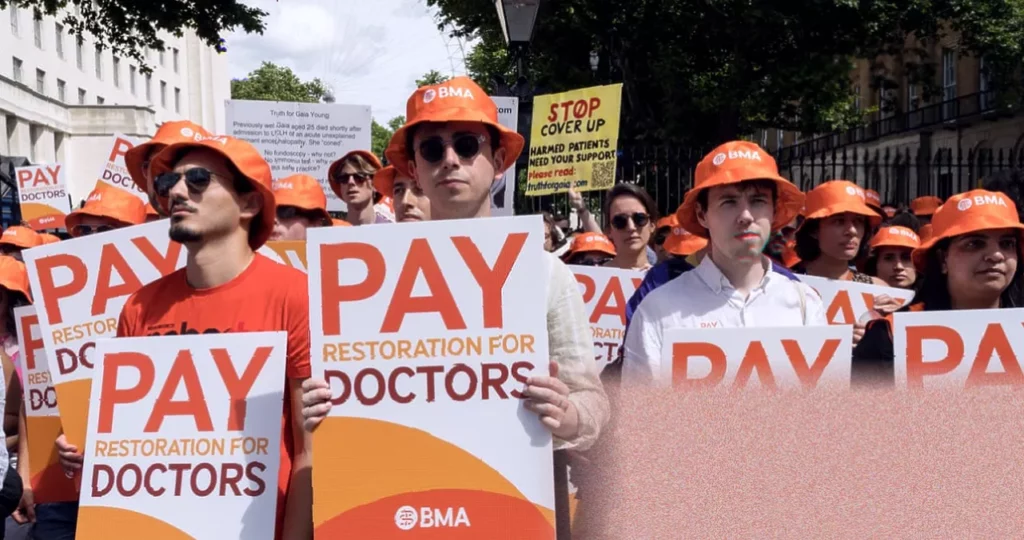
The British Medical Association is pushing ahead with plans to cut up to a third of its English workforce, a move that has sparked fury among staff even as the doctors’ union celebrates record membership and a hard-won pay deal for resident doctors. The BMA has placed 200 of its 600 employees in England at risk of redundancy, triggering accusations of hypocrisy from its own workers and a vote of no confidence in the chief executive leading the restructuring.
Staff cuts on the table despite pay victories
The proposed redundancies come days after resident doctors in England who belong to the BMA narrowly voted to accept a pay deal that will lift the basic salary of the best-paid to £77,348. That settlement followed 15 rounds of strikes that severely disrupted NHS care and cost the health service billions. Yet the BMA’s own financial position remains so precarious that it has decided to shed up to a third of its English staff as part of a major operational reorganisation aimed at reducing a recurring deficit.
The BMA has publicly told the Guardian that as few as 20 staff would ultimately lose their jobs. That figure stands in stark contrast to the 200 staff members placed at risk, a number the union has discussed with representatives of the GMB trade union, which represents most of the BMA’s workforce. A BMA source described the mood inside the organisation as grim: “BMA staff are very scared. They all think they’re going to lose their jobs. People are absolutely miserable. They’re paranoid about the threat of redundancy. It’s the worst reorganisation ever.”
Financial crisis: how the BMA reached this point
The BMA’s financial difficulties run deep, despite its membership having hit a record 200,000 — a surge fuelled by its vigorous campaigns and strikes for better pay. The union is losing millions of pounds every year. Its accounts show that it has required a total of £86.8 million in subsidies from the British Medical Journal, which it owns, since 2008 to remain solvent. That works out at an average of £5.1 million a year. The reliance on BMJ cash underscores the structural deficit that the current restructuring is meant to address.
Some progress had been made: other cost-cutting measures reduced the deficit by £4 million. But inflation has pushed it back up to £5 million, according to a BMA spokesperson. “This means we need to reduce some of our fixed costs and continue to invest in sustaining our excellent membership levels,” the spokesperson said. The need to slash spending is therefore driven not by a short-term wobble but by a persistent gap between income and outgoings, exacerbated by rising costs across the board.
The restructuring is also designed to pivot the BMA more squarely towards its role as a trade union focused on pay and workplace campaigning, and away from its traditional function as a professional association representing most of the UK’s medics. This shift has specific casualties. Up to 20 of the 45 staff who produce reports for the BMA’s respected board of science and board of ethics are likely to lose their jobs. The post of head of region will be cut from seven to four. And the number of industrial relations officer (IRO) posts, which help hospital doctors negotiate disputes with NHS management and run campaigns, is being reduced from 23.5 to 14. Senior BMA figures have described axing IROs as “madness”, arguing it contradicts the union’s own strategic priorities for 2025–30: “organising to win, campaigning to influence and enabling our success”.
Internal backlash: staff, unions and committees rebel
The scale and manner of the proposed cuts have provoked a fierce backlash inside the BMA. The GMB union, which represents most of the affected staff, claims the BMA has breached its own HR rules over the redundancies and attempted to “gag” employees from speaking out. The BMA has not informed its wider membership about the reorganisation or the human cost involved.
Staff have expressed anger at what they see as double standards. One employee said: “BMA leaders seem to think it’s one rule for them, another for everybody else. If a hospital treated its staff like this, we would come down on them like a ton of bricks, rightly.”
In a direct challenge to the leadership, GMB members within the BMA last month passed a vote of no confidence in Rachel Podolak, the chief executive leading the restructuring. On a 72 per cent turnout, 91 per cent said they had no confidence in her. Podolak was appointed in July 2025 and has a background in membership organisations, trade union negotiations and health policy, having previously served as Co-CEO and National Director for Wales. The vote reflects deep distrust among the workforce about how the process is being handled.
The dissent extends beyond the staff room. The chairs of 110 local negotiating committees — BMA branches of hospital doctors — sent a strongly worded letter last month to Podolak and Dr Emma Runswick, the union’s deputy chair of council, condemning the planned loss of IRO and head of region posts. Meanwhile, the BMA’s consultants committee passed a motion criticising the cuts to those roles, but the union’s hierarchy blocked it from being debated at the annual conference last week.
Gavin Davies, a GMB senior organiser, said: “GMB is aware of the redundancies currently being proposed within the BMA. Workers are understandably worried and we will work hard to avoid compulsory redundancies and financial hardship they inevitably bring. GMB is hopeful our negotiations with the BMA will find a solution.”
For its part, the BMA insists the process is not yet final. A spokesperson said: “Final decisions have not yet been made on what changes will be implemented, however the proposals consulted on represented a reduction in the current headcount of the BMA by around 20 full-time equivalent staff. We expect the vast majority of those to be voluntary redundancies, which staff have been able to apply for in recent weeks.” The spokesperson added that the BMA has been “engaging extensively with the GMB as our trade union partner since last year and more recently through a comprehensive process of engaging all affected staff.”