

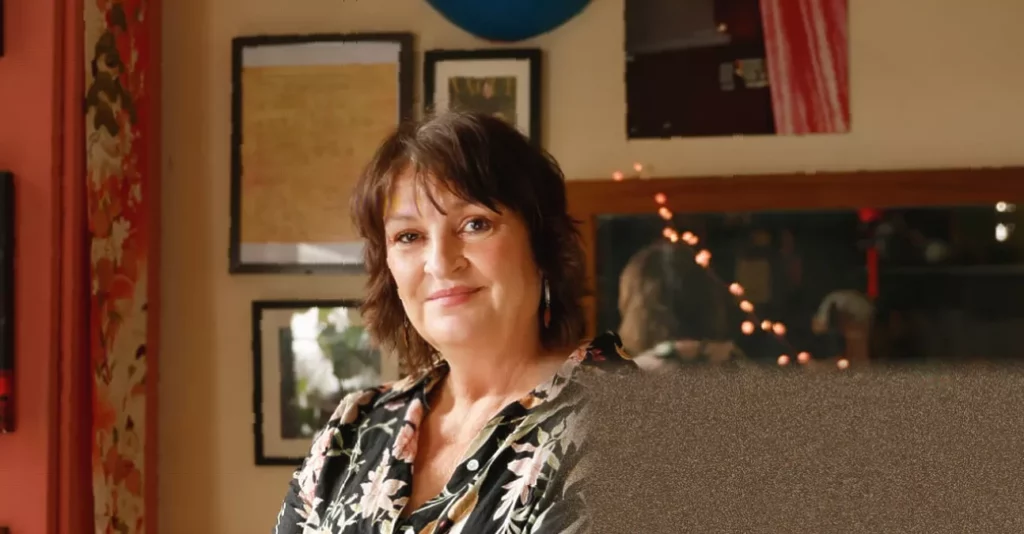
Daniela Nardini, the actress best known for playing the sharp-tongued lawyer Anna Forbes in the BBC Two drama This Life, now works as a qualified therapist in Glasgow. Nearly three decades after the series became a defining show of the Cool Britannia era, Nardini has swapped the set for a consulting room in the city’s West End, where she helps clients navigate depression, anxiety and behavioural issues.
From Bafta-winning breakout to typecast star
Nardini, 60, was born in Largs, Ayrshire, into a Scottish-Italian family that ran the celebrated Nardini’s ice cream parlour on the seafront — a business founded by ancestors who emigrated from Tuscany in the 1890s. She attended St Mary’s Primary School and Largs Academy before training at the Royal Scottish Academy of Music and Drama (now the Royal Conservatoire of Scotland), graduating in 1989.
Early television roles included appearances in Taggart, Doctor Finlay and Take the High Road, alongside fringe theatre work such as playing the title role in Liz Lochhead’s Mary Queen of Scots Got Her Head Chopped Off. But her career breakthrough came in 1996 when she was cast as Anna Forbes in This Life, a role that won her the Bafta TV Award for Best Actress in 1998 and a Scottish Bafta. Critics have since credited Anna Forbes — described in the original review as “provocatively sharp and messy” — as a prototype for characters such as Fleabag, though Nardini has never watched the later series.
The show, which drew up to 3.5 million viewers at its peak, captured the zeitgeist of mid-1990s Britain. Nardini’s character, a hard-smoking, hard-drinking, fiercely independent lawyer, resonated deeply with a generation of young women. “It was crazy, really, because This Life was such an instant success,” she recalls. “It provided me with lots of opportunities. But at the time, I had moved down from Scotland and I found it all quite overwhelming. I’m a family girl and I missed everyone back home.”
When the series was cancelled abruptly after two seasons, Nardini struggled to escape the shadow of Anna Forbes. “Casting directors kept asking: ‘Can you do her again, but in a different way?'” she says. “The only way to really break out was to do theatre.” Over the following years she amassed a wide-ranging acting portfolio, including roles in Reckless, Big Women, Waterloo Road, Lewis, Vera, The Fades and the film Sunshine on Leith. On stage she appeared in Camille at the Lyric, Hammersmith, Top Girls at the Citizens Theatre in Glasgow, and A Streetcar Named Desire at the Donmar Warehouse, among others. In 2009 she won a second Scottish Bafta for her performance in Annie Griffin’s comedy-drama New Town.
Personal crisis and the decision to retrain
Despite her professional success, the years after 2015 brought what Nardini describes as the “worst five years” of her life. Her father, Aldo — the co-founder of the family ice cream business, whom she once likened to the don of The Godfather — died that year. Her marriage to the restaurateur Ivan Stein, with whom she had a daughter, Claudia, ended around the same time. The couple had moved back to Glasgow from London in 2009, with Stein later co-founding the acclaimed restaurant The Gannet. “A chef and an actress … perhaps it’s just not a good idea,” Nardini says drily. “We’re fine. Sometimes things don’t work out and you just have to get on with it.”
Then, at age 50, she was diagnosed with breast cancer that had spread to one lymph node. She underwent a mastectomy and breast reconstruction but did not require chemotherapy. “When I was diagnosed, I felt that it had happened because my heart was broken,” she says. “I felt it was connected to what I had gone through in my life. And I’ve talked to quite a few people who have felt the same thing about their cancer.” She considers herself “very lucky” to have caught it early. “I knew quite quickly that it wasn’t going to kill me and I was going to be OK. Once it was done and I’d been through this treatment, I felt it had been dealt with physically, but not emotionally.”
The physical and emotional toll of losing a breast was profound. “As a woman, to lose your breast is a very profound thing,” she reflects. “The way I’d previously been recognised by the public, it was very sexualised. Then suddenly to lose that part of yourself is very challenging. It changes your relationship with yourself, and not in a negative way.” She began painting during lockdown, producing a series of colourful portraits of women — one canvas, of a figure whose breast has been removed and replaced with red roses, she keeps in her therapy room. “The narrative becomes: ‘I was ill; now I’m healthy. I have survived this. A different strength has come through. My sexuality is still here, but it’s different because of that experience.'”
Compounding the grief, her mother died in 2022, followed by an aunt to whom Nardini was very close. It was not her first encounter with loss: her elder brother, Pietro, had been killed in a car accident when Nardini was a teenager, a tragedy that she says left her “numb for several years”. At 21 she began having panic attacks. “I remember standing outside the drama school building in Glasgow and suddenly my heart was beating really fast and the sky went really big and I felt this overwhelming fear,” she says. “And I believe it was because I hadn’t allowed myself to fully experience my grief.”
Becoming a therapist
That personal history eventually led Nardini to therapy — first as a client, then as a practitioner. “There was just so much happening,” she says. “My marriage, my dad, both things kind of dissolved at a similar time. … And then the breast cancer. It was just too much for me to process.” After seeing a therapist and experiencing the difference it could make, she began her own training, completing an HNC in counselling during lockdown and a diploma to become a qualified Cognitive Behavioural Therapist. The training took longer than expected because of further emotional blows — her mother’s death, her aunt’s death — but she finally qualified in 2024.
Nardini now sees clients in person and online from a therapy room in her Glasgow home, specialising in depression, anxiety and behavioural issues. She is listed on Psychology Today as a qualified CBT therapist. She also has a supervisor to enhance her practice. “Mine has been teaching me about schema, the self-defeating patterns of your life,” she explains. “Once you understand where those are coming from, it’s inspiring, and you can say: ‘OK, now I know that’s not my stuff any more.'”
She draws directly on her own struggles. “If you’ve lived a life and you’ve been through stuff yourself, you are going to have more empathy for people who are going through similar things,” she says. “Sometimes, I think if you are a therapist and you’ve never experienced low mood or anxiety, how can you share about it or talk about it with someone who’s going through it?” Her approach emphasises bringing unexpressed emotions into the open. “Clients will come to me and say: ‘Oh, I just block that out’; or, ‘It just all goes over my head.’ I tell them: ‘No, you have got to bring it into the light because that’s the stuff that’s stopping you from living a happy and healthy life.'”
She sees parallels between therapy and acting. “To be a therapist, you’re listening to a person talking about their challenges. Being an actor, you go on a kind of psychological journey. So, yes, there are similarities.”
Life after fame
Nardini does not miss the spotlight. She found fame overwhelming, particularly the intrusions on private life. “I’d be out with my mum and someone would come barging up and ignore her, just focusing on me. I found that disconcerting. I don’t miss that. Also, if you’ve been in the public eye, people think they can ask you questions about stuff that’s really private.”
Dating has been complicated by her public profile. She has been on two online dates in a decade: one with a psychiatrist where there was no chemistry, and another with a man who had extensively researched her past. “He was bringing up all this stuff about my family,” she recalls. “I asked him: ‘Exactly how long did you spend researching me?!’ After that, I was like: I don’t know about this.” She is wary of a new relationship. “Right now, I’m glad that I don’t have a partner, but it has taken a long time to get to this point.” She would be open to meeting someone — “but he’d have to be quite some guy. Because right now I am really happy. I have a social life. I have a professional life and I feel pretty content. I don’t want any problems coming into my life.”
Despite everything, Nardini still feels lucky. She continues to act alongside her therapy work, most recently joining the cast of the BBC legal drama Counsels, filming in Glasgow as of 2025. “My acting life is quieter now, but people still come to me with small parts,” she says. “So I’d like to keep doing that too.” She also paints, sharing her work on Instagram, and a gallery owner has taken eight of her canvases. Recently she asked a client whether they would give up their job if they won the lottery; the client said yes. “See, that’s the thing. I wouldn’t stop working. I would want to keep doing what I’m doing now. Being a therapist. … Doing it all is what makes me tick.”