

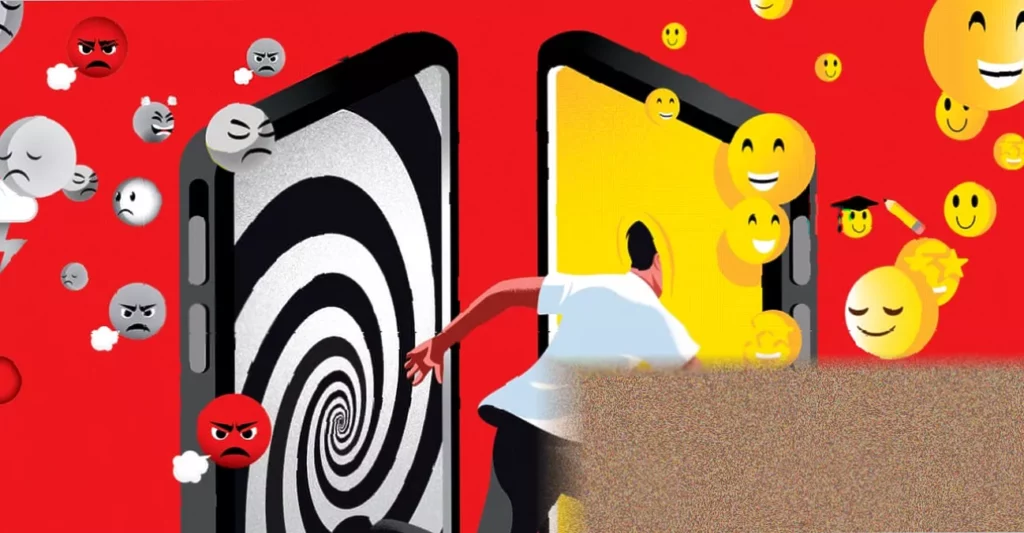
The average UK adult spends roughly seven and a half hours a day staring at a screen – a figure that may well be an undercount, particularly for those whose jobs demand constant connectivity. Yet the instinct to condemn all that screen time as inherently harmful misses a crucial point: usage, not duration, determines the impact. As Keza MacDonald, video games editor at the Guardian and author of Super Nintendo: How One Japanese Company Helped the World Have Fun, puts it: “Not all screen time is created equal.”
The difference lies in the quality of engagement and, above all, in whether you feel in control. Netta Weinstein, a psychology professor at the University of Reading, draws a clear line between two modes: harmonious use and compulsive use. When you make a conscious choice to watch, play or connect, and you feel able to stop when you want, that kind of screen time can support wellbeing. Compulsive use – the inability to tear yourself away, or turning to a screen to avoid other parts of life – tends to do the opposite. “It’s very easy to pick up your phone and spend 40 minutes bouncing between apps and doing nothing in particular,” says MacDonald. “You’re not looking for an experience; you’re just filling time.”
That distinction is backed by research led by Professor Andrew Przybylski, a psychologist at the University of Oxford who studies social media and gaming. His survey of nearly 40,000 players found that gaming itself was not linked to poorer mental health. What mattered was why they played. Those who logged on because they wanted to reported better wellbeing; those who felt compelled – by reward loops, constant notifications or fear of missing out among peers – experienced worse outcomes. “The reason you’re playing is the key factor,” Przybylski said.
Tanay Katiyar, a PhD student in cognition and brain science at the University of Cambridge, frames the debate in evolutionary terms. Our brains, he suggests, were not built for today’s digital environments – a concept known as “evolutionary mismatch”. But he adds that much of modern life falls into the same category. “Technology can solve problems, but it also introduces new ones,” Katiyar notes. Screens are not the enemy; how we use them is what counts.
Active engagement versus passive consumption
Gaming is often written off as a waste of time, but the evidence suggests otherwise – provided the motivation is right. Strategy, action and open‑world games such as Pokémon Go, Red Dead Redemption and Animal Crossing have been shown to support problem‑solving, coordination and neuroplasticity – the brain’s ability to rewire itself as it learns. Multiplayer titles like World of Warcraft can build genuine friendships and communities across the globe. The key, again, is intentionality. MacDonald recommends a simple check‑in each time you log on: “Ask yourself whether this is truly how you want to spend your time.” Play itself is valuable for adults, she argues – it can lower cortisol, trigger dopamine and endorphin release, boost mood and motivation. Research indicates that adults who regularly engage in playful activities report higher levels of life satisfaction.
Swapping passive scrolling for word games offers a more active form of screen use. Puzzles such as Wordle, Words With Friends and Wordiply engage memory, attention and problem‑solving. Frequent engagement with word puzzles is linked to better cognitive function, particularly in memory, focus and processing speed – how quickly your brain can take in and respond to information. Unlike the mindless flick through short‑form videos, these activities demand concentration and build skills over time.
Connection and community represent another positive dimension. Platforms such as Reddit, WhatsApp, Instagram, Mumsnet and dating apps like Hinge are easy to criticise, says Weinstein, but “the digital world can offer opportunities to make connections, build communities and feel understood”. That matters at a time when nearly half of British adults report experiencing loneliness – a condition linked to a 27% higher risk of mortality. For marginalised groups, including racial, sexual and gender minorities, the value is especially pronounced. Research suggests LGBTQIA+ social media users across all age groups find these platforms valuable for embracing their identity, fostering joy and hope for the future; many say it is easier to be themselves online than offline. Even simple video and text chats can help children who feel anxious about speaking to people in real life. But Przybylski warns: “Ask yourself whether you’re using these platforms for positive, engaging or thought‑provoking reasons – or are you feeling angry and looking to argue with a stranger online? Use these tools with purpose.”
By contrast, passive doomscrolling – the excessive consumption of negative news online – can fuel anxiety and stress. The choice between active and passive use is, at root, a choice about control.
From consumption to creation and learning
Perhaps the most transformative way to use a screen is to create, not just consume. In 2010, at the age of 72, David Hockney turned to his iPad as a new canvas, using an Apple Pencil and the Brushes app to produce works as vivid as his traditional paintings. When critics dismissed the medium as a gadget, he retorted: “So is a paintbrush.” Creative tools – from Canva and Soundtrap to coding platforms, video‑editing software, and even writing in Microsoft Word – have made creative expression instantaneous and accessible. They can induce a state of flow, a deeply focused mental space where time seems to fall away and stress drops. Practised regularly, creative activities boost self‑esteem, help process emotion and sharpen learning. A study of toddlers aged two to three found that finger‑painting on a tablet enabled them to produce more diverse marks than traditional materials, potentially aiding the development of writing and drawing skills.
Learning, too, has been transformed. Screens make education available any time, anywhere – complementing, if not replacing, the value of a good teacher physically present. Dr Alan Wong, senior lecturer in psychology at the University of Surrey, notes that digital tools are especially effective for practising foundational skills that require repetition. Malcolm Gladwell’s 10,000‑hour rule for mastery becomes more achievable when spare minutes on the bus or between meetings can become genuine progress. Language‑learning platforms such as Duolingo turn short bursts into cumulative, rewarding experiences, adjusting difficulty in real time and breaking information into digestible chunks. Others, like Simply Piano, offer real‑time feedback and personalised lessons; Skillshare provides classes in graphic design and animation; MasterClass and Create Academy develop creative interests (including a new course from Maria Speake of salvage business Retrouvious on designing with reclaimed materials). For structured learning, medical scientist Dr Federica Amati leads a six‑week course on nutrition science at Imperial Business School.
Not all digital learning is equal, cautions Dr Tamara Russell, a neuroscientist and clinical psychologist. A well‑designed app uses gamification, audio, animation and progress tracking to keep learners engaged – especially those who struggle to focus. “Gamification works for everybody,” Russell says, “but it can be particularly helpful for brains that are very hungry for dopamine, such as those with ADHD, in order to stay engaged.” The best results, she adds, come from knowing yourself as a learner: considering not just what you want to learn, but which device and environment help you absorb information most effectively. A mindfulness practice, she recommends, can help you notice where your attention naturally settles into its deepest focus.