

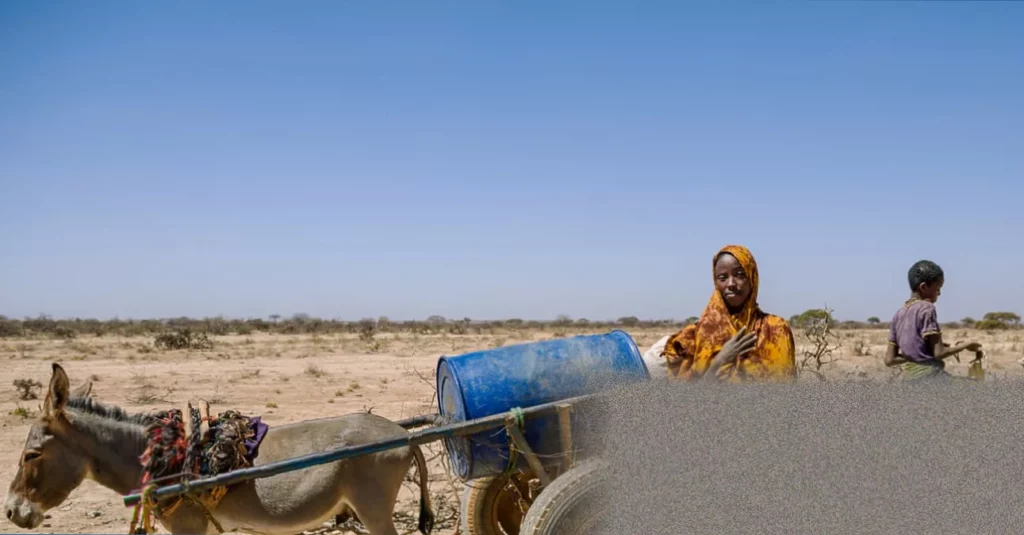
Children’s early years are being fundamentally disrupted by the accelerating impacts of climate change, according to leading child development experts who warn that impairments suffered in infancy can echo throughout a lifetime and even be passed to future generations.
Droughts, flooding, food insecurity, displacement and extreme heat are already undermining children’s nutrition, learning, and physical and mental health. The damage is not confined to one region: it is occurring worldwide and will worsen as extreme weather events grow more frequent and severe. For many countries, these impacts threaten to reverse decades of hard-won progress in child health and education.
Research shows that the most formative period of a child’s life — from conception to age five — is uniquely vulnerable to climatic disruption. Extreme heat, for example, has been shown to impair development: studies indicate that children exposed to temperatures above 30°C are significantly less likely to meet developmental milestones for literacy and numeracy. Heat exposure during pregnancy can lead to premature birth, low birth weight and congenital anomalies. Beyond the physical toll, extreme heat exacerbates existing mental health conditions in children and adolescents, raising the risk of post-traumatic stress disorder and depression.
Air pollution poses another profound threat. Children breathe more rapidly than adults and their lungs are still developing, making them acutely susceptible to pollutants. The consequences include acute respiratory infections such as pneumonia, as well as premature birth, low birth weight, asthma and chronic lung disease. In parts of Africa, death rates among children under five linked to air pollution are markedly higher than those in high-income countries.
Extreme weather events — floods, cyclones and hurricanes — compound these risks by disrupting health services, social support systems and education. Millions of children have had their schooling interrupted each year as a result of climate-related disasters. Meanwhile, the broader mental health crisis among young people is worsening, giving rise to what clinicians describe as eco-anxiety, eco-distress and eco-grief — emotional responses ranging from fear and hopelessness to guilt. Although many healthcare professionals report encountering climate-related anxiety in their patients, its recognition and assessment remain inconsistent across mental health services.
The Children and Climate Initiative, a global collaboration of experts based at the Blavatnik School of Government, University of Oxford, has been working to quantify these impacts by merging national datasets on child development with climate data, with a particular focus on low- and middle-income countries. The initiative recently joined the Alliance for Transformative Action on Climate and Health (ATACH), a network of more than 100 countries and 100 non-governmental partners established after COP26 to build climate-resilient and sustainable health systems. The aim is to ensure that the specific vulnerabilities of young children are brought directly into global policy discussions.
Policy inclusion: securing children’s place in climate frameworks
Despite mounting evidence, children are all too often excluded from climate negotiations and policy planning. That pattern was challenged at COP30 in Belém, Brazil, where the Brazilian Ministry of Health — in collaboration with the World Health Organization and the Pan American Health Organization — launched the Belém Health Action Plan (BHAP). Described as the first international climate adaptation framework dedicated exclusively to health, the BHAP provides a roadmap for health ministries to adapt to climate change, with a focus on equity, climate justice and social participation.
Following consultation that included input from the Children and Climate Initiative, children were explicitly included as an important component of the plan. The BHAP outlines concrete actions for countries to address the tangible health impacts of climate change, with an initial commitment of $300 million (USD) from the Climate and Health Funders Coalition to support solutions targeting extreme heat, air pollution and climate-sensitive infectious diseases. To date, more than 40 countries, along with numerous development agencies and civil society organisations, have endorsed the framework.
However, the BHAP has also drawn criticism for its absence of mitigation strategies, with experts calling for a greater emphasis on reducing emissions as the root cause of the crisis. The African Early Childhood Development Network, which works across sub-Saharan Africa to improve outcomes for young children through policy influence and knowledge sharing, has stressed that advocacy for children’s inclusion must become “second nature” for policymakers rather than a constant task for campaigners.
Building future resilience by putting children at the centre
Looking ahead, the coming decades will bring overlapping health crises and formidable adaptation challenges. Experts argue that thinking through how adaptive processes can respond to the needs of the youngest citizens provides both a practical and a moral framework for deciding what actions to prioritise. Declaring the climate crisis a global public health emergency would be a strong start, but foregrounding children in that emergency is vital for future resilience.
In the UK, the government’s strategy for sustainability and climate change in education aims to prepare schools for climate issues, encourage environmental behaviours and equip children with green skills. Policies such as the UK Climate Change Act (2008), the National Adaptation Programme and the commitment to net-zero emissions by 2050 provide a national backdrop. The Royal College of Paediatrics and Child Health has advocated for child health to be central to climate policy development, highlighting that climate change exacerbates existing health inequalities. Initiatives like the National Education Nature Park seek to connect children with nature, foster biodiversity and develop green skills, while efforts to create biophilic schools and deploy smart environmental monitors aim to improve building design and energy efficiency.
Resources and guidance are already available in the UK to help children cope with climate-related distress and anxiety, yet there is a recognised need for better training for mental health professionals to address these concerns consistently. Organisations such as Save the Children UK are partnering with communities to support children and families facing poverty and climate emergencies, placing a strong emphasis on listening to children’s voices and backing community-led solutions.
The challenge is not simply to adapt infrastructure or reduce emissions; it is to ensure that the most vulnerable — those in the earliest stages of life — are not left behind in a rapidly changing world. The evidence is clear: early impairments to development can have lifelong consequences, and some physical harms may even be transmitted across generations. Without deliberate, sustained inclusion of children in climate policy, the progress of recent decades in child health and education will continue to erode. The task now is to make that inclusion instinctive for every policymaker, at every level.