

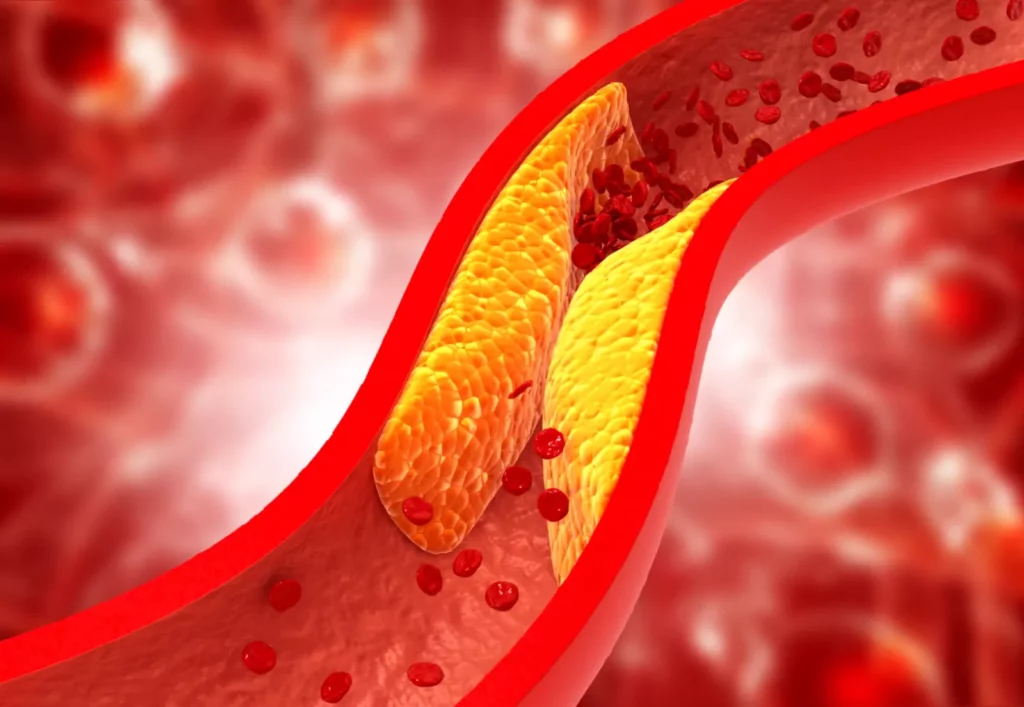
Millions of people carry a hidden form of bad cholesterol that is not picked up by standard blood tests and, until now, has been completely untreatable. Known as lipoprotein(a), or Lp(a), this substance affects up to a quarter of the population and is thought to cause thousands of heart attacks and strokes every year. Yet most patients have no idea they have it — and even when they do, there has been nothing doctors could offer to bring the level down. That is finally changing.
The Hidden Danger of Lp(a)
Cholesterol is a fatty substance transported in the blood, and high levels of ordinary “bad” cholesterol (LDL) are well known to drive the build-up of plaques on artery walls, restricting blood flow and raising the risk of clots that trigger heart attacks and strokes. Statins, diet and exercise can all lower LDL. But Lp(a) operates differently. In a small subset of bad cholesterol particles, the protein covering has a sticky “tail” — a component called apolipoprotein(a) — that makes it far more dangerous. As cardiometabolic physician Dr Michael Albert recently put it: “One particle, several separate roads to a heart attack.”
The sticky tail has three distinct effects: it makes the particles more likely to form plaques, it promotes blood clots, and it makes existing plaques more likely to rupture. High Lp(a) also damages a key valve within the heart and is a major cause of people needing surgery to replace it. Unlike LDL, Lp(a) levels are almost entirely determined by genetics — accounting for 70 to 90 per cent of variation between individuals — and are unaffected by diet, exercise or statin therapy. “Often their cholesterol levels are normal, and they have an otherwise healthy life, but have a very strong family history,” said Professor Marc Dweck, a cardiologist at the University of Edinburgh who co-wrote European guidelines on Lp(a) testing. “A high proportion have high Lp(a).”

Because Lp(a) makes up only a tiny fraction of total bad cholesterol, it does not show up on a normal panel of tests. You could have high Lp(a) while your overall bad cholesterol appears medium or even low. Leading cardiology organisations, including the American Heart Association and the European Atherosclerosis Society, recommend that every adult be tested for Lp(a) at least once in their lifetime. In the UK, HEART UK and The Association for Laboratory Medicine have issued consensus guidance urging measurement in specific groups: anyone with a personal or family history of premature cardiovascular disease (before age 55 for men, 65 for women); first-degree relatives of those with raised Lp(a) above 200 nmol/L; patients with familial hypercholesterolaemia or other inherited lipid conditions; those with calcific aortic valve disease; and individuals with a borderline 10‑year cardiovascular risk of 10 to 15 per cent. A single test is generally sufficient because levels are stable throughout life. Yet the test is not part of routine GP cholesterol checks; it normally has to be ordered by hospital doctors or obtained privately.
Levels vary by ethnicity and sex. People of African descent tend to have higher median levels than those of European or Asian descent. Women’s concentrations are generally five to ten per cent higher than men’s, and they can increase around menopause as oestrogen declines. Overall, about one in five people worldwide — and a similar proportion in the UK — have elevated Lp(a). The condition is present from birth and remains steady.

Why It Matters: The Scale of Risk
High Lp(a) is considered a causal risk factor for atherosclerotic cardiovascular disease. It raises the chance of heart attacks and strokes even when LDL cholesterol, blood pressure and other traditional risk factors are well controlled. It has been linked to premature heart disease (before age 55 in men, 65 in women) and to calcific aortic valve stenosis. Professor Dweck, who also researches the link between Lp(a) and plaque progression, said: “I check it in people who have had recurrent heart attacks at a young age, who don’t have a clear explanation.” The UK government has set a goal to reduce premature deaths from heart disease and strokes by 25 per cent within a decade, but current NHS Health Checks — offered to people aged 40 to 74 — do not include Lp(a) testing. The current NICE guidance on cardiovascular risk assessment (NG238) uses the QRISK3 tool, which does not explicitly incorporate Lp(a). There is a growing call for specific recommendations to be included in future NICE guidance.
New Treatments on the Horizon
For decades, doctors had nothing to offer patients with high Lp(a). The first drugs that modestly reduce it — PCSK9 inhibitors such as evolocumab and alirocumab — have recently become available, but they cut Lp(a) by only 20 to 30 per cent and are not licensed specifically for this purpose. They are offered only to very high‑risk patients, and their effect on cardiovascular risk through Lp(a) reduction alone is still being studied. A more extreme option, lipoprotein apheresis — a blood‑filtering treatment — is available in a few centres but has limited data supporting its benefit for Lp(a) reduction.

The real breakthrough is a second wave of more potent medicines. At least five drugs are undergoing clinical trials. The closest to the clinic is pelacarsen, which reduces Lp(a) by about 80 per cent. Results from a large trial measuring how much it cuts heart attacks and strokes are expected within the next few months. If positive, the drug could be available in the UK within a year or two. “It could be a completely different tool to prevent heart attacks,” said Professor Dweck. Another drug, CTX320, is a form of gene therapy designed to produce long‑lasting effects. “You might be able to move to a once‑in‑a‑lifetime [treatment] with gene editing,” said Professor Kausik Ray, a cardiologist at Imperial College London. Other investigational therapies include olipasiran, a small interfering RNA (siRNA) therapy that targets Lp(a) at the genetic level, and VERVE‑102, a pioneering gene‑editing therapy that uses base‑editing technology to permanently switch off the gene responsible for producing the PCSK9 protein — an approach that, while primarily targeting LDL, demonstrates the potential of gene editing for cardiovascular disease.
The excitement among cardiologists is palpable. “After 60 years of having nothing to offer, that changes,” said Dr Albert. Professor Dweck cautioned that large‑scale trial results are needed before confirming the treatments work, but the fact that so many experimental drugs are in the pipeline is hopeful. As with statins, it is likely that Lp(a) drugs will first be given to people with the highest levels who have already had a heart attack, before being offered more broadly.
In the meantime, individuals who know they have high Lp(a) can still reduce their overall heart risk by traditional routes. “You make sure that everything else is as good as you can get it,” said Professor Dweck — avoiding smoking, controlling weight, managing blood pressure and diabetes. But the first step, as Professor Ray emphasised, is awareness: “If you don’t measure it, you’ve got no idea if it’s high, medium, or low. Your other cholesterol [measurements] don’t give you a clue about it.” International guidance already recommends testing everyone, he added, because it is a powerful way of predicting those at higher risk. For the millions who have this hidden cholesterol, the long wait for treatment may finally be coming to an end.