

Close Menu
    Useful
    • About Us
    • Contact Us
    • Advertise With Us
    • Health Explainers
    • Our Editorial Team
    Facebook
    HealthNewsDaily.co.uk
    • Home
    • NHS

      Patient spends £62,851 on height increase surgery to 6ft despite agonising and potentially fatal side effects

      3 June 2026

      Four in five frail pensioners missing essential NHS checks due to regional disparities

      3 June 2026

      Critical care patients at King’s College Hospital given new rooftop garden

      31 May 2026

      Resident doctors in England plan four-day June walkout

      27 May 2026

      New surgical assistant caught off guard by relaxed atmosphere in operating theatre

      25 May 2026
    • Health Policy

      Government stops short of promising no further aid cuts in letter to parliamentary committee

      3 June 2026

      Anti-abortion activists in NSW signal push to further restrict abortion access

      3 June 2026

      Health officials urged to probe fatalities connected with illicit diet injections

      3 June 2026

      Trial overhaul to provide prostate cancer screening for black men

      2 June 2026

      Asda and Amazon recall children’s sand kits over asbestos risk

      1 June 2026
    • Mental Health

      Federal workers suffer trauma after Trump administration’s unlawful sackings

      3 June 2026

      2026’s monk mode: manosphere trick or imperative

      2 June 2026

      Husband’s rare condition leaves him unable to produce sperm

      31 May 2026

      Diagnosis halted monthly rage attacks that had been tearing my family apart

      31 May 2026

      Nottingham killer’s mother says family tried to get help before triple murder

      29 May 2026
    • Wellness & Lifestyle

      Tenth of employees forgoing meals to afford fuel

      3 June 2026

      Disturbing statistic could bring social media scrolling to a halt

      3 June 2026

      GP stocks five freezer staples to extend life

      2 June 2026

      Doctor pinpoints triggers for after-lunch tiredness and remedies

      2 June 2026

      Peril in dismissing wellness influencers while doctors remain unsure, warns Ranjana Srivastava

      2 June 2026
    • Disease & Prevention

      DRC Ebola outbreak may have started in January, WHO chief suggests

      3 June 2026

      Major US Covid vaccine probe to hear from two UK doctors

      3 June 2026

      At 27 weeks pregnant, mother began chemotherapy and insists she never surrendered

      3 June 2026

      GLP-1 drug use linked to 30% lower breast cancer risk in women

      2 June 2026

      Cause of twin’s sudden 3st weight gain emerged post-mortem

      2 June 2026
    • Treatment & Research

      Poor sleep quality tied to feeling older than one’s actual age

      3 June 2026

      Drug allows bladder cancer patients to avoid surgery, doctors say

      2 June 2026

      Melanoma recurrence could be cut by new vaccine and drug combination

      1 June 2026

      Devi Sridhar: Cancer brings promise, trouble, horror and hope

      1 June 2026

      MHRA seizes 12,000 unlicensed weight-loss medicines in biggest operation to date

      1 June 2026
    HealthNewsDaily.co.uk
    • NHS
    • Health Policy
    • Mental Health
    • Wellness & Lifestyle
    • Disease & Prevention
    • Treatment & Research
    Home » Treatment & Research » Grandfather has UK’s first operation of its kind for brain condition
    Treatment & Research

    Grandfather has UK’s first operation of its kind for brain condition

    Sophie HargreavesBy Sophie Hargreaves19 May 2026
    Surgeon reviewing a 3D-printed model of a patient's skull base and eye socket

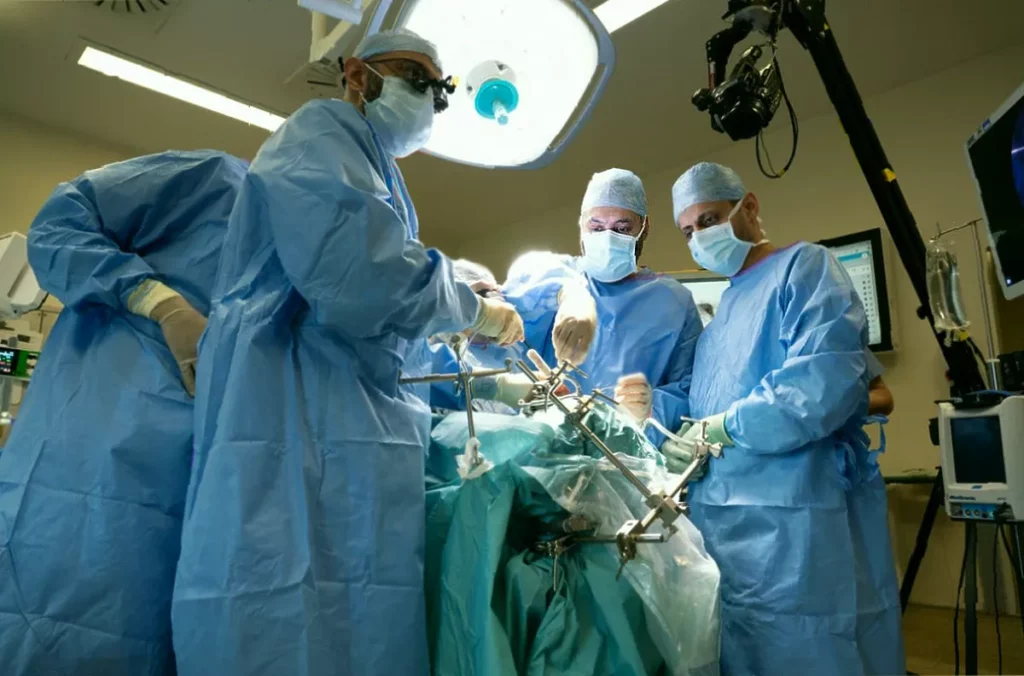
    A pioneering keyhole operation performed through the eye socket is offering patients with brain aneurysms the prospect of a durable, permanent cure while eliminating the most invasive and dangerous elements of traditional brain surgery, neurosurgeons in Leeds have said.

    A Return to Work in Record Time

    Andrew Wood, a 61-year-old builder from West Yorkshire, was back at work just a few weeks after undergoing the procedure in February 2026, having spent only a single night in hospital. His brain aneurysm—a potentially fatal swelling in a blood vessel—was discovered entirely by chance during a scan for an unrelated medical issue in the spring of 2025. “I was shocked. I didn’t have any symptoms whatsoever,” Mr Wood said. The discovery placed him in a high-stakes position: while the aneurysm had not ruptured, the consequences of a rupture are catastrophic, with a 40 per cent chance of death and a 66 per cent chance of some level of brain damage for survivors.

    Navigating the Brain Without Touching It

    In a standard craniotomy, surgeons would have sawed open a section of his skull and physically retracted the brain to reach the aneurysm. This approach carries inherent risks, including stroke, seizures, infection, and a small risk of death, alongside significant scarring and a typical hospital stay of one week. Instead, a team at Leeds Teaching Hospitals NHS Trust accessed the aneurysm through a small incision at the side of the eye and a cut in the outer wall of the eye socket. This UK-first procedure, described as “minimal access surgery” or “keyhole surgery”, allowed direct access to the blood vessel without touching the brain itself. “This meant that we could directly access the aneurysm without even having to touch the brain,” said Consultant Neurosurgeon Asim Sheikh, who led the surgery alongside Consultant Neurosurgeon Kenan Deniz and Consultant Maxillofacial Surgeon Jiten Parmar.

    Engineering Out the Morbidity

    The defining achievement of the operation lies in how it removes the surgical drawbacks typically inseparable from a definitive cure. Traditional clipping—placing a metal clip across the neck of the aneurysm—is the gold standard for durability but has always demanded the trauma of a craniotomy. This new approach severs that link entirely. “And that means he can get the best of both worlds of the surgical treatment of his aneurysm – the best possible, durable cure for his aneurysm while cutting down on the drawbacks of having surgery including big cuts and scars, big incisions on the head and also the morbidity of going through the brain and retracting the brain – all that is completely taken away by this minimal access surgery,” Mr Sheikh explained.

    The morbidity associated with brain retraction has been designed out of the procedure. By using the natural anatomical corridor of the eye socket, surgeons can place the clip on the aneurysm without disturbing or compressing delicate brain tissue. The recovery timeline reflects this advance: Mr Wood returned to his physically demanding job as a builder in May 2026, a recovery unimaginable with open surgery. “I’m in the building trade so the way it was explained to me was: you can do something causing minimum damage and get the same result. I thought it was great,” he said. The meticulous preparation underpinning the operation involved biomechanical engineers creating a bespoke 3D-printed model of Mr Wood’s eye socket, skull base anatomy, and the aneurysm itself, allowing the surgical team to rehearse the complex manoeuvre tailored to his specific anatomy.

    Context of a Rapidly Advancing Field

    The Leeds operation builds on a similar UK-first achieved by the same team in 2024, when they removed a brain tumour through a patient’s eye socket. It represents a broader shift in neurosurgery toward techniques that combine the durability of open surgery with the recovery advantages of endovascular therapy. While endovascular methods—such as coiling, stenting, flow-diverting stents, and the WEB device—have become standard since the International Subarachnoid Aneurysm Trial (ISAT) demonstrated their safety advantages for ruptured aneurysms, they do not always provide the permanent solution that surgical clipping can. The SEATED study, a major UK-wide research project led by King’s College London, is currently tracking outcomes for around 5,000 patients over a decade to address variability in treatment protocols across NHS centres.

    Technological innovations are accelerating these possibilities. Robotic microscopes now offer enhanced precision and novel angles of approach, while mixed reality (MR) navigation—which fuses intraoperative X-rays with external images viewed through MR goggles—provides surgeons with a real-time “inside” view of the patient’s anatomy. These tools are pushing the boundaries of what can be achieved through minimal access, though cost and training remain challenges. For Mr Wood, the choice came down to a simple calculation made possible by that engineering precision. The big incisions are gone. The brain was not moved. He went home the next day and returned to building sites a few weeks later. The drawbacks of surgery, in his case, were removed entirely.

    Hospitals Stroke
    Share. Facebook Twitter LinkedIn WhatsApp Telegram
    Sophie Hargreaves
    Sophie Hargreaves

    Health Correspondent
    Sophie Hargreaves covers medical research, new treatments, disease outbreaks and prevention for Health News Daily. She holds a Master's degree in Health Sciences from the University of Leeds and has spent several years translating complex medical science into clear, accessible reporting for a general audience. Sophie focuses on the latest clinical trials, NICE and MHRA approvals, vaccination programmes and emerging health threats, always with an eye on what these developments mean for people in the UK.
    · MSc Health Sciences (University of Leeds), science communication volunteer, medical research literacy
    · Clinical trials and drug approvals (NICE, MHRA), cancer screening programmes, vaccination and outbreak response, women's health (endometriosis, PCOS, menopause), weight management treatments, AI in diagnostics

    Related Posts

    Treatment & Research

    Poor sleep quality tied to feeling older than one’s actual age

    3 June 2026
    Treatment & Research

    Drug allows bladder cancer patients to avoid surgery, doctors say

    2 June 2026
    Treatment & Research

    Melanoma recurrence could be cut by new vaccine and drug combination

    1 June 2026
    Treatment & Research

    Devi Sridhar: Cancer brings promise, trouble, horror and hope

    1 June 2026
    Join Our Community & Win

    Each month we select one lucky follower to receive a prize from our partners. Follow us on our social channels for your chance to win.

    • Facebook
    Latest
    Disease & Prevention

    DRC Ebola outbreak may have started in January, WHO chief suggests

    3 June 2026
    Wellness & Lifestyle

    Tenth of employees forgoing meals to afford fuel

    3 June 2026
    Health Policy

    Government stops short of promising no further aid cuts in letter to parliamentary committee

    3 June 2026
    NHS

    Patient spends £62,851 on height increase surgery to 6ft despite agonising and potentially fatal side effects

    3 June 2026
    Health Policy

    Anti-abortion activists in NSW signal push to further restrict abortion access

    3 June 2026
    Disease & Prevention

    Major US Covid vaccine probe to hear from two UK doctors

    3 June 2026
    News Categories
    • NHS
    • Health Policy
    • Mental Health
    • Wellness & Lifestyle
    • Disease & Prevention
    • Treatment & Research
    Help
    • About Us
    • Contact Us
    • Advertise With Us
    • Health Explainers
    • Our Editorial Team
    About Us
    About Us

    Health News Daily provides trusted UK health news, covering NHS updates, medical research, public health and wellbeing with clear and reliable reporting.

    Facebook
    • Cookie Policy
    • Privacy Policy
    • Complaints Policy
    • Corrections Policy
    • AI Disclosure Policy
    • Editorial Policy & Ethics
    • Accessibility Statement
    • Medical Disclaimer
    • Terms & Conditions
    • Sponsored Content Disclosure
    • Copyright Notice
    © 2026 Healthnewsdaily.co.uk. All rights reserved.

    Type above and press Enter to search. Press Esc to cancel.