

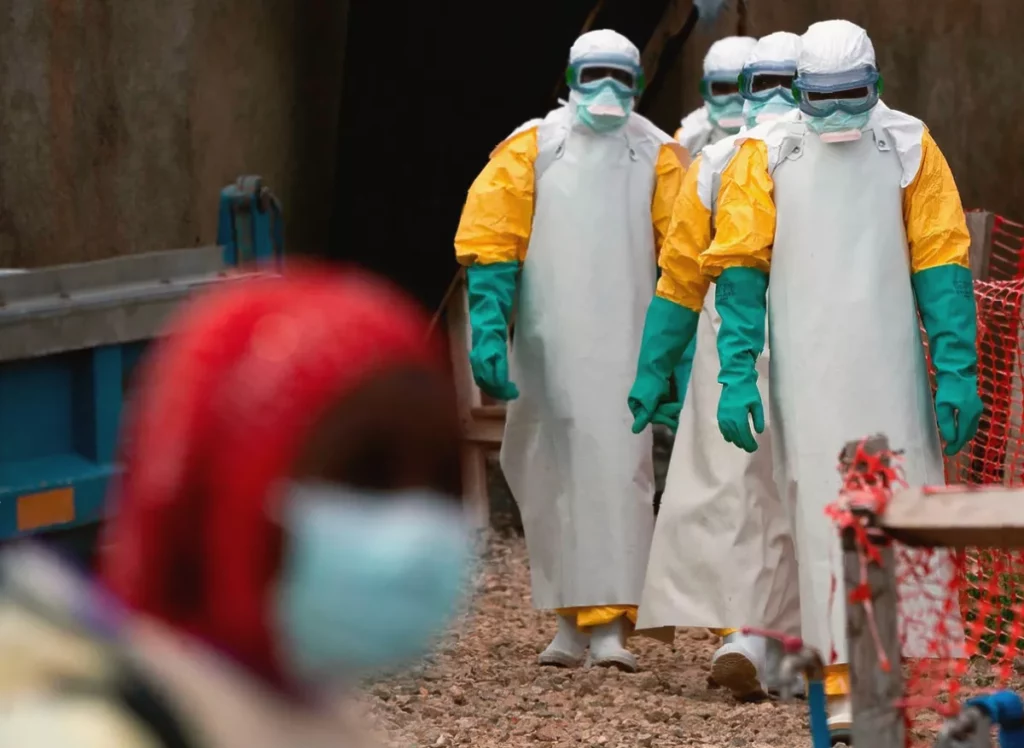
An Ebola outbreak spreading through eastern Democratic Republic of Congo (DRC) has been directly linked to deep cuts in UK and US foreign aid, with a former British Africa minister warning the crisis is a “canary in the coal mine” for global pandemic preparedness. Rory Stewart, who served as the UK’s Africa minister during the last major Ebola outbreak in 2018, said the connection between the dismantling of aid programmes and the resurgence of deadly diseases was “very strong”. The outbreak is caused by the Bundibugyo strain of Ebola, a rarer variant for which there is no approved vaccine or targeted treatment, leaving health workers “flying blind” according to one expert.
Outbreak Scale and Detection Delays
The Africa Centres for Disease Control and Prevention (Africa CDC) has reported more than 390 suspected cases and at least 100 deaths across Ituri province in eastern DRC. Jean Kaseya, the agency’s director general, said the outbreak carries a high risk of regional spread. The DRC’s Ministry of Public Health, which officially declared the outbreak on May 15, later reported eight laboratory-confirmed cases and 246 suspected cases as of May 16, with the death toll rising to 87 by the following day. Cases have also been detected in neighbouring Uganda, which has confirmed two infections including one death, and the virus has reached the capitals of both countries – Kinshasa and Kampala. The World Health Organization (WHO) declared the outbreak a “public health emergency of international concern” on May 17. Uganda’s health authorities say there is no evidence of local transmission, but Rwanda and South Sudan are on high alert, with South Sudan issuing an Ebola alert and Rwanda maintaining heightened surveillance at entry points.
The outbreak was significantly slower to be detected than it should have been. The first suspected case, a nurse, reported symptoms on April 24, but the strain was not officially identified until May 14 – a three-week gap that allowed the virus to spread. Initial laboratory tests used cartridges designed for the wrong Ebola strain, delaying confirmation. Jean Pierre Badombo, the former mayor of Mongbwalu, a mining town at the epicentre, said people began falling ill in April after a large open-casket funeral procession. “After that, we experienced a cascade of deaths,” he told Reuters. At least four health workers have died with symptoms suggestive of viral haemorrhagic fever, raising fears of healthcare-associated transmission.
The Impact of Aid Cuts on Pandemic Preparedness
The delayed detection and escalating spread of the outbreak have been widely attributed to the sweeping reduction in foreign aid by the United States and the United Kingdom. In the US, the Trump administration dismantled the United States Agency for International Development (USAID), terminating approximately 5,800 out of 6,200 multiyear contracts and grants – a reduction of $54 billion in foreign assistance. Overall US foreign assistance spending fell by nearly 57 per cent, cutting off funding for laboratory networks, disease surveillance programmes and emergency response capacity across Africa. Earlier this month, the administration began plans to divert a further $2 billion in global health funding to cover the costs of shutting down USAID operations overseas.
Jeremy Konyndyk, a former USAID official who led the agency’s Covid-19 response, said: “The dismantling of US-funded health programming in DRC … is likely a big factor in why this outbreak was detected so late.” He warned that the WHO was now “reeling” after the US withdrew all funding, cutting the agency’s emergency health budget by 37 per cent and forcing it to lay off thousands of staff. “Its emergency contingency fund is close to empty,” Konyndyk said. “Tough starting point to mount a major response.” The WHO has nonetheless dispatched five tonnes of medical supplies to the DRC and released $500,000 from its contingency fund.
In the UK, billions of pounds have been cut from aid spending as the budget falls from 0.5 per cent to 0.3 per cent of Gross National Income (GNI) to fund increased defence spending. Previous UK reductions have already led to the closure of health facilities, unpaid health workers, and restricted access to lifesaving care in countries such as South Sudan. Analysis by Save the Children UK suggests the latest cuts could mean fewer women and girls receiving support for family planning and nutrition. Rory Stewart said the cuts have “huge impacts, particularly on things like global health”. He added: “Pandemic preparedness – in other words, dealing with an Ebola outbreak or even a new version of a Covid outbreak – requires lots of people on the ground in places like DRC or Uganda who are able to detect cases, respond to them, quarantine and prepare responses. And it’s all the infrastructure behind that which is being undermined at the moment. And that’s a real threat, of course, to the world.”
Expert Warnings: ‘Flying Blind’ Against a Dangerous Strain
The Bundibugyo strain of Ebola is particularly concerning because it has no licensed vaccine or specific targeted treatment, unlike the more common Zaire ebolavirus. The virus has caused only two previous outbreaks – in Uganda (2007–2008) and the DRC (2012) – and its epidemiology remains poorly understood. The case fatality rate in past outbreaks ranged from 30 per cent to 50 per cent. Jennifer Nuzzo, director of the Pandemic Centre at Brown University, said the relative lack of treatments and scientific understanding meant researchers were “flying blind and fighting the virus with both arms tied behind our backs”. She added that the outbreak bore “the cumulative effects of cuts to a number of global health programmes, which have reduced the people and attention given to public health threats”. Lawrence Gostin, university professor at Georgetown, agreed that the situation shows “all the characteristics of weakened health systems, including very late detection, ongoing uncontrolled spread and deep distrust of public health workers”.
Emma Thompson, clinical professor of infectious diseases, stressed that Bundibugyo virus disease is not a mild infection, and Natsuko Imai, research lead at Wellcome, highlighted the absence of approved vaccines, therapeutics and even adequate diagnostics for this strain. Insecurity in the affected areas of Ituri province is further hampering contact tracing and response efforts, while movement restrictions and deep community distrust add to the challenges. Rory Stewart warned that the outbreak should serve as a stark signal. “I’m not trying to start a scare in Britain around this outbreak,” he said, “but what I’m hoping will happen is people will see this and realise how dangerous this is, and how much risk we’re taking by not dealing with it more directly.”