

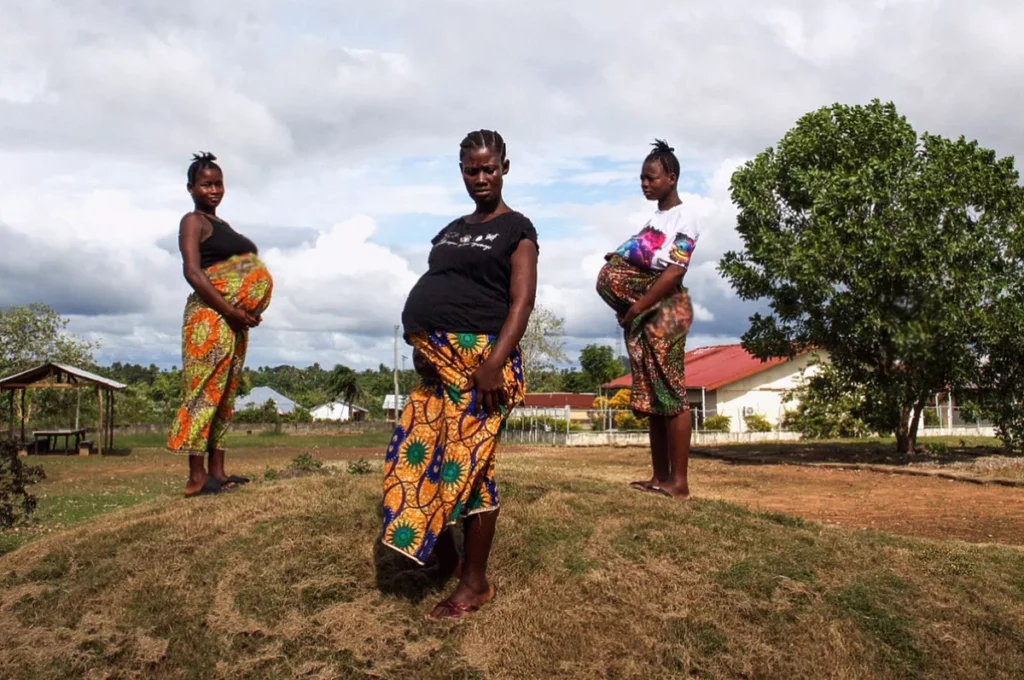
Every week, teenage girls in Sierra Leone’s Tonkolili District walk miles to crowd into two small rooms – not for a classroom lesson, but for a lifeline. Inside the Adolescent Friendly Centre (AFC), they sit shoulder-to-shoulder on plastic chairs and talk openly about menstruation, contraception and consent, subjects their mothers were often never allowed to discuss. For these young women, the centre has become a rare safe space where they are listened to, and where vital health education is changing the course of their lives.
Centre’s Impact: A Sanctuary for Knowledge and Agency
Mamah, 21, describes the centre as indispensable. “If this centre didn’t exist, it would be a problem for girls,” she says. Now studying mass communications at university and training as a journalist through the AFC, she recalls her own upbringing: “Growing up, all I knew is that when someone said ‘let’s do this’, I’d say ‘okay.’ Most parents don’t have time to sit with their daughters and tell them what to avoid. Not having this centre would lead to more girls dropping out of school, getting pregnant at an early age, being forced into early marriage, not knowing their rights, when to say no and when to give consent.”
The centre, run by Plan International after Medecins Sans Frontieres (MSF) Holland handed it over in March 2025, offers free counselling, STI treatment and family planning advice. Abdulai Tunkara, who manages the AFC for Plan International, says adolescents arrive with information about sexual health that is often wrong and sometimes dangerous. Some girls believe menstruation makes them “unclean”; others rely on peer misinformation about contraception. Many have no money for menstrual products or family planning services and are reluctant to visit formal health facilities where they would have to pay. At the centre, young people have started bringing friends and younger siblings with them.
Amida*, 13, attends after school. She says girls in her community were once expected to remain at home while boys were educated. “Now, both boys and girls can go to school and a girl has a right to choose her partner for herself,” she says. She hopes to become a teacher because so few female teachers exist in her community. Fatmata, 29, who works with a community organisation that partners closely with the centre, understands how unusual that aspiration remains. Her elder sister was married at 15, her other at 17. “In my community, they believe that for girls, marriage is better than education. With marriage, it is believed you bring more dignity to your family,” she says. She went to university anyway, with her mother selling goods to cover fees, and is now pursuing a degree in business administration. “I wanted to show girls in the community that no matter what circumstance you are facing, whether you are poor or rich, you just need to pursue an education.”
Mariatu Fofanah, 59, a pastor and teacher and the only woman among 30 school principals in the district, recalls her own experience. When she was 14, her uncles told her father she was too old and should be married. She resisted, but knows what that pressure costs most girls. “Here, parents don’t guide their children about their bodies. Menstruation is not handled at all. If they are lucky, parents mention one or two things in passing,” she says. In the community, menstruation is treated as contamination, and some girls stop going to school entirely. She remembers asking her mother if babies came out of the belly button: “She laughed and told me a proverb.” The AFC is trying to close that knowledge gap, both clinically and socially, but the need far outstrips its resources.
The Challenges That Remain
Across Sierra Leone, child marriage and teenage pregnancy remain deeply entrenched. According to government data, 30 per cent of girls marry or enter unions before turning 18. Research from 2015 indicated that nearly 40 per cent of girls were married before their 18th birthday, with 13 per cent married before they turned 15. A 2019 Sierra Leone Demographic and Health Survey found a teenage pregnancy prevalence of 22.1 per cent. By 2025, 28 per cent of girls aged 15 to 19 were reported as either pregnant or already mothers, a figure that rises to nearly half in Pujehun district. Adolescents make up about 22 per cent of the country’s population, and 21 per cent of girls aged 15 to 19 are pregnant or parenting, with nearly half of adolescent girls anaemic.
The consequences are devastating. Up to 40 per cent of maternal deaths occur among teenagers. Sierra Leone has one of the highest maternal mortality rates in the world, with 1,360 mothers dying per 100,000 live births. The lifetime risk of maternal death is one in 52, and that risk is even greater for adolescents. More than two-thirds of maternal deaths result from haemorrhage, hypertension and sepsis, while roughly a third are linked to unsafe abortions, particularly among adolescents. Girls from the poorest households are 2.5 times more likely to experience teenage pregnancy than those from the richest, and married girls have approximately 15 times higher odds. Child marriage is more common in rural areas – 42 per cent of girls compared with 19 per cent in urban areas – and is driven by poverty, social pressure, low literacy, low contraceptive uptake, unmet family planning needs and a lack of comprehensive sexuality education. Female genital mutilation, affecting 90 per cent of women, adds further psychological and physical trauma; 33.7 per cent of women aged 18 to 49 have undergone both child marriage and FGM.
Sierra Leone’s government has taken steps to address the crisis. The Prohibition of Child Marriage Act, passed in 2024, makes marriage for anyone under 18 a criminal offense punishable by up to 15 years in prison or a fine of around $4,000. It also amends existing legislation and designates officials to raise awareness about the risks. An earlier act introduced in 2021 allows pregnant girls to return to school. In 2016, the country committed to eliminating child marriage by 2030. Yet in rural areas, girls still face severe barriers to education, and the legal framework has not shifted deeply entrenched social norms.
The AFC itself is struggling to meet demand. Its two cramped rooms house three ageing computers, often shared in pairs, while others wait for lessons on sexual health, life skills and technology. Staff say the growing number of young people seeking help has stretched the building beyond capacity, with only one shared toilet serving the entire centre.
Funding Concerns: A Fragile Lifeline
MSF Holland ran the centre from 2019, when it opened to tackle rising rates of teenage pregnancy and unsafe abortions. In early 2025, as the Trump administration slashed the US aid budget and reproductive health funding, MSF withdrew from Sierra Leone altogether. The decision came amid multiple global crises – war in Gaza, Ukraine and South Sudan, and a hunger crisis across swathes of Africa. MSF formally handed the AFC to Plan International in March 2025, but full services did not resume until September, leaving a six-month gap during which adolescents in Tonkolili had nowhere to go for reproductive health support. Funding for the centre, from a foundation, is secured only until spring 2028.
The broader picture for health aid in Sierra Leone is worsening. The US Agency for International Development (USAID) abruptly ceased aid in January 2025, leading to a $45 million reduction in funding for maternal, child and adolescent health projects. In 2024, the US provided $3.2 million to Sierra Leone’s reproductive health sector – about 14 per cent of overall funding. Cuts have already caused shortages of critical supplies such as sutures and anaesthetic agents, impacting emergency C-sections and other vital procedures.
The UK government is also pulling back. Its plan to reduce the global development budget to 0.3 per cent of Gross National Income by 2027 has led to a £35 million Saving Lives in Sierra Leone Phase 3 grant for reproductive, maternal, newborn and child health being slashed to under £1 million by 2026 before closing entirely. A separate component delivered by UNICEF, which supplied crucial medicines for pregnancy and childbirth and established special care units for newborns, is also ending. The UK’s Foreign, Commonwealth and Development Office (FCDO) has suggested Britain is likely to stop delivering aid programmes with health objectives in Sierra Leone altogether. These cuts represent the first clear example of a country-specific impact from the UK’s 40 per cent reduction in development spending, with the government prioritising humanitarian support for Gaza, Ukraine and Sudan and contributions to large international funds like Gavi and the Global Fund. MPs have warned that cuts to British aid have directly caused a rise in worldwide deaths during pregnancy and childbirth.
Sierra Leone’s Ministry of Health cannot sustain the centre alone, according to staff and activists. The country depends heavily on foreign aid to fund essential services, with a GDP per capita of $874 and 25 per cent of its population living in extreme poverty. The healthcare system has only two skilled providers per 10,000 people, and facilities often lack electricity and running water. Maternal deaths frequently occur within health facilities, indicating issues with quality of care and delayed referrals.
Abdulai Tunkara fears the centre may become a story about what once existed, rather than what could still be possible. “What if we reach a point where there is no funding to run free family planning and free STI treatment?” he asks. “What would be the fate of the adolescents? Where can they get the money to afford this?”
*Names changed to protect identities