

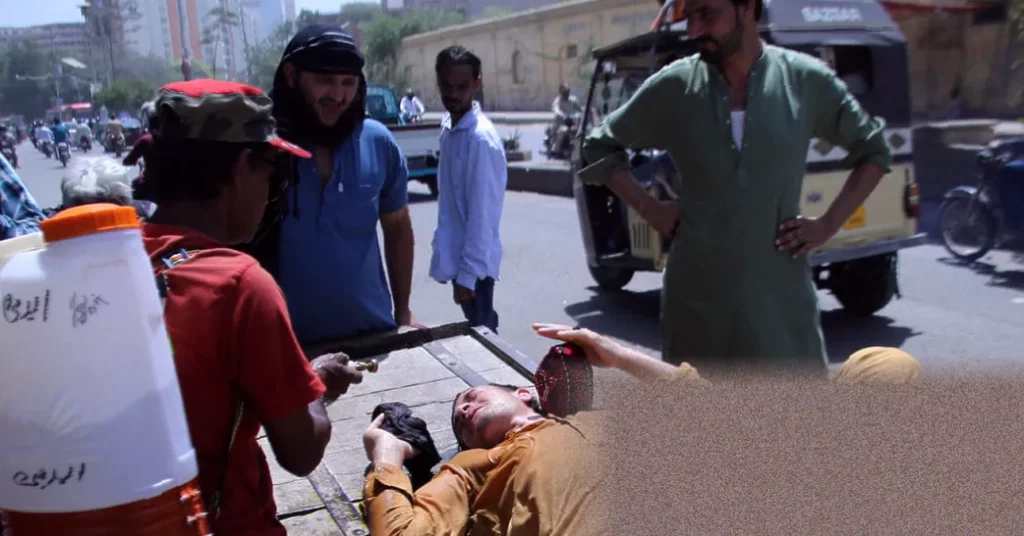
Karachi’s heatwave is the city’s worst since 2018, with the mercury hitting 44.1°C this month – the highest reading since 46°C was recorded on 31 May 2018, according to the Pakistan Meteorological Department (PMD). The PMD has warned that hotter days may still lie ahead as an intense and prolonged heatwave continues to inflict misery across southern Pakistan and northern India.
Health toll mounts as heat overwhelms communities
The impact has been most acute in Karachi’s coastal settlements, where the combination of extreme heat, prolonged electricity outages and acute water shortages has tested the limits of daily survival. In Ibrahim Hyderi, one of the city’s largest fishing communities, residents say conditions are becoming ever more perilous. Abdul Sattar, a fisherman with more than three decades of experience, described how a colleague collapsed from heat exhaustion during the latest hot spell. “We gave him lemon water and rushed him to a doctor,” he said. “He regained consciousness after receiving intravenous fluids.” The community still carries painful memories of Karachi’s catastrophic 2015 heatwave, which killed thousands across the city, including several fishers from Ibrahim Hyderi. More recently, heat-related deaths reported during the summer of 2024 underscored Karachi’s persistent vulnerability.
Official figures show that at least 10 deaths have been recorded in Karachi during the current heatwave. But local health experts and relief agencies often cite tallies significantly higher than government numbers, a pattern that has marked previous crises. In June 2024, more than 568 deaths were reported across Pakistan, 427 of them in Karachi alone. The Edhi Foundation said it received dozens of bodies daily and that morgues ran out of freezer space. At Civil Hospital Karachi, 267 people were admitted with heatstroke between 23 and 26 June last year, and 12 died. The 2015 disaster left morgues overflowing and ambulances carrying decaying corpses as temperatures in the city hit 45°C and Sindh province baked under 48°C.
The strain on healthcare facilities is now visible again. Dr Suresh Kumar, who heads the children’s ward at Ibrahim Hyderi government hospital, said the number of children visiting the outpatient department has risen sharply since the last week of April. “On normal days, we would see around 50 to 60 children,” he said. “Now the number has crossed 200 daily.” Most of these young patients are being treated for diarrhoea, stomach infections and dehydration – illnesses commonly linked to extreme heat and unsafe water. Across the city, other hospitals are also reporting surges. Abbasi Shaheed Hospital has recorded dozens of heat-related cases each day, Ibrahim Hyderi Hospital is seeing 50–60 patients daily, and New Karachi Hospital has reported 70–80 admissions.
Children and older adults remain the most vulnerable, alongside the urban and rural poor, people with disabilities, the unhoused and outdoor workers such as labourers, transport workers and farming communities. Prolonged power cuts – which in some areas last 12 to 18 hours – turn homes into unbearable heat traps, according to residents. K-Electric has been criticised for refusing to halt load-shedding during extreme heat. The water crisis is equally dire: Karachi faces a daily shortfall of around 40 million gallons, forcing residents to buy from private tankers at exploitative rates. Food spoils quickly, clean water becomes harder to secure, and the mental strain – sleeplessness, anxiety – is increasingly reported. For pregnant and breastfeeding women, poor nutrition poses additional risks.
Climate crisis deepens the danger
Climate experts say the current heatwave is no freak event but part of a worsening long-term trend. A study by the World Weather Attribution (WWA) group found that human-caused climate change has approximately tripled the probability of a heatwave of this intensity. The same event, WWA concluded, would have been about 1°C cooler in a pre-industrial climate. Multiple WWA analyses have quantified the shift, with some indicating that South Asian heatwaves are now 30 to 45 times more likely and between 0.85°C and 2°C hotter than they would have been before widespread industrialisation. The group describes such extreme heat as “no longer exceptional in today’s climate” – a regular reality rather than a rare emergency.
According to the PMD, average temperatures across the region have risen by approximately 1.4°C, while Sindh alone has experienced an increase of around 1.7°C in recent decades. Winters are becoming shorter, and summers are growing longer, harsher and more unpredictable. In Karachi, the urban heat island (UHI) effect magnifies the threat. Buildings, roads and other infrastructure absorb and re-emit heat, while the city’s shrinking tree cover and loss of natural landscapes have weakened its natural cooling systems. Urban expansion has come at the expense of vegetation, with a significant decline in green spaces. This means heatwaves last longer and feel more intense, especially at night – the nocturnal UHI magnitude is often higher than the daytime effect.
Yasir Darya, founder of the Climate Action Center, pointed out that Karachi’s humidity often makes temperatures below 40°C feel significantly hotter. “The intensity of heat has sharply increased since 2024,” he said. Warm nights, once rare, are becoming frequent, affecting sleep, health and overall living conditions. Darya warned that the city lacks sufficient cooling centres and public heat-relief infrastructure, and that shrinking tree cover is worsening exposure for vulnerable populations. Karachi’s atmosphere also carries a heavy annual pollution burden from vehicular and industrial emissions, further contributing to global warming and degrading air quality.
Urgent remedies and missing safeguards
Climate specialists are calling for immediate interventions: public cooling centres, expanded access to drinking water, enhanced emergency medical preparedness and large-scale urban tree plantation drives. Directives have already been issued for public awareness campaigns about heatwave risks. But many critics point to chronic governance failings, administrative mismanagement and a lack of adequate data. Pakistan collects insufficient mortality data on climate disaster impacts, limiting its ability to respond effectively. Existing Heat Action Plans have significant gaps, and heatwaves have not been formally classified as a notified disaster – a step that would unlock dedicated relief funding.
Longer-term measures include expanding social protection, completing water infrastructure projects such as the K-IV scheme, and restoring reliable piped water supplies. Urban planners emphasise the importance of planting trees and creating green spaces in vacant areas, alongside pedestrian-centric design, to make Karachi more comfortable and resilient. For the residents of Sindh, however, the crisis is no longer a warning about the future. It is already reshaping everyday life – turning extreme heat from a seasonal hardship into a persistent struggle for survival.