

A rare rodent-borne virus outbreak aboard a cruise ship was identified within 24 hours, after a team of South African infectious disease experts raced to diagnose a critically ill British passenger evacuated from the vessel.
The alert reached Dr Lucille Blumberg, a specialist at South Africa’s National Institute for Communicable Diseases (NICD), on the morning of 1 May, a public holiday in the country. A UK-based colleague who monitors diseases in remote British overseas territories in the South Atlantic had written to say a passenger from a cruise ship thousands of miles away had been flown to a Johannesburg hospital with suspected pneumonia. Others on the vessel were also sick. “Even though it was a public holiday, we moved, we moved really fast,” Blumberg said. “It was busy. There were many conversations. There were online discussions, and there was laboratory testing happening at the time.”
Process of elimination
At first, Blumberg and her colleagues suspected Legionella bacteria, which causes the serious form of pneumonia known as Legionnaires’ disease and is well documented in outbreaks on cruise ships and in hotels. Influenza was another obvious candidate, given that passengers had visited islands where avian influenza is well documented. “I called my infectious disease colleagues, and we had a caucus, and we discussed the usual ones,” Blumberg said. “Legionella is well described in outbreaks in hotels and on cruise ships, and influenza certainly is. These people had visited islands where avian influenza is well documented.”
But tests for both came back negative. The team then ran an extensive panel of tests for other respiratory diseases. All were negative. That left the experts looking for a less common cause. They began examining the ship’s route: the MV Hondius, a Dutch-flagged expedition cruise vessel operated by Oceanwide Expeditions, had started its voyage in Ushuaia, Argentina, on 1 April. Passengers were avid bird watchers and had reportedly visited parts of South America where birds were present — but also rodents.
That pushed the diagnosis towards a rare, rodent-borne hantavirus infection, which is well described — though not common — in Chile and Argentina. “It’s a well-described, not common, but it’s a well-described virus in Chile and Argentina,” Blumberg said. She noted that their work was aided by collaboration with hantavirus experts from South America and the United States, facilitated by the World Health Organization (WHO). “You can get onto a Zoom online and ask your questions and get advice. This is not something every day. So that was quite extraordinary,” she added.
Diagnosis confirmed within a day
By Saturday morning, Blumberg had called the head of the only laboratory in South Africa capable of testing for hantavirus. “I said, we want to do hanta, and she said, ‘yeah, I’m coming.’” Tests carried out on the sick man’s blood samples came back positive that afternoon. The team performed a second set of tests to be absolutely certain, Blumberg said. Those positive results also identified the Andes strain of hantavirus, a particularly dangerous variant.
The identification allowed the WHO to inform the cruise ship of the outbreak and to make a public announcement. The test results also spurred Blumberg to rush to collect blood samples from a Dutch woman who had been among the first two passengers to die. She had disembarked with her husband’s body on the island of St Helena and flown to South Africa, where she died. A posthumous test on her was also positive. “It was a bit of a wow moment,” Blumberg said. “And at least once you know what you’re dealing with, it’s much easier to respond.”
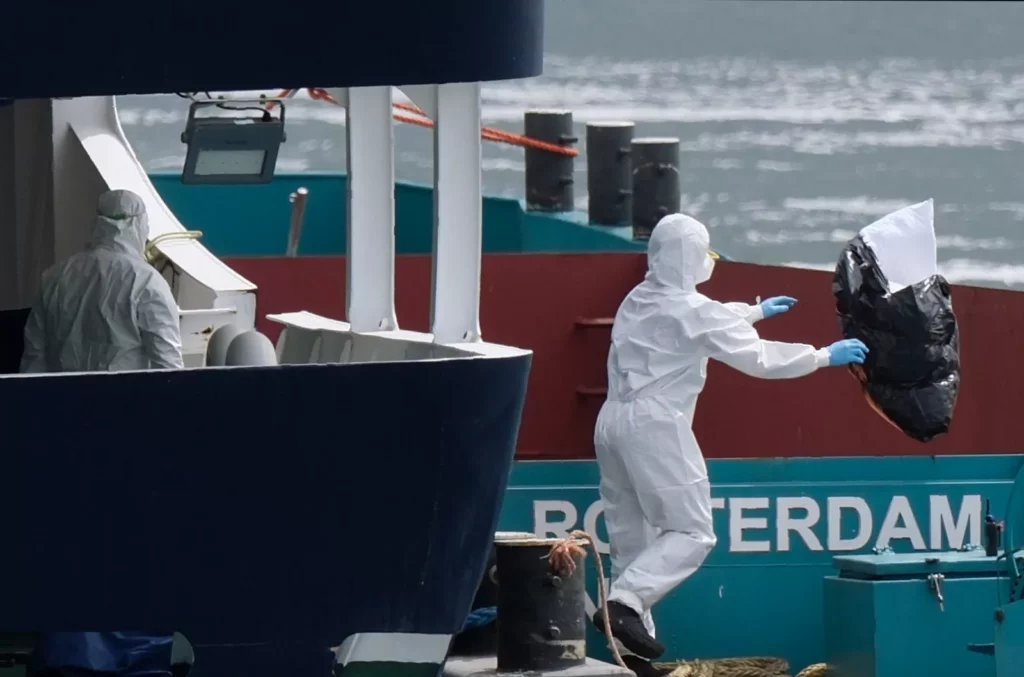
The British man who was the first confirmed case is improving in hospital, South Africa’s health ministry has said. The ship eventually docked in Rotterdam, where it was disinfected and the remaining crew disembarked.
The virus and its implications
Andes hantavirus (ANDV) is primarily found in South America, specifically Chile and Argentina. Rodents carrying this virus have not been found in the United States or Europe. Transmission from rodents to humans occurs mainly through inhalation of aerosolised particles from infected rodent urine, faeces or saliva — often when habitats are disturbed. Crucially, ANDV is the only known hantavirus strain capable of spreading between people, though such human-to-human transmission is rare and typically requires prolonged, close contact, potentially through airborne particles released during respiration, coughing or sneezing. Secondary infections among healthcare workers have been documented when infection control measures were not followed.
The virus causes Hantavirus Pulmonary Syndrome (HPS), a severe respiratory illness. Early symptoms — fatigue, fever, muscle aches, headache, dizziness, chills and gastrointestinal issues — appear between 4 and 42 days after exposure. The illness can progress rapidly to pneumonia, acute respiratory distress syndrome, low blood pressure and irregular heart rate. No licensed treatment or vaccine exists; care is supportive.
According to the WHO and the European Centre for Disease Prevention and Control (ECDC), as of 13 May 2026 there were 11 reported cases, including three deaths, giving a case fatality rate of 27% in this outbreak. That figure is consistent with the Andes strain’s known severity; overall hantavirus case fatality rates vary from less than 1% in parts of Asia and Europe to up to 50% in the Americas.
The MV Hondius carried 147 passengers and crew from 23 countries, including nine EU/EEA states. Its itinerary had included Antarctica, South Georgia Island, Tristan da Cunha, Saint Helena and Ascension Island, before heading towards Cape Verde and the Canary Islands. Oceanwide Expeditions has stated that indications “strongly suggest” the virus was introduced prior to embarkation and did not originate from the vessel itself, noting that strict pest-control procedures were in place and no evidence of rodents was found on board.
Following the WHO notification on 2 May, an international response was coordinated. Laboratory testing and sequencing involved the NICD in South Africa, as well as facilities in Senegal, the UK, the Netherlands and Switzerland. High-risk contacts were advised to undergo active monitoring and quarantine for up to 42 days due to the virus’s long incubation period. The WHO and ECDC have consistently assessed the risk to the general global population as low, given that the natural rodent reservoir is absent from Europe and human-to-human transmission is rare.
“I’ve been doing outbreaks for 25 years. That’s what we do. We do them every day,” Blumberg said. “I think the important thing was to respond immediately to a question that clearly was urgent and then to take it from there.”