

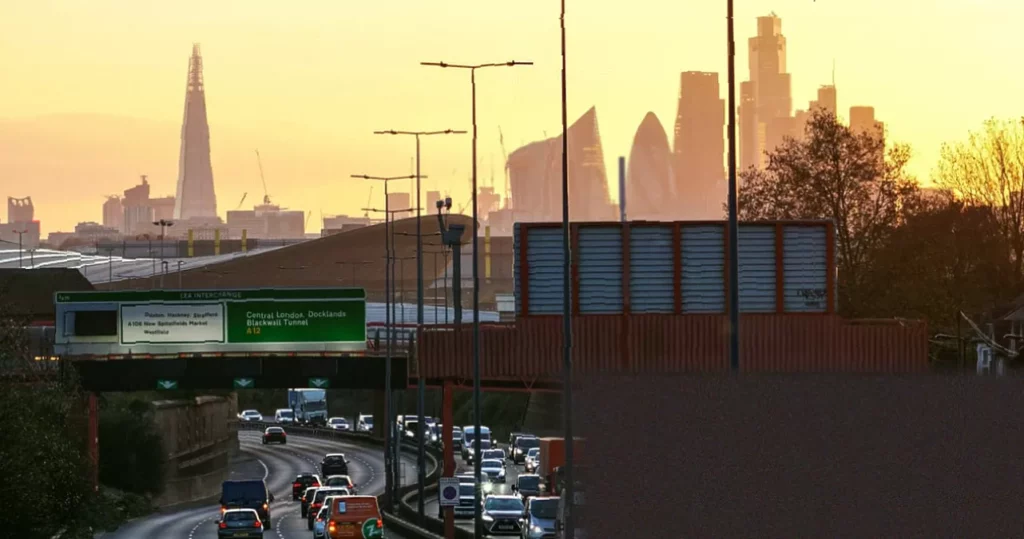
Emergency hospital admissions among adults living in central London fell by 3% per year after the introduction of the T-charge and the ultra-low emission zone (Ulez), according to a new analysis of health records by researchers at Imperial College London. The study, led by Dr Rosemary Chamberlain and Dr Daniela Fecht, found that the decline represents a reversal of the 3% annual increase seen in the years before the schemes began. Admissions for heart problems dropped by 8% and breathing problems by 6%.
The findings add to a growing body of evidence that low-emission and clean air zones can improve public health. In Bradford, a similar zone was followed by a roughly 25% reduction in GP visits for heart and respiratory conditions. Research from the University of Bath has also linked London’s Low Emission Zone (LEZ) and Ulez to an 18.5% reduction in sick leave across Greater London, a 6.8% fall in general health problems and a 10.2% decrease in respiratory issues, alongside improvements in happiness, life satisfaction and reduced anxiety, with annual public health savings estimated at more than £37 million.
How the study separated the schemes’ impact from other factors
Establishing a direct link between a specific policy and health outcomes is notoriously difficult because many other trends — from changes in healthcare-seeking behaviour to other pollution-reduction measures — can confound the analysis. The Imperial College team took several steps to isolate the effect of the T-charge and Ulez. First, they examined emergency admissions only, excluding cases such as accidents, burns, drug overdoses, poisoning and self-harm, to focus on conditions most plausibly linked to air pollution. Second, they compared the central London zone with other areas of the country that were similar in demographic and socioeconomic profile but had not introduced such schemes.
Dr Chamberlain explained: “We needed to make sure that we could separate the effect of the schemes from other trends, such as changes in healthcare seeking behaviour, overall trends in hospital admissions and other policies that improved air pollution. We did this by looking at other areas in the country that are similar to the central Ulez area.” When the researchers applied this control-group comparison, the reductions in total emergency admissions and heart-related admissions remained robust and statistically significant. The downward trend for breathing problems persisted but did not reach statistical significance – a finding the researchers believe may reflect the study’s focus on adults. “Children are particularly susceptible to the effects of air pollution on respiratory health,” Dr Chamberlain said, noting that an analysis of childhood respiratory outcomes could show a more conclusive result.
The research team also pointed to other research that underscores children’s vulnerability. Prolonged exposure to traffic pollutants can stunt lung growth, and the ongoing Children’s Health in London and Luton (CHILL) study – whose preliminary findings suggest lower asthma rates among London children compared to Luton – is expected to provide further evidence. The University of Bath studies have similarly reported that the Ulez reduced a range of conditions, including a 22.5% drop in health problems, a 6.5% reduction in anxiety, and an 18% decrease in sick leave.
Background: T-charge and Ulez
The T-charge, or toxicity charge, was introduced on 23 October 2017 as an additional £10 daily levy on older, more polluting vehicles (those not meeting Euro IV standards) driving within the central London Congestion Charge zone during weekday hours. It affected an estimated 10,000 vehicles and was designed as a stepping stone to the more comprehensive Ulez, which replaced it on 8 April 2019. The Ulez operates 24 hours a day, every day of the year, with daily charges of £12.50 for cars, vans and motorcycles, and £100 for lorries, buses and coaches. It initially covered the same central area before being expanded to Inner London (within the North and South Circular roads) on 25 October 2021 and then to all 32 London boroughs on 29 August 2023.
These schemes have been linked to substantial reductions in pollution. In central London, roadside nitrogen dioxide (NO₂) concentrations were 54% lower in 2024 compared with a scenario without the Ulez and its expansions. Across London as a whole, NO₂ levels have fallen by 27% since 2019. Fine particulate matter (PM2.5) from vehicle exhausts was 31% lower in outer London in 2024 than it would have been without the expansion. The T-charge was also associated with drops in PM2.5, NO₂ and benzene at schools within the congestion charge zone.
Limitations and caveats
The researchers acknowledged that the central London Ulez was launched just one year before the Covid-19 pandemic struck, and that they did not have sufficient health data to distinguish the effects of the zone from those of lockdowns, even though NO₂ from traffic had already been reduced by about 44% on central London roads before lockdowns began. They also noted that other factors such as increased walking and cycling, or a reduction in traffic noise, may have contributed to the observed health improvements. However, Dr Fecht was clear that the study’s design controlled for other trends: “We controlled for other factors and trends in our study design so we can conclude that reductions in hospital admissions are directly linked to the emission reduction initiatives in central London. … Other factors such as more walking and cycling or a reduction in traffic noise may also be contributing but we are fairly certain that these improvements in health are due to the reductions in air pollution. Our results provide clear evidence that clean air zones and low emission zones can bring public health benefits.”
Further research is needed to examine longer-term effects as more post-pandemic data become available, particularly for children and across different socioeconomic groups – some studies have suggested that deprived communities may experience greater benefits from the Ulez. The interaction between air pollution, mental health and the Ulez – with emerging evidence linking higher exposure to increased risk of mood disorders and dementia-related use of mental health services – also warrants deeper investigation.