

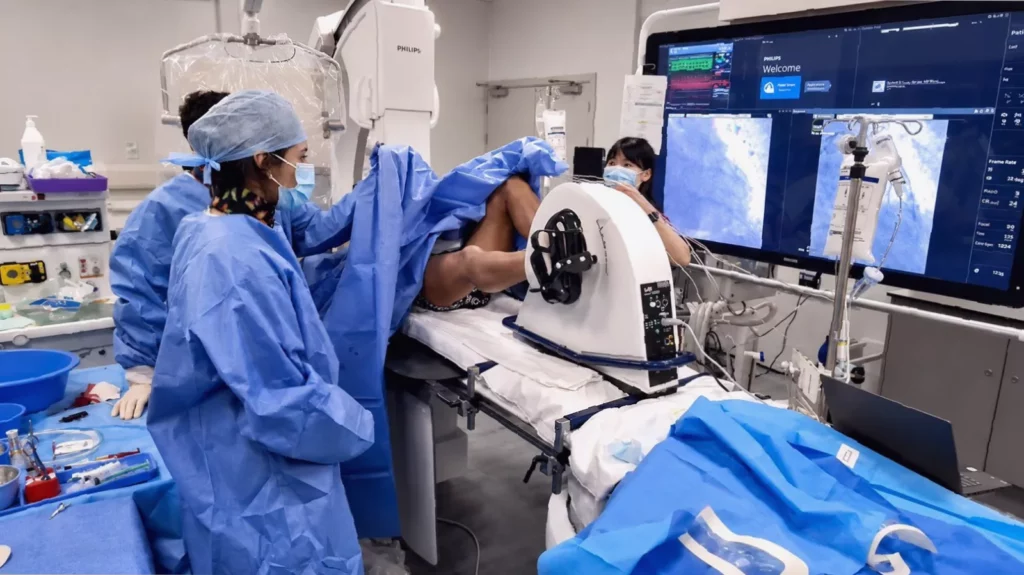
Doctors are deliberately triggering angina attacks in patients to pinpoint the exact cause of the chest pain – a world-first study that could transform how the condition is treated.
Professor Rasha Al-Lamee, a cardiologist at Imperial College London who designed and led the research, said: “We are simulating an angina attack.” The aim is to discover precisely how much narrowing of the heart’s arteries is needed to produce the gripping tightness and pain, so that doctors can decide which patients will truly benefit from having a stent implanted.
Simulating an attack to measure the trigger
Angina occurs when the coronary arteries become narrowed by fatty plaques. During exertion – climbing stairs, for example – the heart demands more oxygen, but the narrowed vessels cannot deliver enough blood, causing chest pain. Current diagnostic tests, such as scans that measure arterial narrowing, are not definitive. Many older people have narrowed arteries yet never experience angina, and one in three patients who receive a stent continue to have symptoms or see them return.
The Imperial College team is the first to measure the degree of narrowing that actually triggers pain. Their unusual method takes place in the catheterisation laboratory, the same room where stents are inserted. Patients lie on their backs and pedal a set of bicycle pedals to raise their heart rate. Meanwhile, a thin wire is inserted into the coronary artery; at the end of the wire is a long, inflatable balloon. As the patient exercises, the balloon is slowly inflated to partially block the artery, allowing the doctors to control – with great precision – the reduction in blood flow.
“The question is how narrow does that artery have to be to cause angina? No one has ever measured it,” said Dr Fiyyaz Ahmed-Jushuf, a fellow cardiologist on the team. The patient is asked to say the moment they first feel the familiar chest tightness, enabling the doctors to record the exact level of blood-flow reduction that provokes an attack. A stent is then implanted as normal.
What the findings reveal about stenting
So far, 65 patients have undergone the procedure, and the results, published last month in the journal Circulation, have been striking. On average, it takes a far greater degree of narrowing than previously assumed to trigger angina. The study found that patients whose pain began only when blood flow was reduced by 40 to 50 per cent were the ones most likely to be cured by a stent. Currently, many doctors recommend stenting if there is at least a 20 per cent reduction in blood flow.
“What we found is that patients who had angina at the biggest [blood flow] drop, they were the ones that were most likely to get better,” Professor Al-Lamee said. “The narrowing needs to be much more severe for you to get angina relief, so that explains to some extent why some people that we stent don’t get better.”
The findings build on earlier work by Professor Al-Lamee, who led the ORBITA and ORBITA-2 trials – large placebo-controlled studies examining stenting for stable angina. Those trials showed that while stenting can help, it is not effective for everyone. Patients may continue to experience chest pain because the real cause is something else: a lung condition, stomach problems, blockages in the smaller blood vessels, or even anxiety. For such patients, stenting exposes them to unnecessary risks, including damage to the artery and, rarely, triggering a heart attack.
Patient experience: ‘This is what I feel’
Trish Longdon, a fit and active 74-year-old, began experiencing a “horrible tightness” in her chest when jogging. She agreed to take part in the study. “I lay on my back in a bizarre position, but as I pedalled, it took probably about 10 minutes for my heart rate to rise. Then there came a point where I said: ‘This is what I feel when I have to stop jogging.'” Her stent was successful, and her angina has not returned in two years.
Professor Colin Berry, a cardiologist at the University of Glasgow who was not involved in the research, said the study sheds light on a crucial question. “Patients think they’ve been treated successfully, the clinicians think they’ve done a great job. But the patient goes back into the community and the pain continues or goes away but then recurs. It’s a difficult experience.” He cautioned that the findings will not change practice overnight because the trial was small, and more research is needed to confirm the results.
Dr Ahmed-Jushuf said: “The ultimate goal is to ensure that the patients most likely to benefit from a stent receive one, while avoiding unnecessary procedures.”