

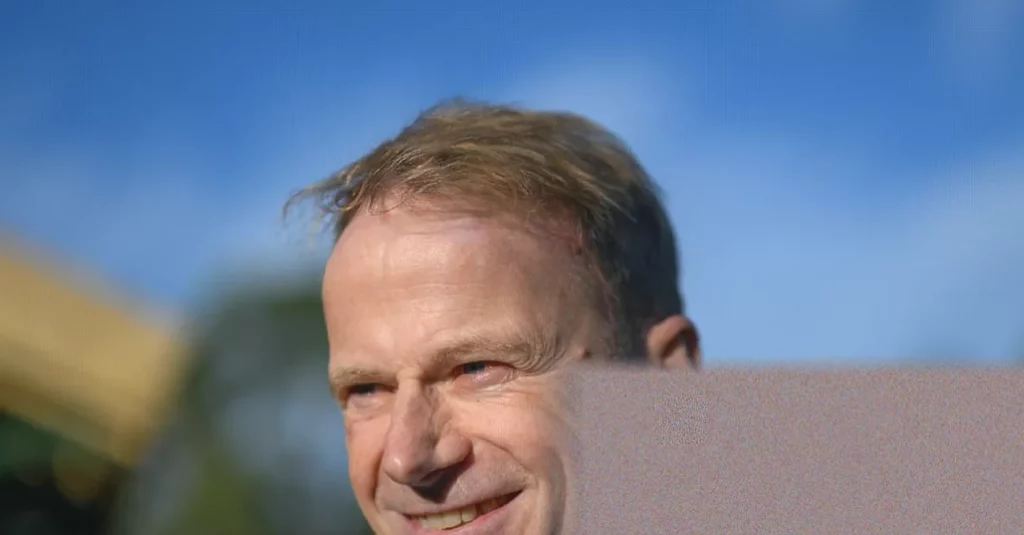
Cancer researcher Richard Scolyer has died aged 59, bringing an end to a life that transformed the treatment of melanoma and inspired a world-first experimental battle against his own brain tumour.
The eminent pathologist and former Australian of the Year passed away surrounded by his family, who released a final statement he had written in the weeks before his death. In it, Scolyer thanked Australians for their “outpouring of love and support” for him and his family, and described the encouragement he had received from his “amazing online community which spans many countries” and from “my hometown Tasmanians”.
“You’ve laughed with me, cried with me, and provided encouragement and support to keep going just when I needed it most,” the statement read. “I haven’t sugar-coated my journey and I sincerely thank you for allowing me the space and opportunity to share it with you, warts and all. I hope I have in some small way made the road ahead easier and smoother for others.”
In a message that became a testament to his character, Scolyer said he would be “delighted and humbled to be remembered as a proud everyday Aussie who ‘gave it a crack,’ and in doing so, inspired others to pursue their dreams and passions with humility, love and compassion.”
Professor John Thompson of the University of Sydney hailed Scolyer’s “cheery, down-to-earth ‘lad from Launceston’ personality” and said his career in medicine and pathology research had produced “huge benefits for countless cancer patients worldwide”.
A devastating diagnosis and a pioneering gamble
In May 2023, Scolyer was told he had grade-four inoperable glioblastoma – an aggressive form of brain cancer – and was given six to eight months to live. Rather than accept the grim prognosis, he became “patient zero” in a world-first experimental treatment that adapted the immunotherapy principles he had helped pioneer for melanoma to target his own brain tumour.
Working in collaboration with Professor Georgina Long, his co-medical director at the Melanoma Institute Australia, Scolyer underwent a combination of immunotherapy drugs before surgery, followed by radiotherapy and a personalised anti-tumour vaccine. The approach successfully slowed the growth of the glioblastoma for nearly two years, until the cancer returned in early 2025.
Scolyer had publicly documented every stage of his journey on social media, building a following of more than 150,000 people. He used the platform to share both his hopes and his anxieties, including a post in March 2025 in which he wrote: “Not the best day ever. There seems to be further progression of my brain tumour … Whilst it is a bit disappointing, in the big picture it’s not the end of the road and I’ve got more to do!”
Only a week earlier he had told his followers he was “a bit anxious” about the brain scan, which was due shortly before he was to take part in a four-day leg of the Tour de Cure charity cycling event in his native Tasmania.
The treatment he pioneered, based on the immunotherapy that had already turned advanced melanoma into a largely curable disease, has now inspired a new clinical trial for glioblastoma in the United States. The Australian Government has also committed $5.9 million to establish the Richard Scolyer Chair in Brain Cancer Research at Chris O’Brien Lifehouse, ensuring his work continues to shape future therapies.
A career that saved thousands of lives
Born in Launceston on December 16, 1966, to Jenny, a primary school teacher, and Maurice, an auto electrician, Scolyer excelled early. He was head prefect and dux at Riverside High School before studying medicine at the University of Tasmania. After specialising in pathology at the University of Sydney, he became a world authority on skin cancer and melanoma diagnoses, co-directing the Melanoma Institute Australia alongside Professor Long.
Together, they revolutionised the treatment of advanced melanoma, transforming a once-fatal diagnosis into a curable condition. Their work has been credited with saving thousands of lives and significantly increasing survival rates for patients with advanced melanoma.
Scolyer was among the world’s leading publishers on melanoma, with more than 700 publications and book chapters to his name. He also helped build the world’s largest melanoma biospecimen bank. His achievements were recognised with nine New South Wales Premier’s Awards for Outstanding Cancer Research, including the Wildfire Highly Cited Publication award, and in 2021 he was appointed an Officer of the Order of Australia.
In 2024, Scolyer and Long were jointly named Australians of the Year. Prime Minister Anthony Albanese said the world had lost “one of our brightest lights and one of our biggest hearts”, and confirmed that Scolyer would be mourned at a state funeral.
“Prof Scolyer took his place in the national spotlight with determination and purpose as he very publicly dealt with his glioblastoma,” Albanese said. “Every day, this remarkable man – the cancer specialist who became his own subject – took us into his confidence and he lifted us all in the process. He showed us what it means to hope, and to keep searching for solutions. He showed us how to stand firm against fear and stay true to yourself.”
Scolyer is survived by his wife, Dr Katie Nicholl, and their three children, Emily, Matthew and Lucy.