

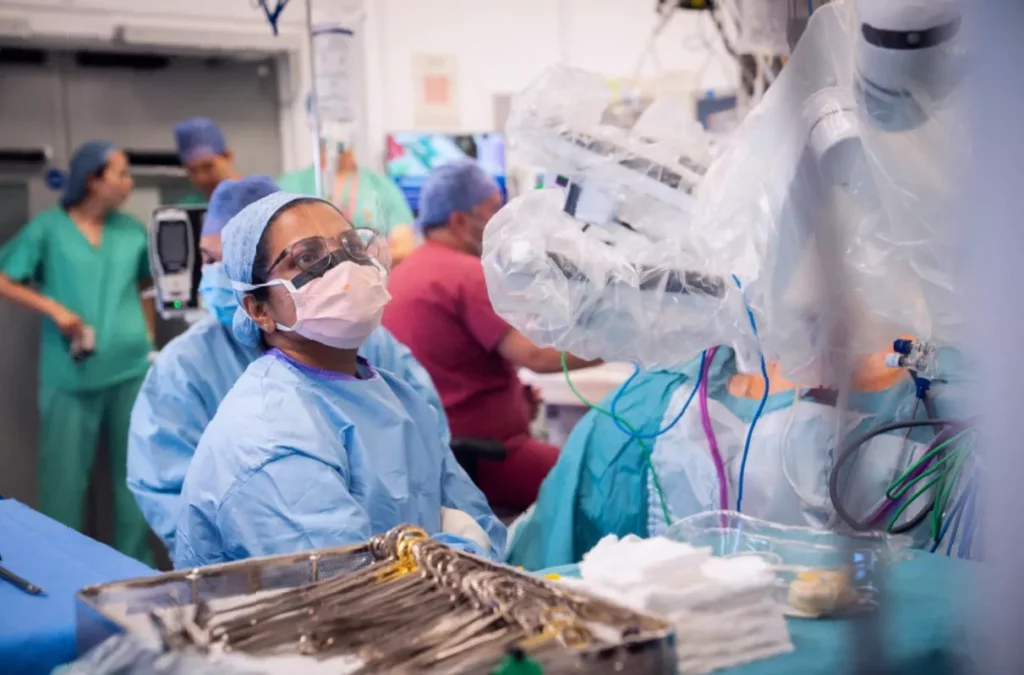
Surgeons at a London hospital have used an artificial intelligence tool that colour-codes anatomy in real time for the first time during a live operation in the UK, giving them a “Google Maps for surgery” view of tissues that the human eye alone cannot see.
The patient, a woman in her sixties, underwent a bowel resection on Thursday at St Mark’s, the National Bowel Hospital, which is part of London North West University Healthcare NHS Trust. The operation marked the first use of the Eureka AI system outside Japan, where it was developed by Japanese surgeons who trained the algorithm on thousands of surgical video recordings.
First UK deployment of Eureka AI
The portable unit works alongside robotic or laparoscopic procedures, projecting real-time colour-coded highlights onto a screen. During the procedure, consultant surgeon Mr Kapil Sahnan and his team used the overlays to identify and protect or dissect specific tissues. Nerves appeared green, while connective tissue showed in turquoise, with the option to keep the colours constant or make them pulse.
Mr Sahnan described the tool as an “extra helping arm” that “looks at your live surgery and starts telling you which are the hidden structures which perhaps you can’t see”. He compared the navigational assistance to the leap from paper A-Z maps to digital route-finding. “That version of navigation has now been applied to surgery,” he said. “The difference has been that real time aspect, so you can see it at the same time as you’re operating. The idea being is you want to prevent any errors happening before they do, and one way to do that is use… intelligence which has been derived from thousands and thousands and thousands of operative videos where people have gone through and labelled things. So the computer can see things before the human eye can.”
St Mark’s Hospital is a specialist centre for intestinal and colorectal medicine and a national and international referral centre. Mr Sahnan, who is also the hospital’s Director of Innovation, has a history of pioneering surgical technologies, including wearing an exoskeleton to reduce strain during long operations, and co-leads the hospital’s IBD robotic programme. He is an Honorary Senior Clinical Lecturer at Imperial College London with research interests in AI for robotic surgery.
How the AI identifies hidden structures
Eureka’s core function is to enhance precision and safety by making invisible anatomical features visible in real time. In laparoscopic and robotic-assisted surgery, surgeons work through small incisions using camera feeds, which can obscure fine detail. The AI analyses the live video feed and overlays colour-coded markers on structures that might otherwise be difficult to distinguish, such as nerves, blood vessels and connective tissue.
The system was trained on thousands of recorded operations in which human experts had manually labelled each type of tissue. By learning these patterns, the AI can now predict and highlight the same structures during a live procedure. Mr Sahnan noted that the colour overlays produce “really beautiful images” that can be displayed continuously or set to pulse to draw the surgeon’s attention.
Laparoscopic surgery has been the gold standard for many abdominal conditions since the 1990s, offering shorter hospital stays and faster recovery. Robotic-assisted surgery is now expanding rapidly in the NHS, with the aim of increasing robot-assisted minimally invasive procedures from about one in five to 90 per cent by 2035. Systems such as the da Vinci surgical platform are already in use across UK hospitals, and AI integration is growing, with tools like Eureka providing real-time analytics and decision support.
Experts stress that AI is intended to augment, not replace, the surgeon’s judgment, and that robust human oversight remains essential. The Eureka system is one example of Japan’s leadership in surgical AI, with similar systems such as Eureka Alpha already approved for use in endoscopic surgeries there. The collaboration between Japanese and UK institutions in AI healthcare research has been notable, and the deployment at St Mark’s represents a concrete step in cross-border adoption.
Roadmap for wider rollout
Mr Sahnan said work was now under way “to work out how we can genuinely prove that this is going to be advantageous and, more importantly, how we can start rolling it out”. He expressed hope that the technology could become widespread within a couple of years. “We’re lucky to have it today, but it would be amazing if everybody had it in the next couple of years, it would make surgery for everybody a lot safer.”
The London North West University Healthcare NHS Trust, which manages St Mark’s, is actively involved in research and innovation, having secured significant funding for clinical trials and novel therapies. The hospital’s status as a pioneer in colorectal surgery and robotic techniques positions it to lead the evaluation and dissemination of AI-assisted surgery in the UK.