

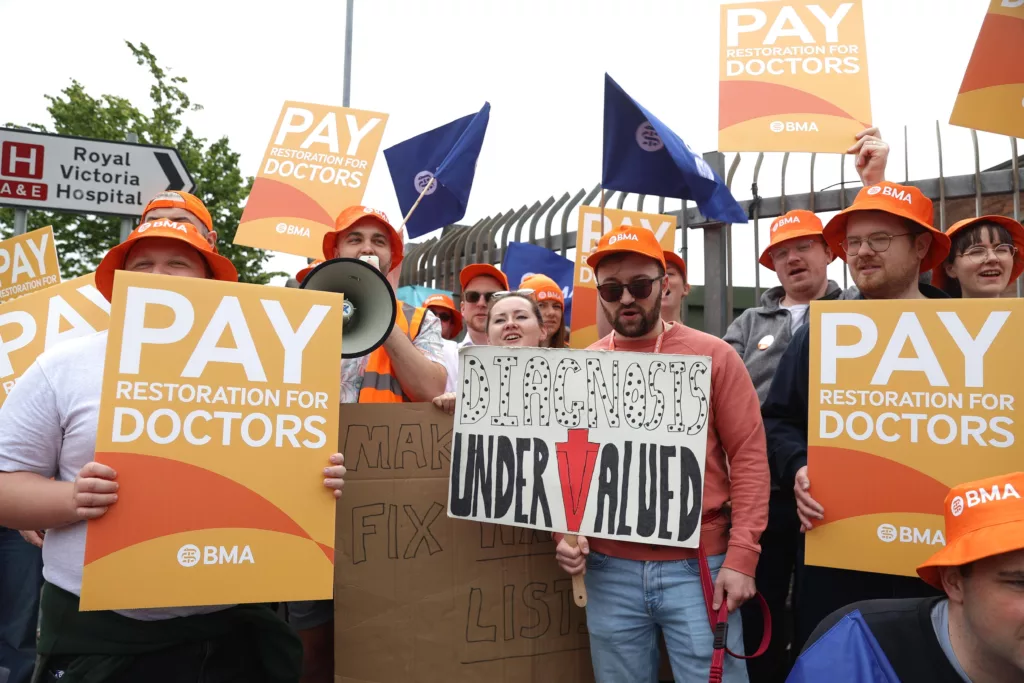
Resident doctors in England have voted to accept a new pay and conditions offer, bringing an end to months of industrial action that have repeatedly disrupted NHS services.
The ballot, which also included final-year medical students, secured approval with 52.9 per cent in favour, the British Medical Association confirmed. Turnout stood at 57 per cent, and the result was notably tight, with 47.1 per cent of participants rejecting the proposed terms. The Department of Health and Social Care confirmed the outcome brings strike action to a close.
Health Secretary James Murray welcomed the result, calling it “very good news for resident doctors, patients and the NHS as a whole, allowing us to draw a line under the disruption of previous months and focus on getting on with the job of rebuilding our health service”. He said the settlement would deliver tangible benefits for medical staff, including enhanced pay structures and improved career advancement opportunities, and would bring reassurance to patients through greater stability within the NHS. Mr Murray acknowledged that challenges remain, adding: “But this is the beginning, not the end of the journey.” He pledged to continue working constructively with resident doctors, all NHS staff and the unions that represent them.
The pay uplift and contract changes
The deal secures an average pay uplift of 6.6 per cent, with full implementation scheduled for April 2027. According to the BMA, this means resident doctor pay will be on average 35.2 per cent higher than it was four years ago. Specific increases by grade were set out in the offer:
Foundation Year 1 doctors receive a 6.2 per cent pay rise backdated to April 2026, with potential for a 7.1 per cent increase upon progression to FY2. Foundation Year 2 doctors get 7.1 per cent backdated to April 2026, with potential for 5.1 per cent upon progression to ST1. ST/CT1 and ST/CT2 doctors each receive a 5.1 per cent uplift backdated to April 2026, with potential for further 5.1 per cent rises upon progression to the next level. Locally employed doctors (LEDs) post-FY2 and pre-ST3 get a 5.1 per cent uplift backdated to April 2026, with an 8.1 per cent increase available if they progress to ST2 within the year.
As part of the settlement, all locally employed medics will be moved onto the standard 2016 resident doctor contract terms. The package also includes the creation of 4,500 additional specialty training places over three years, reimbursement of mandatory Royal College portfolio fees and mandatory examination costs, and improvements to support doctors’ progression through training rotations. Faster progression will be available for doctors working less than full time, and a new route will allow locally employed doctors to progress through enhanced Annual Review of Competence Progression assessments.
Clinical academic resident doctors will see their flexible pay premium rise from £5,600 to £10,000.
Background and context of the dispute
The vote marks the culmination of a long-running dispute that has seen the BMA’s Resident Doctors Committee call 21 days of strike action since July 2025. The first walkout by resident doctors began on 13 March 2023. A previous deal agreed in autumn 2024 quickly collapsed, and the strikes have taken a heavy toll on NHS services, with thousands of cancelled appointments and operations. Each strike day has been estimated to cost up to £300 million.
The BMA has stressed that even with this deal, resident doctors’ pay remains nearly a fifth behind 2008 levels in real terms. The union’s campaign for “pay restoration” seeks to reverse the real-terms losses sustained since that year. Dr Jack Fletcher, chair of the BMA’s Resident Doctors Committee, described the offer as “sufficient to continue on the road to pay restoration” and to tackle the “absurd lack of jobs in the NHS”. However, he warned that if the pay review process cannot deliver continued improvements, the risk of further disputes remains.
The pay review process for 2026/27 is expected to be announced in July 2026.