


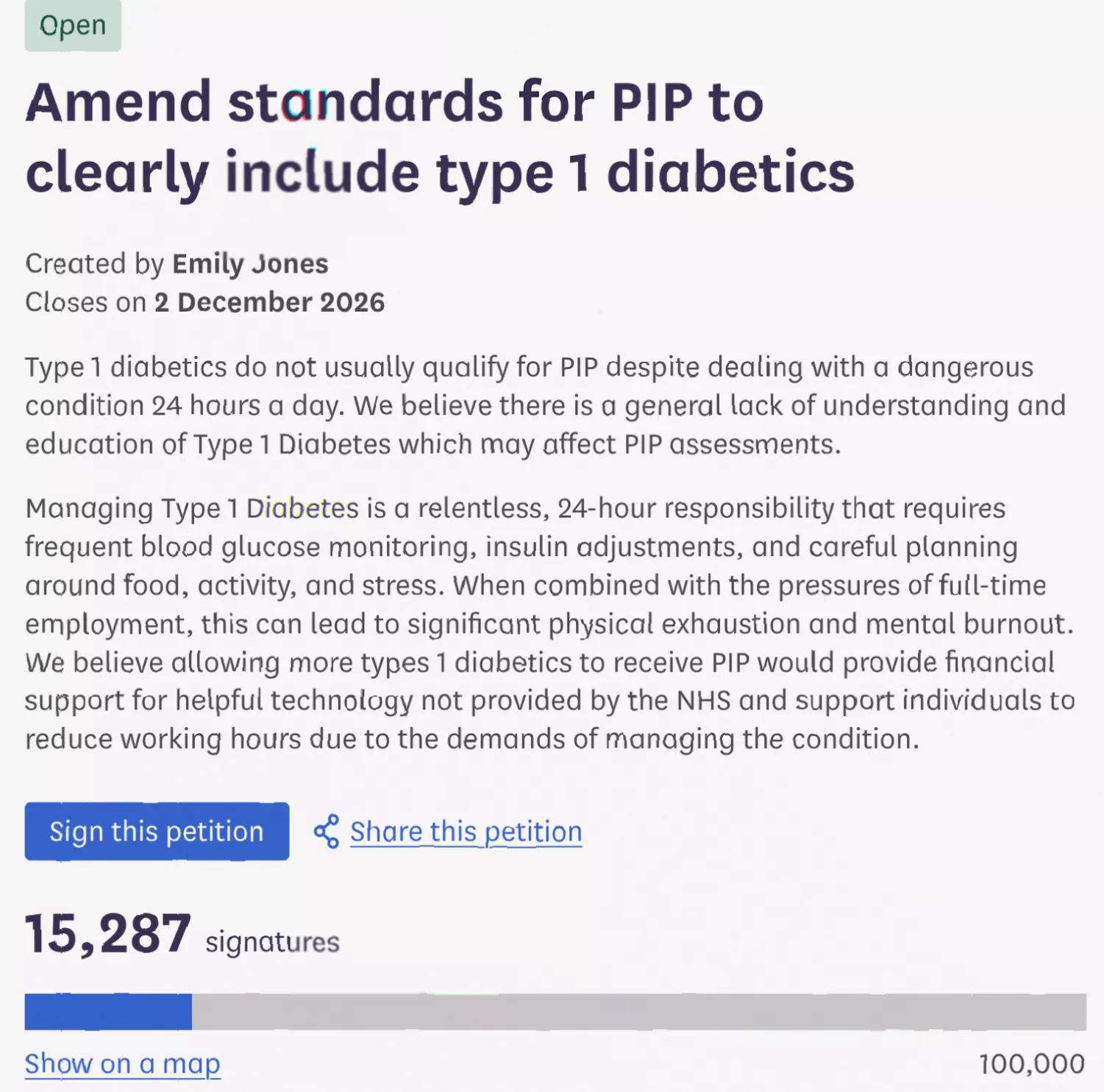
More than 15,000 people have signed a petition demanding that Type 1 Diabetes be formally recognised within the rules for Personal Independence Payment (PIP), forcing the Department for Work and Pensions (DWP) to issue an official response.
The petition, launched by Emily Jones on the Parliament website, has gathered 15,245 signatures – comfortably exceeding the 10,000-signature threshold that compels the Government to reply. It remains open for further support; if it reaches 100,000 names, the Petitions Committee will consider it for a debate in the House of Commons.
Campaigners are urging the Work and Pensions Secretary, Pat McFadden, to rethink how people living with Type 1 Diabetes are assessed for the benefit. They argue that the condition – which demands constant blood glucose monitoring, insulin adjustments and careful planning around meals, exercise and stress – is rarely reflected in PIP decisions, despite what Ms Jones describes as managing a “dangerous condition 24 hours a day”. Balancing this “relentless, 24-hour responsibility” with full-time employment, they say, can produce significant physical exhaustion and mental burnout.
The petition specifically calls for PIP to help cover the cost of diabetes technology that is not routinely funded by the NHS, as well as providing financial support for individuals who need to reduce their working hours because of the condition. Campaigners believe a lack of understanding about Type 1 Diabetes among assessors may be influencing outcomes.
How PIP assessments work
Personal Independence Payment is a tax-free, non-means-tested benefit for working-age adults intended to help with the extra costs of long-term health conditions or disabilities. Payments are made every four weeks, with current awards ranging from £121.20 to £778.40 depending on the level of support required.

The DWP has stressed that eligibility is not determined by a diagnosis alone. In its formal response to the petition, the department stated: “People can be impacted by health conditions in different ways, so PIP uses a functional assessment to measure the impact of a person’s health condition or impairment on their day-to-day life rather than focusing solely on the health condition or impairment itself.”
Under this system, assessors examine whether a claimant can complete a specific set of activities, including preparing food, dressing and undressing, managing money, monitoring their own health, engaging with other people, and planning and following journeys. The criteria were developed in consultation with health professionals, disability specialists and disabled people to capture needs arising from physical, sensory, cognitive and mental health conditions.
The assessment focuses on how symptoms and treatment – for someone with Type 1 Diabetes, that includes insulin management, the risk of hypoglycaemia, and complications such as neuropathy or vision loss – affect the ability to perform these everyday tasks. Examples of difficulties that could score PIP points include needing help to monitor blood sugar, manage medication, prepare food, or manage personal care because of fatigue or pain.
In January 2025, 40,868 PIP recipients had diabetes listed as a qualifying condition. However, the DWP points out that the same condition can affect people very differently, which is why the assessment considers the overall impact on functional ability rather than the diagnosis.
Wider context and ongoing review
Type 1 Diabetes is classified as an “unseen disability” under the Equality Act 2010, offering protection against discrimination in the workplace – provided it has a substantial and long-term negative effect on normal day-to-day activities. Yet research cited in the petition debate indicates that nearly half of employees with Type 1 Diabetes report negative treatment at work, with some being denied breaks or time off for diabetes management, and others missing out on career development or training opportunities.
Access to diabetes technology remains uneven. National Institute for Health and Care Excellence (NICE) guidelines recommend Continuous Glucose Monitoring (CGM) for certain groups, including under-18s, adults with an HbA1c above 7.5%, and those experiencing disabling hypoglycaemia. In England and Wales, hybrid closed-loop systems – combining CGM with an insulin pump – are also recommended for people meeting specific criteria. But in practice, a “postcode lottery” of clinical knowledge, confidence and NHS funding means access can vary significantly from one area to another. Every person with Type 1 Diabetes can get a Dexcom ONE sensor on prescription in most parts of the UK, but eligibility for other CGM systems requires a check with a healthcare professional. In Northern Ireland, adults and children are entitled to CGM on the NHS, though local teams determine prescribing.
The DWP’s response comes as the wider Timms Review – a comprehensive examination of PIP and its assessment processes – continues. The review, which aims to ensure the benefit remains fair and fit for the future, is expected to report in the autumn.
The petition calling for Type 1 Diabetes to be recognised within PIP assessments remains open for signatures. Should it reach 100,000, it will be considered for a parliamentary debate, potentially triggering further discussion about whether the current functional framework adequately captures the demands of the condition.