

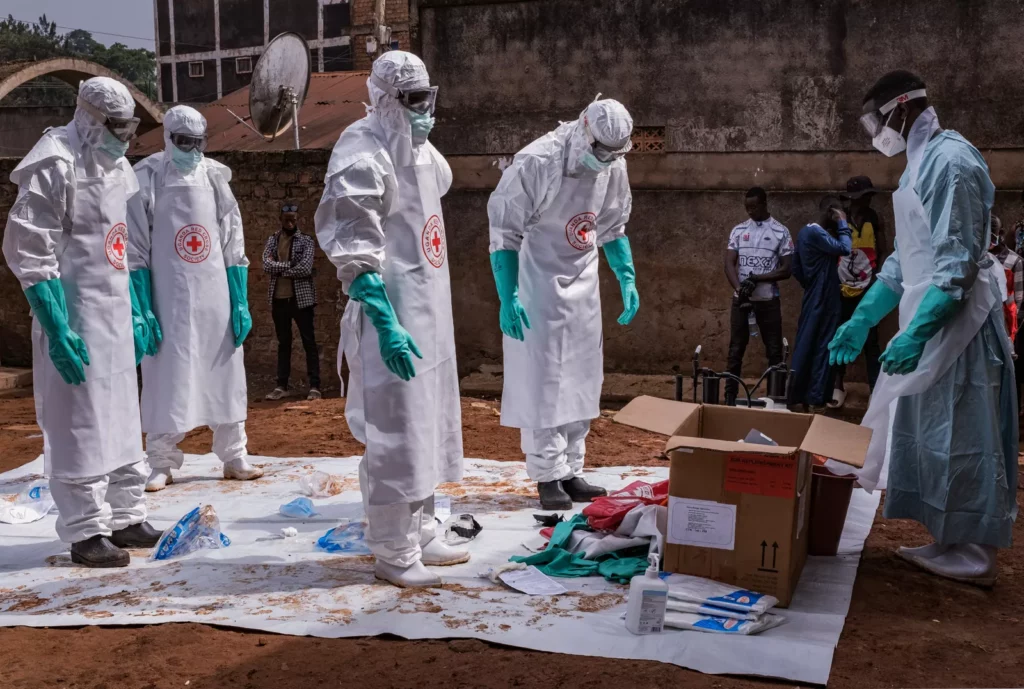
The head of the World Health Organization has demanded an “immediate ceasefire” in the eastern Democratic Republic of Congo as suspected cases of Ebola approach 1,000, warning that the region faces a “catastrophic collision of disease and conflict.”
Dr Tedros Adhanom Ghebreyesus wrote on social media that health workers “cannot isolate the sick while bombs are falling” and called on all warring parties to agree to a halt in hostilities to allow medical teams safe and sustained access. “Stopping this Ebola transmission depends entirely on humanitarian access. Yet ongoing clashes are driving mass displacement, pushing exposed contacts into overcrowded camps and severing critical containment corridors,” he said. He added that attacks on health facilities make tracking cases and their contacts “nearly impossible.”
Conflict and displacement cripple containment
The mineral-rich east of the DRC has been plagued by decades of war as numerous armed groups compete with central authorities for power. Fighting escalated sharply at the start of 2025, when the Rwandan-backed M23 rebel group made major advances across the region. Multiple armed groups are active, including the Allied Democratic Forces (ADF) and CODECO militias, compounding an already dire security situation.
According to the UN humanitarian office, almost one million people have been displaced by conflict in Ituri province alone – the epicentre of the current Ebola outbreak. Across the eastern provinces of Ituri, North Kivu, South Kivu and Tanganyika, nearly 10 million people are facing acute hunger between January and June 2026. At the national level, an estimated 26.5 million people in the DRC are experiencing high levels of acute food insecurity.
The violence directly undermines Ebola containment. Insecurity makes it impossible for contact tracers to reach exposed individuals. Attacks on health facilities have occurred, and community members have sometimes demanded the release of bodies for burial – despite the fact that Ebola victims remain highly infectious after death. Years of conflict have weakened community trust in authorities, and misinformation about the disease has further hampered efforts. As Dr Tedros put it: “We cannot build community trust or isolate the sick while bombs are falling.”
Outbreak details and growing risk
The current outbreak is caused by the Bundibugyo strain of the Ebola virus, which has a fatality rate of between 21 and 50 per cent. Symptoms include muscle aches, high temperature, headache, sore throat, vomiting and diarrhoea. Early symptoms can mimic malaria or typhoid, leading to delayed diagnosis. The virus is transmitted through sweat, blood, faeces or vomit, with most transmission in previous Bundibugyo outbreaks linked to handling deceased persons without appropriate protection.
There are currently no approved vaccines or specific treatments for the Bundibugyo strain. Existing Ebola vaccines, developed for the Zaire strain, offer limited or no protection. Scientists at Oxford University are working urgently to develop a vaccine using the ChAdOx platform developed during the Covid-19 pandemic, and clinical-grade doses could be ready within two to three months. The Serum Institute of India is involved in large-scale production for a likely “ring vaccination” strategy.
As of 27 May 2026, WHO data shows 906 suspected cases of Ebola in the DRC and 223 suspected deaths. Confirmed cases stand at 105, with 10 confirmed deaths. Uganda has reported seven confirmed cases and one death. The Africa Centres for Disease Control and Prevention has warned the outbreak could infect up to 7,500 people.
The outbreak has spread across 11 health zones, centred in Ituri province but with cases also in North Kivu, including the cities of Butembo and Goma, and South Kivu. Uganda responded by ordering the immediate closure of its border with the DRC, except for Ebola response teams, humanitarian aid and essential cargo. Those crossing from the DRC will be asked to self-isolate for 21 days, according to senior Ugandan health official Diana Atwine. However, the WHO has warned that such measures could push people to use informal, unmonitored border crossings, increasing the risk of undetected spread.
The Red Cross has warned that ten other African countries are at risk: Rwanda, Kenya, Tanzania, Angola, Burundi, the Central African Republic, the Republic of Congo, Ethiopia, South Sudan and Zambia. The African Union’s health agency cited “high mobility and insecurity” in the region as the reason for the cross-border danger.
Testing delays and humanitarian toll
Confirming cases remains a major challenge. Samples from the outbreak zone must travel 1,700 kilometres to the Institut National de Recherche Biomédicale in Kinshasa – the only facility in the country capable of testing for the Bundibugyo strain. The long distance delays diagnosis and response.
Save the Children has reported that a quarter of the confirmed deaths were children, and has called for an urgent scale-up of infection prevention measures. The International Federation of Red Cross and Red Crescent Societies (IFRC) has launched a CHF 29 million regional emergency appeal and deployed volunteers to support community engagement and public health activities. Three Red Cross volunteers died in eastern DRC in March after contracting the virus while carrying out dead body management activities unrelated to Ebola at the time. The previous Ebola outbreak in the DRC, caused by the Zaire strain in Kasai Province, ended in December 2025 and resulted in 81 confirmed cases and 28 deaths.