

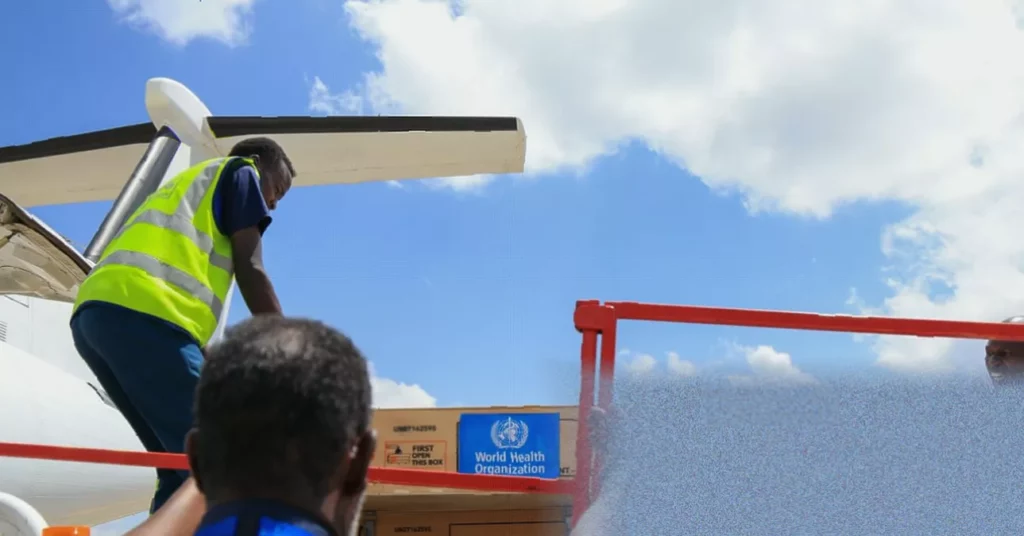
The Trump administration is building a quarantine and treatment centre in Kenya for Americans affected by the Ebola outbreak, opting to keep citizens out of the United States rather than bringing them home for care.
The White House confirmed on Wednesday that the facility is being set up specifically for Americans who need to leave the Democratic Republic of Congo (DRC) quickly and quarantine after Ebola exposure. “The facility is designed to provide access to high-quality care for Americans who would need to quickly get out of DRC and quarantine without the risks of a lengthy transport back to the US,” a White House official told the Guardian. The centre will also treat Americans who contract Ebola, including critical care needs, though the official said each case would be evaluated for “forward transport for more advanced care as appropriate in order to maximise patient outcomes.” The official did not clarify whether that onward transport would be to the US or to Europe, where other Americans have previously been taken for quarantine and treatment, nor whether Americans would be allowed to return to the US if they did not wish to go to Kenya.
The facility is being developed through a coordinated effort involving the Departments of Defense, State, and Health and Human Services. The US military has been directed to establish a 50-bed unit within a week, with the potential to expand to 250 beds. Prefabricated medical facilities are expected to be transported from the United States. While the exact location in Kenya has not been specified, it is understood to be on a Kenyan air base, and the Kenyan government has approved the plan. US public health officers are expected to staff the centre, with some already receiving deployment notices.
Ethical concerns and risk of amplifying spread
Public health experts have voiced strong objections to the decision. Jennifer Nuzzo, an epidemiologist and director of the Pandemic Center at the Brown University School of Public Health, said: “It is shocking to me that the administration is looking to prevent Americans from coming home to receive the proven world-class care that our taxpayer-funded biocontainment and treatment units are equipped to provide.” She added: “There are profound ethical concerns with this approach. Without adequate plans for the safe quarantine of exposed individuals and prompt isolation of those who become infected, I fear these facilities could amplify the spread of the virus. The prospect of not being able to come home for safe and effective care may create disincentives for people to disclose having been exposed, which could drive cases underground, and cause the virus to spread even more.”
Other experts have questioned whether the Kenya centre can match the standard of care available in the United States. Dr Craig Spencer, who survived Ebola in 2014, has questioned whether the facility can provide equivalent quality. Dr Ali Khan, dean of the public health college at the University of Nebraska Medical Center, stressed the importance of equivalent care quality and excellent infection control. A former official at the US Centers for Disease Control and Prevention called the plan “unbelievably unethical and irresponsible”, citing concerns that Kenya may lack a proper Level 4 containment facility or extensive experience handling Ebola. The United States already operates a network of specialised biocontainment and treatment units – including at Emory University Hospital, the University of Nebraska Medical Center, and NYC Health + Hospitals/Bellevue – that were established and enhanced after the 2014-2015 Ebola outbreak and are equipped for the high-level isolation and treatment of patients with highly hazardous communicable diseases.
Disincentive for volunteers
The policy also threatens to undermine the willingness of US experts to volunteer for outbreak response. Jeremy Konyndyk, president of Refugees International and former executive director of the USAid Covid-19 taskforce as well as a former leader in the 2014-2015 USAid Ebola response, said: “That’s basically telling any American health worker who might go and work on the effort to contain this outbreak that if they get sick, they can’t come home. It disincentivises people from going. In 2014, we faced this exact scenario – cases coming back to the United States – and we fought really hard not to put a travel ban in place because we knew that would ultimately be counterproductive to the goal of ending the outbreak.” During previous outbreaks, Americans responding on the ground – whether caring directly for patients or organising logistics for contact tracing and safe burial teams – knew they could return home for some of the best medical care in the world. The White House official noted that the risks of transportation are extremely low if a person is not symptomatic, and the US has extensive experience evacuating people exposed to or infected with Ebola or other contagious pathogens.
In parallel with the Kenya facility, the US has imposed travel restrictions. Green card holders and other non-US citizens who have recently travelled in the DRC, Uganda and South Sudan are banned from entering the United States. The ban, initially set for 30 days, has been extended to cover lawful permanent residents. US citizens and nationals returning from those countries undergo enhanced public health screening at designated airports: Washington Dulles International Airport, Hartsfield-Jackson Atlanta International Airport and George Bush Intercontinental Airport in Houston, with flights rerouted to those entry points.
The decision marks a notable departure from the approach taken during the 2014-2015 West African Ebola outbreak, when several Americans who contracted the virus abroad were medically evacuated to the US for treatment, a practice that led to the creation of the current network of quarantine and isolation facilities. It also echoes President Trump’s own public stance at the time. In 2014, Trump – then a businessman – criticised the Obama administration’s decision to bring infected Americans home, tweeting: “The U.S. cannot allow EBOLA infected people back. People that go to far away places to help out are great — but must suffer the consequences!” He also suggested that infected individuals should be treated “over there”.
The establishment of the Kenya centre comes amid a growing Ebola outbreak in the DRC and Uganda. The World Health Organization has declared the outbreak a public health emergency of international concern. The outbreak involves a rare strain, the Bundibugyo strain, for which no vaccine exists. As of recent reports, the DRC has seen over 900 suspected cases with hundreds of deaths, and Uganda has reported confirmed cases and deaths. The Africa Centres for Disease Control and Prevention has warned that ten African countries are at risk.