

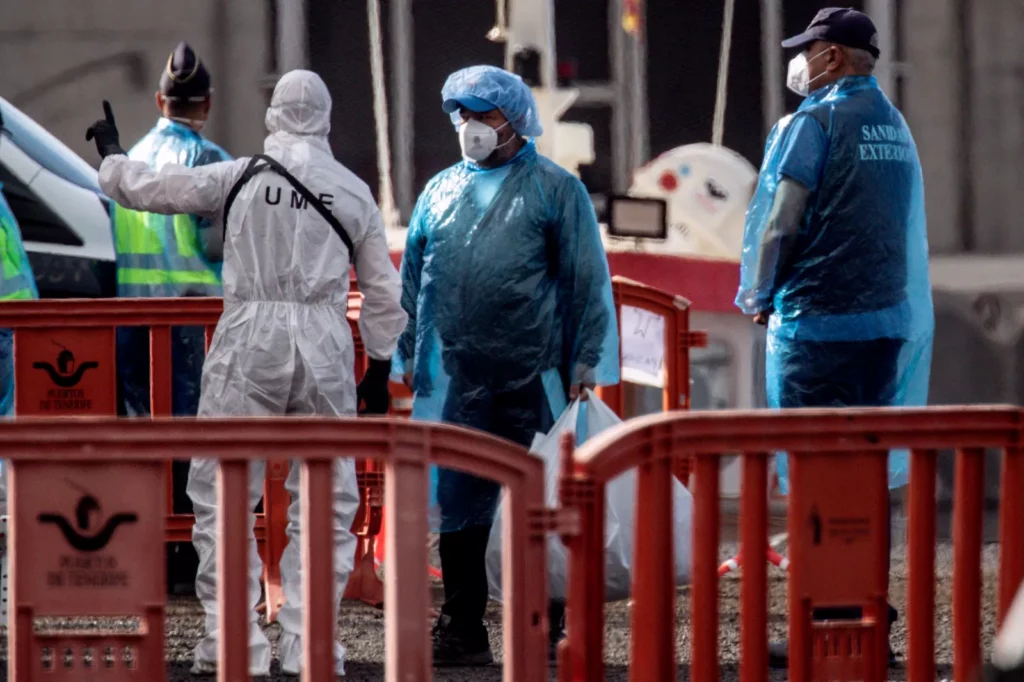
No Americans remain under public health monitoring for hantavirus, the United States Department of Health and Human Services has confirmed, as the country’s response to a deadly outbreak on a Dutch cruise ship draws to a close.
Monitoring concludes without US cases
Eighteen American passengers who had been placed under quarantine at Nebraska Medicine’s National Quarantine Unit after returning from the MV Hondius last month, along with seven others who were monitoring symptoms at home, have now completed the observation period. “None remain under public health monitoring,” the Department of Health and Human Services said in a statement. All were observed for 42 days, the incubation period for the Andes virus strain – the only form of hantavirus known to spread between humans.
The department credited its own response for ensuring the virus did not spread inside the United States, noting that no cases have occurred on American soil. Health and Human Services Secretary Robert F. Kennedy, Jr., said: “HHS moved swiftly to identify potential exposures, support state and local health officials, and prepare our healthcare system to respond. As a result, no sustained transmission of hantavirus occurred in the United States, and the monitoring period has concluded with no individuals remaining under observation.”
Dr Jay Bhattacharya, acting director of the US Centers for Disease Control and Prevention, called the outcome a “successful conclusion” that demonstrated “the strength of a coordinated response to infectious disease threats that occur outside of our borders.” He added: “I am grateful for the world-class team at CDC whose dedication and swift action helped identify potential exposures, provide clear guidance, and protect the American people. As a result, we prevented any new cases from arising in the US.”
Outbreak and international response
The outbreak was identified aboard the MV Hondius, a Dutch-flagged cruise ship that departed from Ushuaia, Argentina, on 1 April 2026 with 152 passengers and crew, according to the World Health Organization. The vessel was sailing for Cape Verde off the western coast of Africa when the first passenger fell ill in April. The first case, a 70-year-old Dutch man, began showing symptoms on 6 April and died on board five days later. His body remained on the ship until 24 April, when it was disembarked at Saint Helena. His wife, who accompanied the body for repatriation, later died in a Johannesburg hospital on 26 April. A third passenger, a German woman, died on board on 2 May. In total, 13 cases – eleven confirmed and two probable – and three deaths were reported by the World Health Organization, giving a case fatality rate of 23% for this cluster.
No rodents were detected on the MV Hondius, suggesting the outbreak was driven by person-to-person transmission after the virus was introduced. The World Health Organization was notified on 2 May and issued Disease Outbreak News reports. The European Centre for Disease Prevention and Control classified everyone aboard as high-risk contacts because of the Andes virus’s incubation period of up to 42 days, recommending six weeks of quarantine and active monitoring. International contact tracing tracked 188 high-risk contacts across seven countries. Eighteen American passengers were repatriated and placed in the 42-day monitoring period at the National Quarantine Unit. The CDC formally concluded its hantavirus response on 24 June 2026 after the risk diminished and all monitoring periods ended.
Understanding hantavirus and the Andes strain
Hantavirus infections are caused by exposure to the contaminated urine, droppings or saliva of infected rodents. Early symptoms are flu-like – fever, muscle aches, fatigue – but can rapidly progress to Hantavirus Pulmonary Syndrome, a severe respiratory illness marked by trouble breathing and fluid in the lungs. Mortality rates can reach up to 50%, depending on access to care. In the Americas, the case fatality rate for hantavirus pulmonary syndrome can be as high as 50% in some reports, particularly among elderly individuals or those with underlying conditions. There is no specific treatment or vaccine; care is supportive and focuses on managing symptoms.
The outbreak on the MV Hondius involved the Andes virus strain, which is unique among hantaviruses because it can spread from person to person, albeit inefficiently, through close contact, respiratory droplets, body fluids and contaminated surfaces. The incubation period typically ranges from one to eight weeks, with symptoms appearing between four and 42 days after exposure. Rodents carrying the Andes virus have not been found in the United States, and experts say the strain does not pass easily between humans. “This is not the next Covid, but it is a serious infectious disease,” said Maria Van Kerkhove, the World Health Organization’s director of epidemic and pandemic preparedness and prevention. “Most people will never be exposed to this.” WHO Director-General Tedros Adhanom Ghebreyesus said in May that the threat is “stable for now”.
Passengers criticise quarantine conditions
While the Trump administration has praised its response, not everyone affected has been satisfied. Many passengers were forced to remain at Nebraska Medicine’s National Quarantine Unit for longer than they would have liked, with some reporting that they received federal orders compelling them to stay. “I’m held here involuntarily, so in that sense it’s a prison term – I mean, it’s a perfectly nice prison, but I’m still here involuntarily,” an anonymous passenger said in May.
Coordinating with states to allow home monitoring met with difficulties. Angela Perryman, a 47-year-old passenger, was unable to return home to Florida because the state would not agree to provide round-the-clock monitoring. Federal officials had demanded 24/7 surveillance, but Florida officials refused to meet those terms. As a result, Perryman spent the full 42 days at the quarantine unit alongside seven other passengers who remained there voluntarily. The other ten people at the facility were allowed to leave earlier after striking agreements to be closely monitored at home. Perryman described her six-week quarantine as “a political stunt” and is considering litigation, according to reports.
The CDC formally concluded its hantavirus response on 24 June 2026, after the risk diminished and monitoring periods for all exposed individuals had expired.