

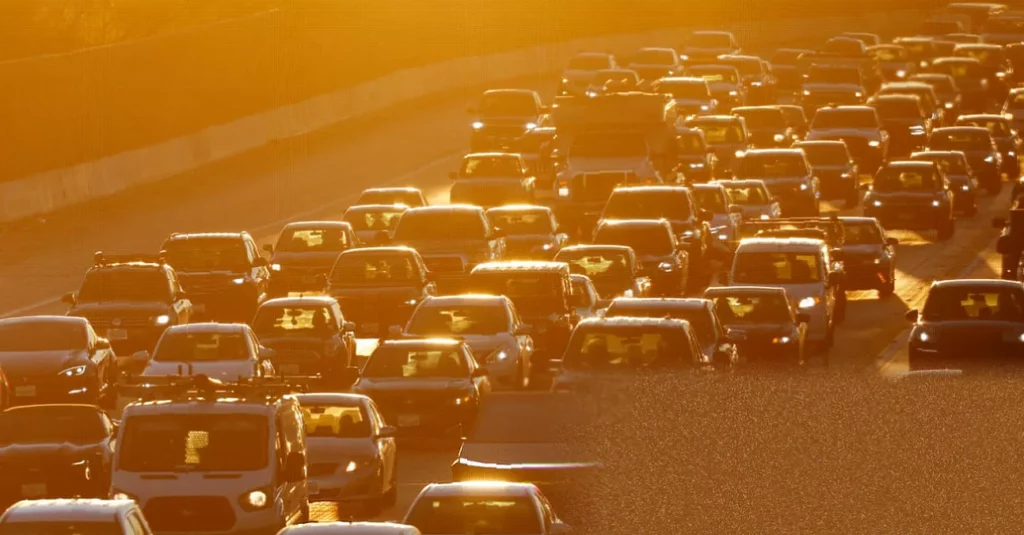
More than 41,800 premature deaths in the United States last year were linked to toxic pollution from road vehicles, according to a new analysis that underscores the lethal toll of fossil-fueled transport. The study, carried out by the non-profit International Council on Clean Transportation (ICCT), found that roughly five Americans die every hour from exposure to emissions produced by cars, trucks and buses.
41,800 premature deaths
The ICCT quantified the pollution released during both the production and consumption of fuel for road vehicles, using sensor measurements gathered in partnership with the UK-based Fia Foundation. Researchers then calculated the health impact using established methods from academic literature. “Transportation emissions have real, everyday impacts on the health and safety of communities we live in and represent,” said Paul Jones III, transportation planner at the New York City Environmental Justice Alliance, a network of grassroots groups that reviewed the findings.
Lingzhi Jin, a senior researcher at the ICCT, said in a statement: “At a time when many Americans are concerned about the impact of environmental toxins on their families’ health, public health authorities can’t afford to overlook the impact of vehicle pollution on mortality and respiratory health outcomes.” The analysis comes as polling indicates a growing share of the US public is worried about environmental toxins and would support stricter federal regulation.
The American Lung Association reported last year that nearly half of Americans breathe dangerous levels of airborne emissions – a rise compared with the previous year. The organisation’s “State of the Air” report has consistently highlighted that communities of colour are disproportionately exposed to unhealthy air.
A global asthma burden
The ICCT study also found that the United States records more new paediatric asthma cases attributable to vehicle pollution each year than any other country. In 2024, American children accounted for one in ten of all such cases worldwide. The key pollutant involved is nitrogen dioxide (NO₂), which comes primarily from vehicle exhaust. A 2019 study published in The Lancet Planetary Health estimated that traffic-related air pollution is associated with four million new cases of childhood asthma globally each year, with 13 per cent of these cases linked to NO₂.
Air pollution from traffic is especially harmful to children’s developing lungs, potentially stunting growth and leading to lifelong respiratory problems. In the UK, where 1.1 million children have asthma, exposure to pollution can increase the risk of asthma attacks. Studies have shown that children exposed to diesel-dominated air in London exhibited poorer lung capacity.
Globally, the scale of the problem is immense. A separate analysis led by the ICCT, George Washington University and the University of Colorado Boulder, supported by the Fia Foundation, found that 1.9 million premature deaths and 1.4 million childhood asthma cases could be prevented by 2040 through appropriate policy interventions. Without further action, health disparities are projected to widen: premature deaths and asthma cases are expected to double in the least developed countries by 2040, even as they decline in high-income nations.
Diesel vehicles are a particularly significant source of harmful emissions. In the UK, nearly 90 per cent of the estimated £6 billion annual health damage cost to the NHS and society from vehicle emissions comes from diesel, and diesel pollution has been linked to around 40,000 early deaths. The “Dieselgate” scandal revealed that diesel cars in major markets emit over 50 per cent more nitrogen oxide than official certification limits, a problem tied to tens of thousands of premature deaths worldwide.
The road to zero emissions
The authors of the ICCT study argue that accelerating the transition to zero-emission vehicles could dramatically reduce these harms. In the United States, they calculated that if the nation achieves a 100 per cent market share for electric cars, trucks and buses by 2040, more than 100,000 premature deaths could be averted and over 42,000 children could be spared from developing asthma by 2050, compared with the currently expected rate of adoption.
Yet the current US administration is moving in the opposite direction. The Trump administration has implemented sweeping environmental rollbacks, including weakening federal fuel economy and emissions standards for passenger vehicles. The Safer Affordable Fuel-Efficient (SAFE) rule, finalised in March 2020, increased annual standards by only 1.5 per cent, a sharp reduction from previous targets. These rollbacks are estimated to add 1.8 gigatons of cumulative US emissions through 2035. The administration also attempted to rescind the authority of individual states to adopt stricter emissions standards than federal requirements.
Elsewhere, regulators are pursuing firmer action. The European Union has progressively tightened emission standards, from Euro 1 through to the upcoming Euro 7 rules due in 2026, which will for the first time regulate non-exhaust emissions such as tyre and brake particulates. The UK has set binding targets for zero-emission vehicles, aiming for 80 per cent of new cars and 70 per cent of new vans to be zero-emission by 2030, and 100 per cent by 2035. The sale of new petrol and diesel cars and vans is due to be banned from 2030, with hybrids permitted until 2035 under certain conditions. Cities such as London have already introduced Low Emission Zones and Ultra Low Emission Zones to curb traffic pollution.
In the UK, the overall health costs associated with air pollution are estimated at between £8.5 billion and £20.2 billion per year. The American Lung Association found last year that nearly half of Americans breathe dangerous levels of airborne emissions – a rise compared with one year earlier.