

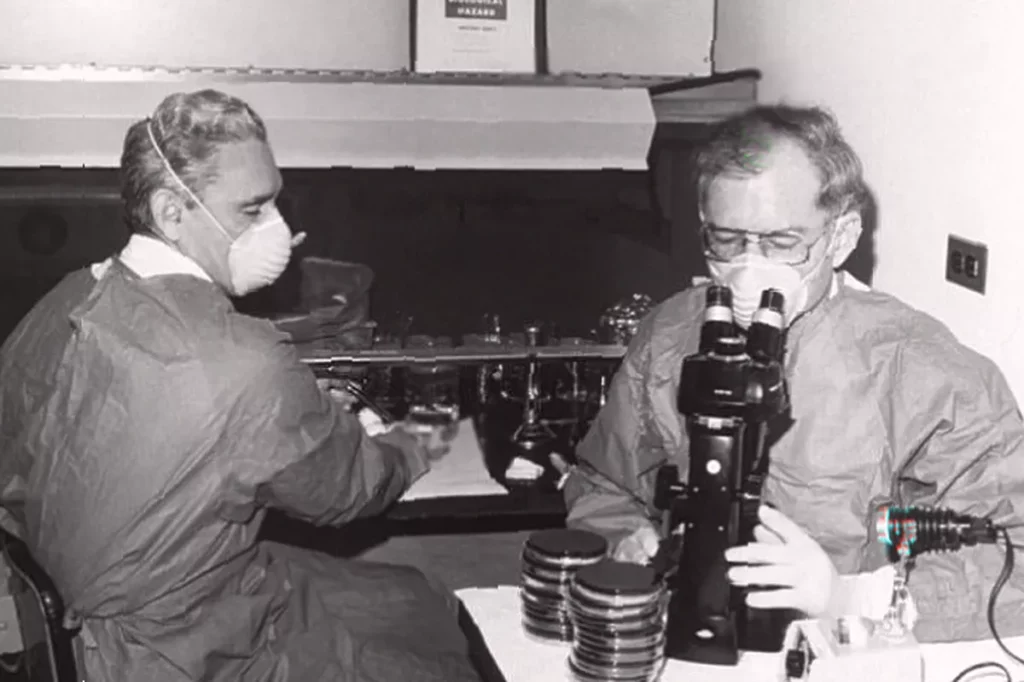
More than 200 delegates at an American Legion convention in Philadelphia fell ill with a mysterious pneumonia in July 1976; 34 of them died. It would take months of painstaking laboratory work to identify the culprit – a previously unknown bacterium that thrives in the very water systems designed for comfort.
The discovery of a new pathogen
In the aftermath of the outbreak at the Bellevue-Stratford Hotel, doctors and scientists were baffled. Standard tests for known bacteria and viruses came back negative, and theories ranged from heavy metal toxins to viral infection – and even to terrorism or extraterrestrial causes. One of the physicians on the front line, a newly minted pulmonary fellow at Hahnemann University Hospital just a mile from the hotel, treated some of the first patients without knowing what they were facing.
It was not until December 1976 that Dr. Joseph McDade, a microbiologist at the U.S. Centers for Disease Control and Prevention (CDC), isolated and identified the organism after detailed microbiological investigation and animal testing. The newly recognised bacterium was named Legionella pneumophila – literally “Legion’s lung-loving” – after the convention that first brought it to light.
The discovery allowed scientists to re-examine earlier, unexplained respiratory illnesses. The first known domestic epidemic was retroactively linked to an outbreak at a Hormel Foods Corporation meat-packing plant in Austin, Minnesota, in 1957. A milder form of the disease, Pontiac fever, which had affected workers and visitors at a Michigan health department building in 1968, was also confirmed to be caused by the same microbe. Pontiac fever does not lead to pneumonia and typically resolves without treatment, unlike its more deadly relative.
How Legionella thrives and spreads
Legionella pneumophila differed from any infectious respiratory organism known at the time because it multiplied in an environmental water source and was not spread by person-to-person contact – transmission between individuals remains extremely rare. The bacterium is Gram-negative and aerobic, and its unique lipopolysaccharide structures make it colourless when standard laboratory staining methods are used, rendering it difficult to identify. It has two distinct life-cycle phases: a replicative phase and an infectious phase, during which it becomes motile and more toxic.
The key to understanding the 1976 outbreak lay in the hotel’s air conditioning system. Epidemiological investigations traced the source to the cooling towers, where the bacterium had proliferated in biofilms – the slimy layers that grow on wet surfaces. That discovery prompted new global regulations for climate control systems, but it also revealed a far broader habitat.
Scientists now know that Legionella can thrive in a wide range of engineered water systems. Household pipes and plumbing fixtures, whirlpools, hot tubs, spas, humidifiers, decorative fountains, and even composted materials and moist soil can provide a home for the bacterium. It favours warm, stagnant water, particularly when biofilms are present. From these environments, tiny water droplets – aerosols – containing the bacteria can become airborne and be inhaled by nearby people. The disease is contracted through this route, not by drinking contaminated water.
Preventing Legionella growth requires careful management of building water systems. Disinfecting pipes and cooling towers can reduce the bacteria, and new designs can minimise the production of aerosols. Current consensus guidelines emphasise keeping hot water lines above critical temperatures – above 60°C (140°F) – and cold water below 20°C (68°F), while avoiding stagnant zones where chlorine in the water can decay. Regular flushing of showers and taps after periods of non-use, along with routine risk assessments, are also recommended, particularly in hospitals, hotels, cruise ships and large office buildings where monitoring is now standard.
One professor of environmental engineering at Drexel University in Philadelphia has developed methods to assess the risk from environmental microorganisms, and students there have used those methods to calculate critical concentrations of Legionella for water management. The bacterium is only one of dozens of species of micro-organisms that can cause respiratory illness from airborne water particles. In fact, there are over 66 species and 70 serotypes of Legionella, with L. pneumophila serogroup 1 being the most common cause of human infections. Other species, such as L. longbeachae, can also cause Legionnaires’ disease and Pontiac fever.
Modern treatment and management
In the early days of treating Legionnaires’ disease, the standard antibiotic was erythromycin, but it carried many side effects. Today, doctors typically treat the condition with newer antibiotics such as azithromycin or levofloxacin, which are also used for a variety of infections. Treatment usually lasts one to three weeks, and severe cases may require hospitalisation with intravenous antibiotics, oxygen therapy or mechanical ventilation.
The disease runs a spectrum from very mild symptoms – cough, chest congestion, headache, muscle aches, fever and chills – to severe pneumonia requiring prolonged hospital care. Confusion, diarrhoea, nausea and vomiting can also occur. The incubation period is typically two to 19 days, with six to seven days being most common. Fortunately, rapid diagnostic tests have been developed. Hospitals now use urine antigen tests to detect the organism in urine, alongside blood and respiratory specimen tests, allowing quicker identification and treatment.
Despite these advances, infections remain a significant public health problem. Reported cases of Legionnaires’ disease in the United States have risen sharply: currently there are about 2.5 confirmed cases per 100,000 people per year, a fivefold increase since 2000, according to the CDC. The economic burden in the U.S. alone is estimated at more than US$1 billion per year. Cases peak during warm, humid weather or after rain, and the bacteria continue to find niches in cooling towers, hot water tanks, hospital plumbing and decorative fountains.
Notable outbreaks have occurred worldwide. In 1999, a whirlpool spa at a flower show in the Netherlands caused at least 188 illnesses and 21 deaths. In 2015, multiple building cooling towers in New York’s South Bronx led to 138 cases and 16 deaths. More recently, an outbreak that began in late July 2025 in the Harlem neighbourhood of New York resulted in 90 hospitalisations and seven deaths.
In the United Kingdom, the disease has also left a significant mark. A major outbreak at Staffordshire Hospital in 1985 caused 175 cases and 28 deaths, traced to the hospital’s air-conditioning cooling tower. In 2002, an outbreak at a leisure facility in Barrow-in-Furness led to 180 cases and seven deaths, and in 2012, an Edinburgh outbreak resulted in 92 cases and four fatalities. In 2019, there were 33 deaths attributed to Legionnaires’ disease in the UK. The case fatality rate in England and Wales was estimated at 3.1% in 2023 and 2.8% in 2024. The majority of cases occur in individuals aged 60 and over, with males accounting for around 70% of infections; smoking is a significant risk factor, present in over half of cases. In 2024, 472 cases of legionellosis were reported in England and Wales, a decrease from the previous year, with most exposures being community-acquired (51.6%) and a substantial proportion linked to travel abroad (43.8%).
The UK Health Security Agency (UKHSA) is currently investigating a rise in cases in parts of northwest and southwest London, focusing on potential sources such as cooling towers and spa pools. This ongoing surveillance highlights that, despite decades of study, the bacterium remains a persistent threat. Current clinical tests may still miss much of the diversity of Legionella, but molecular biological tools are improving rapidly, and DNA-based methods are expanding the diagnostic toolkit – offering hope for earlier detection and better prevention of future outbreaks.