

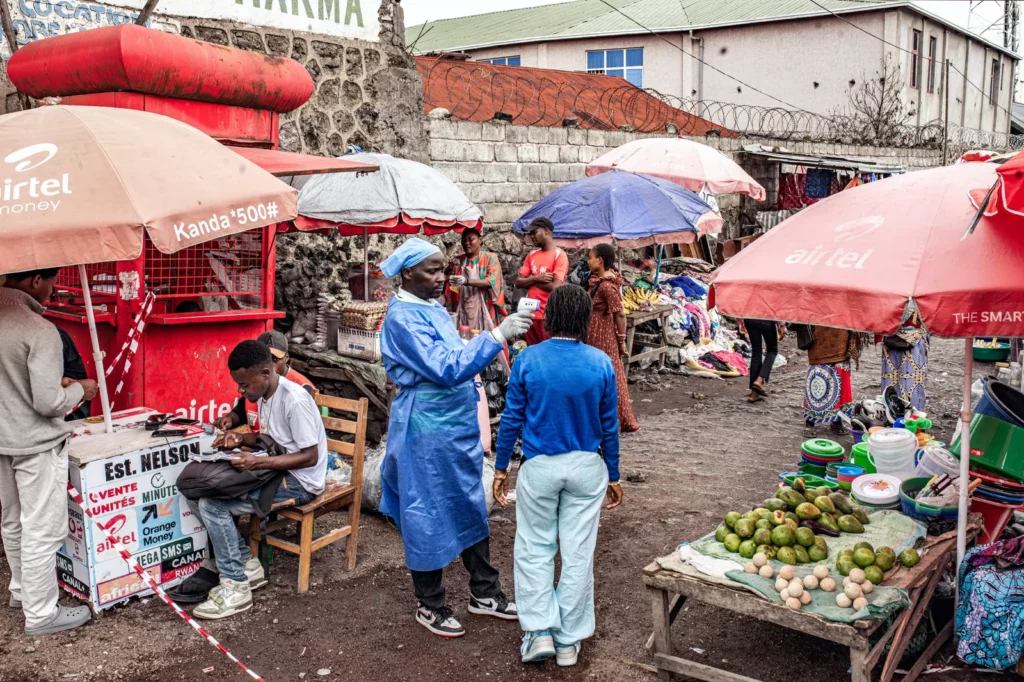
Decades of development failure are fuelling the current Ebola crisis in the Democratic Republic of the Congo, the head of the country delegation for the International Committee of the Red Cross has warned, as the outbreak spreads faster than any previous epidemic in the nation’s history.
Structural collapse behind the outbreak
François Moreillon, the ICRC’s chief in the DRC, said the emergency could not be understood simply as a health crisis or the result of militia violence alone. “What we have is an acute protection crisis coupled with a structural crisis,” he told The Independent during a visit to London. “The structural dimensions stem from three decades of conflict in the eastern DRC, which have weakened institutions and access to essential services, and left families already struggling to meet their basic needs far ahead of the Ebola crisis hitting.”
The ICRC, which has been operating in the country since independence in 1960 and runs its seventh-largest field operation there with a budget of 81.1 million Swiss francs (£76 million), points to the state of water infrastructure as a stark illustration of long-term neglect. In Bunia, the capital of Ituri Province, the water system has seen no major improvements since it was first installed in the 1950s. In Goma, the capital of North Kivu, roughly half a million people depend on a single, highly vulnerable pipeline. Only about 20 per cent of the population in Ituri has access to clean water, and just 25 per cent have functional sanitation. The conflict has also damaged power lines, disrupting water and electricity supplies in cities such as Goma.
These deficiencies have left entire communities exposed to multiple disease outbreaks. “The absence of effective health, water, electricity and education services means that the people here have suffered not only from Ebola, but also from mpox and cholera in recent years,” Mr Moreillon said. The ICRC’s surveys have repeatedly found clinics looted because of the conflict, and large numbers of medical professionals report security concerns at their workplaces. The healthcare system in eastern DRC was already fragile, with a severe shortage of physicians and nurses, and many health facilities face medication shortages. A significant number of clinics have seen staff leave because of the violence.
Extreme poverty remains pervasive across the affected provinces. The lack of sustained investment in essential infrastructure — water systems, electricity, education and healthcare — has created what Mr Moreillon describes as a “structural crisis” that makes responding to any health emergency extraordinarily difficult. Displacement camps housing hundreds of thousands of people are severely lacking in water and sanitation services, according to NGOs working in the region, an environment that accelerates the spread of Ebola, mpox and cholera.
This long-term degradation means that when humanitarian aid flows to the DRC nearly halved in 2025 compared with 2024, communities were in a far worse position than they might otherwise have been. “If you do not make the necessary long-term investment in these places, then the impacts [of humanitarian aid cuts] become much more dramatic,” Mr Moreillon said.
Conflict escalates and aid shrinks
Beyond the structural failures, the current outbreak is also being driven by an acute escalation in fighting and a drastic reduction in international funding. “The context in which this crisis is happening is one where fighting is ongoing, and property is continuing to be destroyed, and access to health centres is impacted,” Mr Moreillon said. The number of wounded people the ICRC has assisted in the DRC has surged from 1,500 in 2023 to more than 4,000 in 2025. Dozens of armed groups operate across the east, creating constant displacement and making humanitarian access treacherous. More than five million people have been displaced in Ituri, South Kivu and North Kivu provinces alone. Displacement camps are often overcrowded with limited hygiene infrastructure, hindering efforts to isolate infected individuals.
Red Cross volunteers have been attacked while conducting safe burial operations — a vital part of containing the disease — and there are reports of patients fleeing treatment centres because of insecurity or misinformation. The fact that impacted areas are controlled by a mixture of government forces and non-state armed groups further complicates the response.
At the same time, humanitarian aid to the DRC has fallen by $600 million year-on-year. Last month, the UK minister for development acknowledged that foreign aid cuts — carried out by countries including the UK, the US, Germany and France — have been “counterproductive” to containment efforts, a view echoed by numerous NGOs. The UK is shifting its aid strategy from direct bilateral funding to broader multilateral investment, a move critics warn could have a devastating impact on fragile health systems in Africa.
The consequences are immediate. Contact tracing — a strategy vital to containing the disease — is currently running at around 65 per cent, up from 45 per cent a few weeks ago but still far short of the 95 per cent required to bring the outbreak under control. The ICRC’s own budget for 2026 has been cut by 17 per cent compared with 2025 because of declining donor contributions. The exodus of NGOs from the region and the unwillingness of development actors to invest in infrastructure mean the ICRC — typically focused on humanitarian work in conflict zones — is now being forced to support interventions it has not traditionally handled, including maintaining water systems in Bunia and Goma. “We are not adding a new water distribution system, but maintaining a system so that it does not collapse,” Mr Moreillon said. “These kinds of things should not be in our hands, but it is where we are with so many development actors pulling out.”
This is the 17th Ebola outbreak in the DRC, and the number of cases has risen faster than in any previous one. The current strain is the rare Bundibugyo virus, for which existing Ebola treatments may not be fully effective, further complicating the response. As of late June 2026, the DRC has reported more than 1,155 confirmed cases and 304 deaths. Neighbouring Uganda has also recorded 20 cases and two deaths, many linked to travel from the DRC. The Red Cross has warned that the epidemic may not have peaked and could last a year.
Global relevance of a distant crisis
While events in the DRC can seem far away, Mr Moreillon stressed that citizens of wealthy countries should not assume the crisis has no bearing on their lives. “It is important for us to express solidarity, but also to remember in this globalised world that what is happening quite far away may still have an impact on us,” he said, speaking just ahead of the news that France had recorded Europe’s first Ebola case stemming from the current outbreak — a doctor who had returned from a humanitarian mission in the DRC.
The outbreak serves as a stark reminder that a weakened global health system leaves everyone exposed. The US withdrawal from the World Health Organization and cuts to USAID have been cited as factors contributing to the current situation. Without increased funding, the humanitarian sector will struggle to address the needs of the most vulnerable, and the disease will continue to spread across borders.