

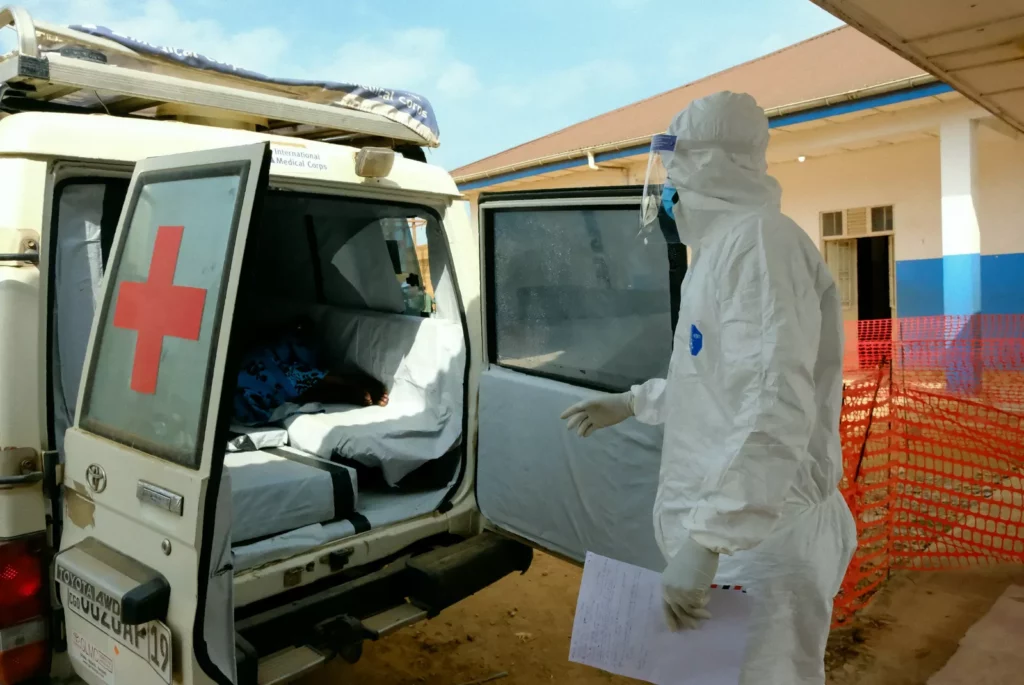
Maternal deaths are rising in the Democratic Republic of Congo as pregnant women increasingly avoid hospitals for fear of contracting Ebola, raising alarm that the outbreak is triggering a second, preventable health crisis. The United Nations Population Fund (UNFPA) has recorded seven maternal deaths in eastern Ituri province this year compared to just two during the same week last year. At least three of those deaths are directly linked to the outbreak, the agency said, with women either too scared to attend a health facility or presenting symptoms consistent with Ebola.
Fear drives pregnant women away from care
The impact of Ebola-related fear on maternal health services has been stark. In Bunia, the provincial capital of Ituri, prenatal consultations at one clinic have plummeted from around 60 expectant mothers a month to just ten, according to the clinic’s medical director, Dr Sonny Mwembo. Across the region, some pregnant women are now asking medical professionals to visit their homes to avoid health centres entirely. One community member, whose wife is six months pregnant, said she stopped attending prenatal check-ups after the nurse who conducted her last examination later fell ill and died of Ebola.
Noemi Dalmonte, UNFPA’s deputy representative in the DRC, said women fear infection and are also exposed to widespread misinformation about the disease. “This epidemic started in a mining area. The province is affected by war but the area is not really a war zone. There are not a lot of people who are used to humanitarian workers,” she said. Some community members blame international NGOs for the outbreak, deepening distrust of the very organisations trying to help.
The consequences for pregnant women who do contract the virus are devastating. Ebola infection during pregnancy is associated with a near-total loss of the baby and a high risk of the mother dying from severe bleeding. Yet maternity care has suffered disproportionately from aid cuts. In the broader Ituri response area, UNFPA estimates approximately 37,820 pregnant women are at risk, with 642,000 women of reproductive age across its full DRC response area exposed to danger.
Women account for more than 54 per cent of confirmed cases in the current outbreak, a figure driven by their roles as primary caregivers for the sick. Beyond direct infection, women and girls face heightened risks of sexual violence and exploitation as disrupted health services force them to travel further for water and hygiene, increasing their vulnerability.
A rare virus with no approved treatments
The outbreak is caused by the rare Bundibugyo strain of Ebola, which has no approved vaccines or specific treatments. Among the DRC’s 16 previous outbreaks, the more common Zaire virus, for which a vaccine exists, was responsible for most. The Bundibugyo strain has historically caused high mortality: 32 per cent in Uganda in 2007 and 55 per cent in the DRC in 2012. Clinical trials for promising experimental medicines, including Mapp Biopharmaceutical’s MBP134, are expected to begin soon, and the Coalition for Epidemic Preparedness Innovations (CEPI) is fast-tracking three candidate vaccines. So far, 74 patients have recovered from the disease.
Since the outbreak was declared just over a month ago, confirmed Ebola cases across the DRC and neighbouring Uganda have reached at least 894, with more than 200 deaths, according to Africa’s Centres for Disease Control and Prevention (Africa CDC). Experts say the true infection rate could be far higher. The outbreak is concentrated in Ituri province, which accounts for more than 90 per cent of cases, and has also spread to North Kivu and South Kivu provinces and across the border into Uganda, including the capital Kampala, where 19 confirmed cases and two deaths have been recorded. The World Health Organization declared the outbreak a Public Health Emergency of International Concern on 17 May 2026.
Funding gaps and weakened health systems
The response to the outbreak is severely hampered by pre-existing weaknesses in health infrastructure, exacerbated by significant cuts to international aid. Global humanitarian funding for the DRC has been slashed by nearly 46 per cent, from $2.58 billion in 2024 to $1.4 billion in 2026, the lowest coverage rate in a decade. The withdrawal of US funding for disease surveillance, overseen by President Donald Trump last year, has been a critical factor. “Last year was a shock to the system in the DRC – it’s one of the least developed countries with one of the highest maternal mortality rates,” said Ms Dalmonte. “That shock created a situation that made an outbreak easy because the health system was very dependent on international aid.”
Contact tracing coverage has fallen to 43 per cent, according to Oxfam, far below the 79 per cent recorded a month into the 2018-2020 DRC outbreak. Africa CDC official Wessam Mankoula said that for 800 confirmed cases, the list should contain between 17,000 and 35,000 contacts, but only around 4,000 have been tracked and are being evaluated – less than 15 per cent. “We are still far from controlling the situation of this outbreak,” he said.
Donors have pledged $910 million (£689 million) in support, but less than $90 million had actually been made available, Dr Mankoula added. The US Centers for Disease Control and Prevention (CDC) has announced it will release $107 million in emergency funding, but Africa CDC warns of a $21.5 million deficit. “Some of those pledges just came recently, two days ago, following the engagement with different countries either from the continent or outside of the continent,” Dr Mankoula said. “We’ll keep following up with different member states and different partners about their commitment to turn those pledges into actual money.”
On the ground, health workers face severe shortages of personal protective equipment, particularly for midwives. Esther Ileli, who supports UNFPA midwives in Bunia across different hospitals and has been based in Ituri province for six years, said: “This is a very stressful situation with a heavy workload. We have to consider how to help births, as well as protection and prevention of Ebola.” She added that mistrust of midwives persists, and that doctors and nurses have died. UNFPA has begun an outreach programme with local women’s organisations. “Ebola exists. Ebola kills: women, men, girls, boys. But reproductive health needs to continue and we are working to protect women,” Ms Ileli said.