

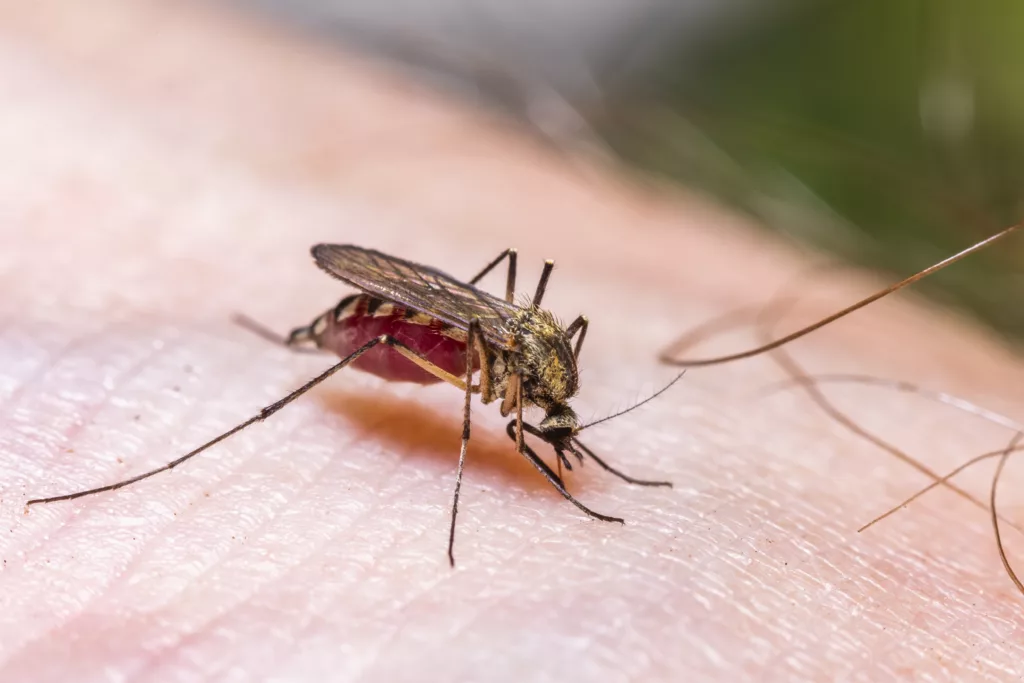
Britain has recorded its hottest June day on record, with the mercury hitting a provisional 36.7°C in Merryfield, Somerset, just as experts warn that the heatwave is creating the ideal breeding conditions for a surge in mosquitoes capable of carrying serious diseases.
Record-Breaking Heat
The Met Office confirmed that Thursday afternoon’s temperature exceeded both the previous day’s high of 36.1°C in Gosport, Hampshire, and the long-standing June record from the much-discussed summer of 1976. The heat was not confined to England: Wales provisionally set a new daily maximum for June with 35.9°C in Cardiff, while Northern Ireland equalled its warmest June day on record at 30.8°C in Castlederg. Night-time temperatures also broke records, with Cardiff recording its highest minimum temperature for June at 23.5°C. These extreme readings come as part of a broader European heatwave that has triggered multiple health alerts and disruptions across the continent.
The Mosquito Threat
Dr Mojca Kristan, assistant professor in medical entomology at the London School of Hygiene and Tropical Medicine (LSHTM), said the current weather conditions are “perfect for mosquitoes”. The insects thrive in warmth and require standing water to lay their eggs. “May was too dry, but we’ve had rain in June so there’s water around and, as the weather continues to warm up, I would expect mosquitoes to emerge and start biting to get the blood they need to breed,” she explained. Female mosquitoes bite to obtain blood, which is essential for egg development, and eggs can hatch in a matter of days if temperatures are high enough.
While native UK mosquitoes are not considered a major disease risk, Dr Kristan warned that invasive species capable of carrying nasty illnesses such as dengue fever and Zika could take hold in the coming years. The two most concerning are Aedes albopictus, known as the Asian tiger mosquito, and Aedes aegypti, the Egyptian mosquito. Both are vectors for dengue, chikungunya and Zika, and Aedes aegypti can also transmit yellow fever. Neither species is currently established in the UK, but eggs of Aedes albopictus have been detected here — first in 2016 and again in August 2024 at a service station on the M20 in Kent. Eggs of Aedes aegypti were discovered in a freight storage facility near Heathrow Airport in September 2023, though that was understood to be an isolated incident.
Climate models suggest that parts of southern England, particularly the Southeast, are becoming increasingly suitable for these mosquitoes. According to modelling studies, by the 2040s the Asian tiger mosquito could be widely established across England, and by the 2060s the climate in London and surrounding areas is most likely to help the endemic transmission of dengue fever. Under high-warming scenarios, diseases once confined to the tropics could become “national domestic diseases”, experts have warned.
Some of these viruses are already present in Europe, especially around the Mediterranean. Locally acquired dengue cases have been reported in France, Italy and Spain, with Paris experiencing local outbreaks. In 2023, Europe reported 122 dengue cases. Chikungunya has caused significant outbreaks in France and Italy in 2025, and the virus can now be transmitted by mosquitoes across most of Europe — with transmission possible for up to two months in southeast England. The UK recorded 73 travel-related chikungunya cases between January and June 2025, nearly triple the number from the same period in 2024. Seven Zika virus cases were recorded in the UK in 2025, and local mosquito-transmitted Zika has occurred in Europe as recently as 2019.

Beyond the Aedes species, concern also surrounds native Culex mosquitoes — Culex modestus and Culex pipiens — which can carry West Nile virus and Usutu virus. Fragments of West Nile virus genetic material were detected in UK mosquitoes for the first time in samples from 2023. While the risk to the public is currently low, the virus has expanded across Europe and the detection is considered a significant development. Most infected individuals experience no symptoms or mild illness, but around one in 150 cases can lead to severe neurological effects and potentially death.
Malaria is not endemic in the UK, but around 2,000 imported cases are reported annually among travellers returning from high-risk areas. In 2023, imported malaria cases in England, Wales and Northern Ireland exceeded 2,000 — the highest figure in 20 years. London consistently reports the largest proportion of these cases, and the increase is linked to global travel, including visits to friends and relatives in endemic regions. Experts still believe it is unlikely that malaria will become endemic in the UK, but the Anopheles mosquitoes that can transmit the parasite are present.
Symptoms of the diseases carried by these mosquitoes vary. Dengue fever can feel like flu, with a high temperature, severe headache, pain behind the eyes, muscle and joint pain, and nausea. Severe cases can lead to internal bleeding and be fatal. Chikungunya causes fever, joint pain, headache, muscle pain, joint swelling and a rash, with joint pain often persisting for months. Zika is usually mild in most people but is serious in pregnant women, where it can cause stillbirth, miscarriage, developmental problems and microcephaly — abnormally small heads — in infants.
Preventative Measures
Dr Kristan advised that people can take straightforward steps to reduce their risk of bites. “Wear insect repellent and cover your skin with long sleeves, plus wear socks in the evening as mosquitoes like biting around ankles,” she said. The UK Health Security Agency (UKHSA) conducts active surveillance for invasive mosquitoes, focusing on early detection and preventing establishment. Members of the public can help by clearing standing water from gardens — buckets, old tyres, clogged gutters and other small containers provide ideal breeding sites. Clinicians have also been advised to consider a wider range of mosquito-borne infections when assessing patients, particularly those who have travelled abroad.
Dr Kristan summed up the situation: “At the moment there’s a low risk of bites from UK mosquitoes spreading serious illness, but we have to be alert to the threat of new disease-carrying mosquito species as climate change makes Britain a more attractive place for mosquitoes to survive and thrive.”