

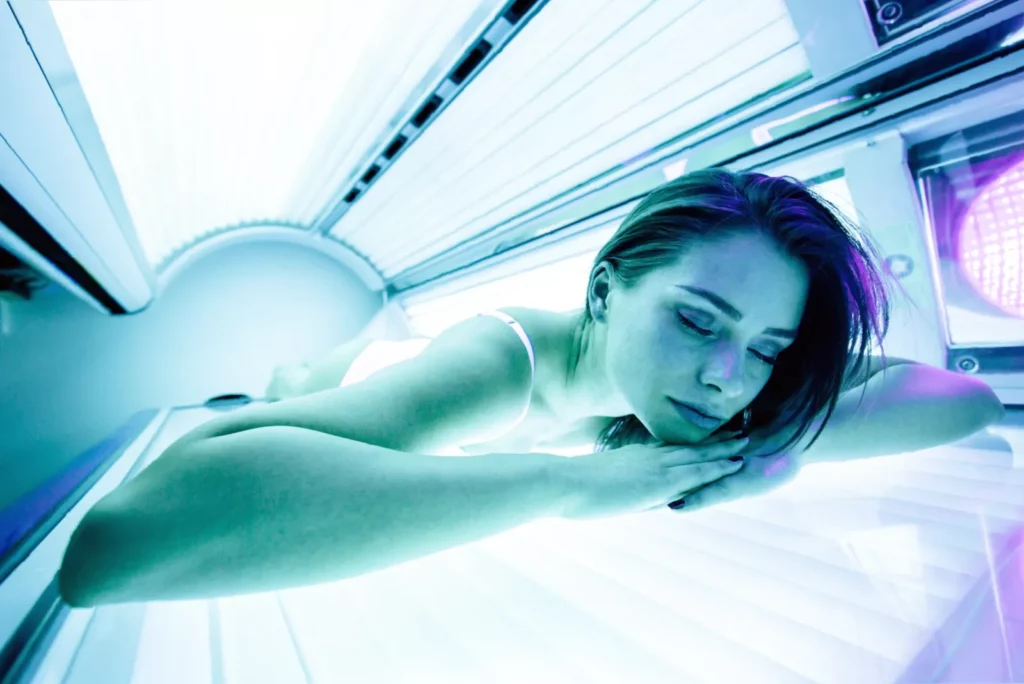
Government advisers are urging ministers to consider a “total ban” on commercial sunbeds, warning that current laws have failed to curb their use and that young people are increasingly turning to them despite known cancer risks.
The recommendation comes in a new report from the Committee on Medical Aspects of Radiation in the Environment (Comare), which advises the government on the health effects of radiation. The committee’s 21st report reviews the latest scientific evidence and concludes that sunbed use is a “small but important contributor to the total skin cancer burden in the UK”. It explicitly calls on ministers to “consider whether it is appropriate to introduce a complete ban on the commercial use of sunbeds” and to revisit recommendations first made in 2009.
The report paints a stark picture of ineffective regulation. Despite legislation introduced in England and Wales in 2011 – and earlier in Scotland – making it illegal for under-18s to use commercial sunbeds, Comare found that “the numbers of commercial sunbed outlets in the UK do not appear to have declined appreciably since 2009, suggesting that use has also not been much reduced”. The authors noted “indications of increasing use by young people” and highlighted that some operators are making “false and unsubstantiated claims of health benefits”, often amplified on social media platforms.
Regulatory failures and rising youth usage
Investigations have repeatedly revealed that teenagers as young as 14 are still accessing tanning salons, despite the age ban. Enforcement has been inconsistent, with a lack of ID checks and unsupervised “tap and tan” facilities allowing underage use to continue. The Department of Health and Social Care has launched consultations on stricter measures – including mandatory ID checks, banning unsupervised machines, and prohibiting the sale or hire of sunbeds to under-18s for private use – but Comare argues that even these proposals may not go far enough.
Recent data shows that around 28% of UK adults use sunbeds, with the figure rising to 43% among 18- to 25-year-olds. Belfast has been identified as the “sunbed capital of the UK”, where 37% of adults use them. Sunbed salons are also more prevalent in deprived areas, correlating with higher melanoma rates in young women. Comare’s report emphasises that these patterns reflect a persistent failure of the current regulatory framework.
Overwhelming health evidence
Sunbeds emit high-intensity ultraviolet (UV) radiation and are classified as Group 1 carcinogens by the World Health Organisation and the International Agency for Research on Cancer – placing them in the same category as tobacco and asbestos. Cancer Research UK states unequivocally that there is “no such thing as safe UV tanning”, warning that a tan is a sign of skin damage.
The evidence of harm is specific and compelling. Using a sunbed before the age of 35 increases the risk of melanoma – the deadliest form of skin cancer – by between 59% and 75%. Studies suggest that sunbed use causes approximately 440 melanomas and around 100 deaths each year in the UK. Melanoma is one of the most common cancers in young people aged 15 to 24. Health authorities including the NHS and the British Association of Dermatologists (BAD) have repeatedly warned that any UV tanning is unsafe.
Comare’s report also notes emerging evidence of addiction to sunbed use, and criticises the industry for making unsupported health claims – such as benefits for vitamin D, mood, and treating conditions like seasonal affective disorder and psoriasis. The Advertising Standards Authority has banned ads for making such claims.
A cost-effective ban with international precedent
The report acknowledges that a ban “should save lives and reduce costs of cancer treatment”, though it also points to “wider policy considerations, for example in relation to the constraint on freedom of individual choice, which applies to a range of self-imposed risks”. Any ban would require “careful planning, with supporting public awareness campaigns and strong enforcement”.
A study cited by Comare found that a ban on commercial sunbeds would be cost-effective, leading to fewer cases of skin cancer, reduced deaths, and easing the burden on the NHS. One estimate projected 1,206 fewer melanoma cases and 207 fewer deaths, saving the NHS £700,000, while another calculated a net monetary benefit of £10.6 million over a lifetime for 18-year-olds in England. Internationally, Iran, Brazil and Australia have already implemented bans on commercial sunbeds, with private or home use remaining permissible. Australia banned sunbeds in 2016.
Medical experts welcome the call for action
Dr Tamara Griffiths, president of the British Association of Dermatologists, welcomed Comare’s findings. “There is now a consensus that sunbed regulation and enforcement in the UK are not strong enough,” she said. “Comare’s recommendations are sensible, practical steps that would strengthen protections for the public, and we welcome them.”
She expressed particular encouragement that Comare “has explicitly recommended that the government needs to consider a total ban on the commercial use of sunbeds”, adding, “The British Association of Dermatologists believes that the case for a ban is already strong.”
Highlighting the industry’s shortcomings, Dr Griffiths said: “Sunbed operators have demonstrated that they are not able to consistently meet existing requirements, including limits on the amount of UV radiation emitted by their machines and age restrictions.” She noted that “some operators have also made health claims about sunbed use that are not supported by the evidence. This is not true of every operator, but it is a persistent issue.” The British Photodermatology Group, which strongly discourages the use of UV equipment for cosmetic tanning, has also added its support for a ban.
“Stronger regulation will only protect the public if it is implemented, monitored, and enforced effectively,” Dr Griffiths warned. “If the industry has struggled to meet existing standards consistently, the Government should be cautious about relying on tighter rules alone. A ban on commercial sunbeds remains the clearest and most effective way to reduce avoidable harm.”
The Department of Health and Social Care has been approached for comment.