

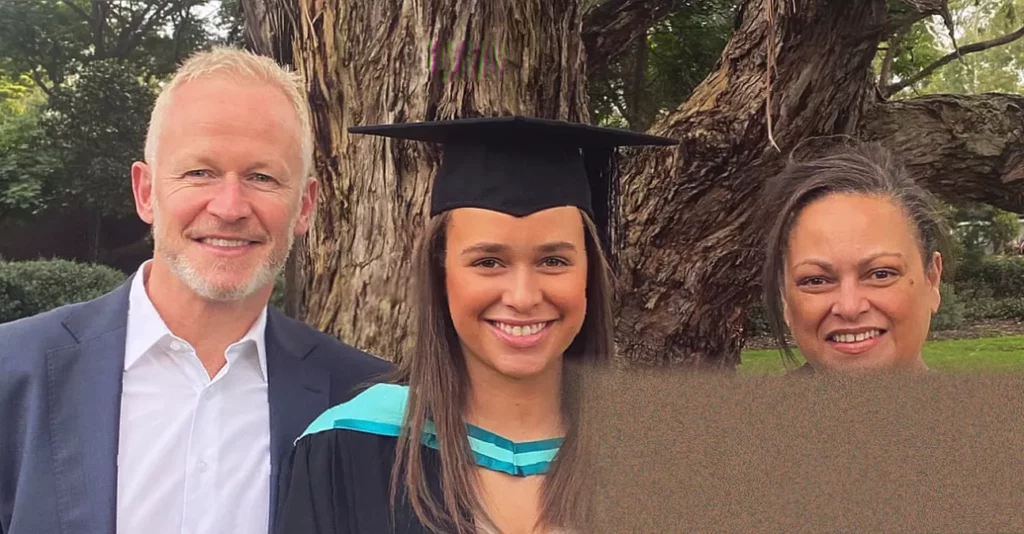
Alexandra Thoms had spent the evening assembling a flat-pack dining table with her father, Gordon, in the two-bedroom Melbourne apartment she had moved into just weeks earlier. At 23, she was a homeowner, a double-degree graduate with a job at Deloitte, an avid skier and gymgoer – healthy, ambitious and full of plans. She sent her parents a picture of the food she had cooked that night, placed her phone next to her pillow and went to sleep. It was Sunday 27 August 2023, and it was the last time she would ever close her eyes.
The next morning, when Alexandra failed to call – she spoke to her parents every day, usually the first to dial – Gordon and Bronwyn grew concerned. By nightfall, with no answer to repeated calls, they drove to her apartment. The door was locked. Deliveries lay untouched outside. They called the police and fire brigade, who forced the door open. A young officer emerged and looked at Gordon. “I’m so sorry,” he said. Alexandra was lying on her bed in her pyjamas. “It was clear she had instantly passed away,” Gordon later recalled. “No struggle.” The cause was later identified as arrhythmogenic cardiomyopathy – an inherited condition in which the heart’s electrical signals can misfire – that had gone entirely undetected.
The hidden threat to young hearts
Sudden cardiac arrest kills millions of people worldwide each year. When a heart’s electrical system fails, the muscle quivers instead of pumping rhythmically, cutting off oxygen-rich blood to the brain and other organs. Unless the rhythm self-corrects or is restored by a defibrillator, death follows within minutes. The fatality rate is around 90%, making it a sudden cardiac death. And while public health campaigns have driven down overall cardiovascular disease deaths by 80% over the past half-century, the rate of sudden cardiac death among young Australians has remained virtually unchanged.
In the United Kingdom, an estimated 12 people aged 13 to 45 die each week from undiagnosed heart conditions. According to research from the UK’s national cardiac pathology referral centre at City, University of London, the incidence of sudden cardiac death in young people aged 1 to 35 is around 1.3 cases per 100,000 person-years, with males accounting for 72% of cases. In the United States, about 2,000 people under 25 die each year. In Australia, studies suggest that, on average, one person under 35 experiences a sudden cardiac arrest every day; most do not survive. The charity Alexandra’s Mission, founded by her father, puts the number even higher: seven young Australians aged 1 to 35 lose their lives to sudden cardiac death every week – approximately 360 cases a year, extrapolated from Victorian data.
“It’s just such a shock to the families,” said André La Gerche, an academic cardiologist and head of the Heart Laboratory at St Vincent’s Institute of Medical Research and the Victor Chang Cardiac Research Institute, who chairs the Australian Sudden Cardiac Arrest Alliance. “The child goes off to school and doesn’t come home, or goes to bed and doesn’t wake up. They go from being perfectly well to not being there at all.” He added that research into sudden cardiac death is underfunded and public awareness is low, even within the medical community.
What causes a young heart to stop?
The exact cause of sudden cardiac arrest varies, but all cases share one feature: an immediate loss of consciousness. “A sudden cardiac arrest is dramatic,” said Elizabeth Paratz, a cardiologist at St Vincent’s Institute of Medical Research and the Victor Chang Cardiac Research Institute. “That’s when the heart stops suddenly and you need resuscitation. It can stop for a whole heap of reasons.” In young children, inherited conditions that interfere with the tiny electrical impulses telling the heart muscle to squeeze – known as arrhythmias – are typical. In teenagers and young adults, structural abnormalities called cardiomyopathies become more common; these can cause an electrical short-circuit or pump failure.
Arrhythmogenic cardiomyopathy, the condition that killed Alexandra, is one such inherited disease. Others include channelopathies – genetic disorders of the heart’s electrical system such as Long QT Syndrome, Brugada syndrome and catecholaminergic polymorphic ventricular tachycardia. Brugada syndrome is a major cause of Sudden Arrhythmic Death Syndrome (SADS), particularly in young males who die in their sleep. In the UK, SADS is the most common cause of cardiac death in the young, affecting around 500 people each year.
Yet even after autopsy, about 40% of fatal cases in young people reveal a heart with no obvious flaw, leading to a classification of “unascertained”. “The younger you go, the more likely it is that the heart will look entirely normal and you won’t find a reason,” Paratz said. That was the case for nine-month-old Sonny Green, who died from cardiac arrest after mild symptoms of gastro. His cause of death was marked unascertained. A year later, his sister Airlie was born. At five months old, she also went into cardiac arrest but survived after having a defibrillator implanted. At 18 months, she contracted gastro again and suffered cardiac death. Only after Airlie’s first arrest did medical teams consider genetics: both children had a rare genetic disorder called PPA2, known to cause lethal cardiac failure, often triggered by viral illnesses. In adolescents and young adults, even a small intake of alcohol can be the fatal trigger. Sonny’s postmortem samples were tested; he had it too.
“It makes me think, how many deaths are classified incorrectly?” said Danielle Green, their mother, who has been lobbying policymakers to mandate genetic testing in postmortems for young people when the cause of death is unexplained. No Australian state government has such a mandate. Richard Bagnall, head of the Centenary Institute’s centre for cardiovascular research, said targeted postmortem genetic testing offers a critical way to identify at-risk relatives. “If you find a variant that caused the death, you can answer the two questions that almost every family will ask: why did this happen and how can we prevent it from happening again to other people in the family?”
Prevention, screening and the difference a defibrillator makes
Once an inherited condition is identified, preventive measures become available: periodic cardiac screening, lifestyle changes, medication, or an implantable cardioverter-defibrillator (ICD). In the UK, the charity Cardiac Risk in the Young (CRY) offers subsidised ECG and echocardiogram screening to individuals aged 14 to 35. The NHS typically offers screening only to those with symptoms or a family history, yet most sudden cardiac deaths occur without warning. Professor Elijah R. Behr at Mayo Clinic Healthcare in London has called for screening in high-risk groups including athletes, people with suspicious ECG findings, and those with a family history of inherited heart disease or unexplained premature sudden cardiac death.
International approaches vary. Japan offers mass screening to the general school population. Italy makes cardiac screening mandatory for competitive athletes. Australian cardiologists tend to favour more targeted measures, citing the costs of mass screening and the prevalence of false positives that could cause anxiety and unnecessary follow-up tests.
The presence of automated external defibrillators (AEDs) dramatically improves survival. Cardiologists told Guardian Australia that widespread AED availability could push cardiac arrest survival rates from 10% to about 20%. In August 2024, then 12-year-old Xavier Arruzza collapsed at soccer training in Sydney’s south-west. A club member started CPR; a trained volunteer alerted via the GoodSAM app took over; another person rushed the club’s AED to the child. Three shocks later, his heart resumed its rhythm. “Without the defibrillator, I don’t think he’d … I am one of the lucky ones,” said his mother, Rose. In Australia, charities including Heartbeat of Football – founded by sports broadcaster Andy Paschalidis after seeing a teammate die on the pitch – have been pushing for defibrillators at community sporting grounds. South Australia is the only state that mandates AEDs in a range of public buildings; other states offer grants. About half of all European Union countries require citizens to complete CPR training, including defibrillator use, as a prerequisite for a driving licence. Japan and Sweden provide comprehensive training at school. In the UK, CPR training is now mandatory in schools, though a significant percentage of students still report not having received it, and there is no structured tracking of delivery.
The Danish footballer Christian Eriksen survived a cardiac arrest during a Euro 2020 match because he received immediate CPR and a defibrillator shock. He collapsed again in June 2026; this time an ICD implanted in his chest after the first episode restored his rhythm, and he walked off the field. “The paradox of exercise,” said Belinda Gray, director of the genetic heart disease clinic at Royal Prince Alfred Hospital, “is that it is protective for your overall cardiovascular risk, but there is also an increased risk of sudden death for elite athletes.” About 10% to 15% of sudden cardiac deaths occur during or immediately after exercise.
Other young victims include 17-year-old Edward Millear, who died after rowing training on the Yarra River; 14-year-old Joshua Oguns, who collapsed during a basketball game; and 15-year-old Kent Yamazaki, who died playing tennis. Their stories echo a grim statistic: sudden cardiac death ranks among the leading causes of fatalities in children and young adults, surpassing deaths from car accidents and various forms of cancer. “Statistically speaking, it’s a rare cause of death,” La Gerche said. “But it’s near the top of the reasons why a young person dies, and even when there’s a high‑profile case, it’s often soon forgotten.”
A family’s long road to answers
After Alexandra’s death, it took the Thoms family nearly two years to navigate the complex process of identifying the genetic cause, getting family members tested and taking preventive measures. The testing revealed that Alexandra’s younger brother, Charlie, now 24, has the same advanced cardiomyopathy. He now has an implanted defibrillator and takes daily medication. Gordon described the process as “long, cumbersome and stressful”. In Australia, referral systems for genetic testing through coroners, GPs and cardiologists are inconsistent; symptoms can go unrecognised, and access to specialist clinics is unequal between metropolitan and regional areas and higher and lower socioeconomic groups, according to Jodie Ingles, lab head and cardiac genetic counsellor at the Garvan Institute of Medical Research. “The reality out there in the community is that it’s just a total mess,” she said.
Gordon Thoms has set up Alexandra’s Mission, a charity aimed at preventing cardiac deaths in young people. “This is not about blame,” he said. “It’s about leadership, and recognising sudden cardiac arrest for what it is – a major, preventable public health emergency.” He thinks about his daughter skiing at her favourite spots at Mount Hotham in Victoria’s alpine region. “She loved adventure and was totally fearless – she would push me to ski in places that I wouldn’t have gone on my own, always with a big smile on her face. My wife and I often talk about how she lived her life almost as if she knew tomorrow may never come.”