

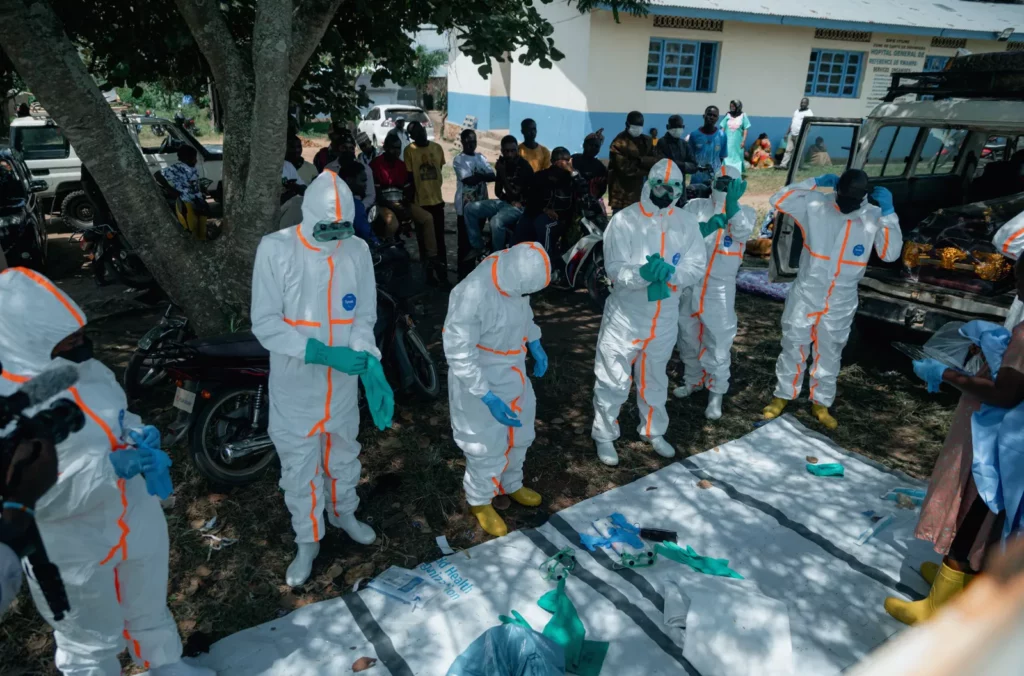
The Ebola outbreak in the Democratic Republic of the Congo (DRC) and Uganda could become the largest on record, the US Centers for Disease Control and Prevention (CDC) has warned, as computer models project the number of cases could grow to 20,000 or more depending on how quickly infected people are isolated.
The CDC’s warning comes as the number of confirmed cases in the DRC has risen to 544, with at least 91 deaths, according to the country’s health ministry. The epicentre remains Ituri province, where Africa Centres for Disease Control and Prevention (Africa CDC) has reported 515 confirmed cases. In neighbouring Uganda, there are 19 confirmed cases, including two deaths – five linked to local transmission and 14 with travel links to the DRC. Eight cases have been reported in Kampala and one in the neighbouring district of Wakiso.
The World Health Organization (WHO) declared the outbreak a Public Health Emergency of International Concern (PHEIC) on 17 May after cases were detected in both countries. Africa CDC followed with a Public Health Emergency of Continental Security declaration the next day. Ten other countries in the region are considered at risk by the African Union’s primary public health agency.
Health officials have warned that the outbreak is already outpacing the international response, with efforts to investigate and trace cases hampered by conflict, insecurity, displacement and weak access, according to the WHO. The number of confirmed cases has been significantly higher than in previous Ebola outbreaks through the first 21 days, and transmission likely remains active in affected communities despite existing contact tracing, testing and surveillance.
A different strain: the Bundibugyo virus
Unlike the devastating 2014–2016 West Africa outbreak, which killed 11,000 people and was caused by the Zaire ebolavirus, this crisis is driven by the Bundibugyo virus (BDBV) – a species first identified in Uganda in 2007. Bundibugyo is one of four ebolavirus species known to cause human disease, but it has caused relatively few outbreaks since its discovery.
The 2007 outbreak in Uganda recorded 56 laboratory-confirmed cases with a case fatality rate (CFR) of approximately 40%. A 2012 outbreak in the DRC had 59 cases and 34 deaths, a CFR of 50%. In the current outbreak, the reported CFR in the DRC stands at around 17.7%, though experts caution this is likely an underestimation because many deaths occurred before the outbreak was declared and remain under investigation. Symptoms of Bundibugyo virus disease are similar to other ebolaviruses – initially non-specific fever, headache, muscle pain, sore throat and fatigue – making early diagnosis challenging before progression to organ dysfunction, gastrointestinal symptoms and haemorrhage.
Critically, there is no licensed vaccine specifically for the Bundibugyo strain. Existing Ebola vaccines, such as Merck’s rVSV-ZEBOV and Johnson & Johnson’s Zabdeno/Mvabea regimen, were developed against the Zaire species and may not offer cross-protection. This absence of a proven prophylactic tool has fuelled warnings that the outbreak could rival the worst in history if containment efforts fail.
Response and funding gaps
A joint $518 million Ebola response plan was launched by the WHO and Africa CDC on 5 June, covering the six months from June to November 2026. The plan emphasises a “One Response” approach – bringing together governments, partners and communities – and focuses on emergency coordination, surveillance, laboratory testing, infection prevention, clinical care, community engagement and logistics.
The UK has pledged £21 million to the current outbreak, a fraction of the £427 million it committed to the West Africa outbreak. This contribution comes as the UK government cuts billions from aid spending, reducing the budget from 0.5 per cent to 0.3 per cent of Gross National Income (GNI) to fund increased defence spending. Baroness Chapman, the development minister, acknowledged in a BBC World Service interview during a trip to Kinshasa that the reduction could be seen as counterproductive in the face of an international health emergency. “Yes, in a way,” she said, but added: “We’re still spending just short of £10 billion on international development each year. What we have to do is make sure we spend that really well.” Africa is being hit particularly hard, with bilateral support to individual countries falling 56 per cent. Baroness Chapman also said of the wider response: “I’m not convinced we are sufficiently ready and we are under responding at the moment, but this can change and it does need to change.” A team from the UK is currently in Kinshasa and “working incredibly hard”, she added.
US foreign assistance spending has fallen by nearly 57 per cent after the Trump administration dismantled the United States Agency for International Development (USAID) last year. USAID had previously financed laboratory networks, disease surveillance programmes and emergency response capacity across Africa. The US has imposed entry restrictions and public health screenings at four airports, though the CDC assesses the risk to the US population as low, with minimal risk of cases being introduced and low risk of secondary transmission.
Misinformation and attacks on health facilities
Misinformation has proved almost as dangerous as the virus itself, the WHO’s Director-General, Tedros Adhanom Ghebreyesus, has warned. “Misinformation is almost as dangerous as the virus itself, and spreads just as fast,” he said after visiting the eastern province of Ituri. He cited conspiracy theories spreading online about the origin of the virus – some believing the outbreak is a hoax or that the disease comes from a bioweapons lab – and suspicion that aid workers spread the virus through their vehicle antennas.
This distrust has turned violent. In one town, residents set fire to isolation tents at a treatment facility after being prevented from taking the body of a local man who died from Ebola for burial – victims remain highly infectious after death. As a result, 18 people suspected of having the disease fled. At least three attacks on health facilities have been recorded. The uptick in humanitarian efforts amid decades of conflict and displacement has spurred suspicion of ulterior motives, according to health officials. The outbreak began in early May with clusters of severe illness affecting healthcare workers in the Bunia Health Zone in Ituri, a province already facing significant humanitarian and security challenges that continue to hamper containment.