

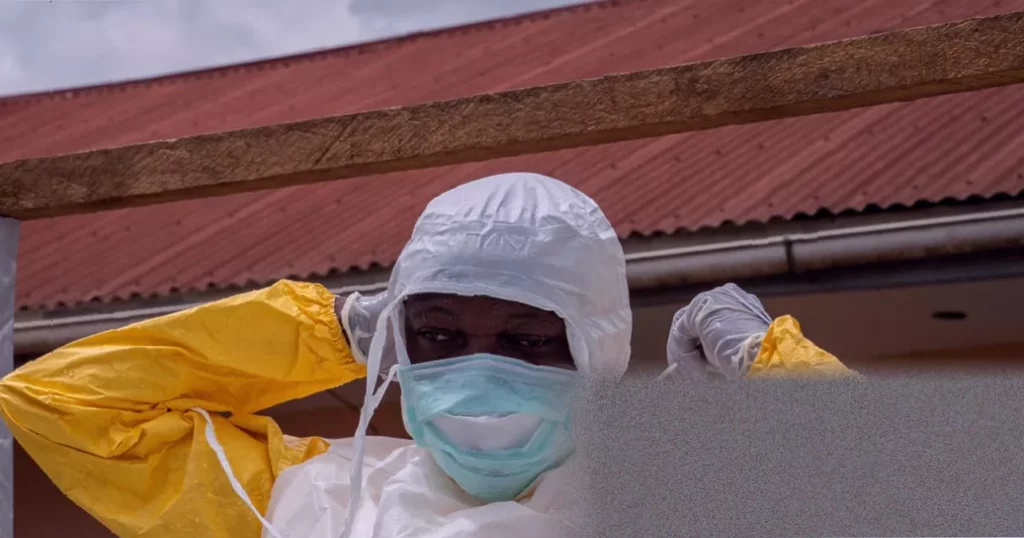
The Ebola outbreak in central Africa could spiral to match the scale of the 2014-2016 West African epidemic, the deadliest in history, according to a stark warning from US health officials. The US Centers for Disease Control and Prevention (CDC) on Friday published computer modelling that projects between 10,000 and more than 20,000 cases, depending on how quickly infected individuals are isolated. The West African outbreak recorded over 28,000 cases and more than 11,000 deaths.
Without strong public health interventions, “the modelling work suggests an outbreak of that scale is possible,” said Dr Satish Pillai, incident manager for the CDC’s Ebola response. The current isolation rate is unknown but believed to be on “the lower end of the scenarios” the CDC modelled, Pillai added. If isolation rates were raised to 50% or 70%, the number of cases could be closer to 10,000, CDC officials said. The modelling attempts to project different scenarios based on how many infections and deaths have already occurred and how quickly responders can identify and isolate infected people before they spread the virus to others.
Limited tools to slow the spread
The current outbreak is caused by the Bundibugyo virus (BDBV), a less common strain of Ebola with a case fatality rate of approximately 30-50%, lower than the Zaire strain but still highly lethal. There are no licensed vaccines or specific treatments for this strain, making containment reliant on classic public health measures: isolating infected patients, tracing contacts, and providing supportive care to manage symptoms such as fever, vomiting and diarrhoea. The virus is spread through direct contact with body fluids including vomit, blood and semen, and the bodies of deceased infected individuals are also highly contagious. It is not airborne.
Contact tracing has been a focus of the response. As of June 2, 2026, over 4,000 contacts had been identified and were under monitoring in the Democratic Republic of the Congo, according to health authorities. However, the work is severely hampered by insecurity and mistrust. Several treatments are in development, including monoclonal antibodies (MBP134 and Maftivimab) and the antiviral remdesivir, while three vaccine developers – IAVI, the University of Oxford and Moderna – are working on candidates specifically targeting the Bundibugyo strain using platforms similar to those for COVID-19 and existing Ebola vaccines. Clinical trials are anticipated within months. The World Health Organization (WHO) has advised against using the existing licensed Ebola vaccine, Ervebo, which targets the Zaire strain, outside of carefully designed research settings for this outbreak. The United States has also introduced enhanced travel screening and entry restrictions for travellers from affected regions, implemented by the CDC and the Department of Homeland Security.
The limits of modelling
Despite the alarming projections, experts urge caution. Jennifer Nuzzo, director of Brown University’s Pandemic Center, said the modelling “affirms what we have worried about since the beginning: this outbreak is following a dangerous trajectory” if more is not done to stop its spread. But she warned that predicting outbreak progression is extremely difficult with limited data. “I wouldn’t read too much into the specific numbers. It’s really hard to make an accurate projection when you have limited data,” she said. The CDC’s own record illustrates the uncertainty: during the 2014 West African outbreak, the agency modelled a worst-case scenario of 1.4 million infections if nothing was done – more than 50 times higher than the actual number of cases. The current models are based on factors including confirmed deaths and isolation rates, but if the actual number of deaths in late May were greater than recognised, the outcomes could be worse, CDC officials noted.
Conflict and insecurity fuel the crisis
The outbreak has been declared a Public Health Emergency of International Concern by the WHO, but the response is being crippled by an armed conflict in eastern DRC. The government is battling the Rwanda-backed M23 rebel group and the Islamic State-affiliated Allied Democratic Forces (ADF). The violence has caused mass displacement of people living in the conflict areas, officials say, forcing populations into remote areas where the virus can spread unnoticed. Health workers and treatment centres have been attacked, and infrastructure – including the closure of Goma airport – has hampered the delivery of medical supplies. The M23 group has downplayed concerns about the outbreak. Mistrust is rife: some communities, traumatised by years of conflict and fed misinformation, have attacked health centres, believing Ebola is not real. The same insecurity has disrupted vaccination campaigns and treatment for other diseases, exacerbating malaria and cholera outbreaks. Healthcare workers are at the highest risk of exposure, and there have been reports of them contracting the virus.
Health authorities in DRC and Uganda first declared outbreaks on May 15, 2026, and the WHO followed on May 17. Some experts believe infections may have been occurring as early as February 2026, but initial testing focused on a different Ebola strain. As of early June, the Africa Centres for Disease Control and Prevention reported about 400 confirmed cases, including 63 deaths. In the DRC, separate tallies put the number at 381 confirmed cases and 64 deaths as of June 3, while Uganda had 15 confirmed cases and one death as of June 2. Experts say there are probably other cases that have not been diagnosed or reported. Commentary on the outbreak has also pointed to a connection between deforestation and the emergence of Ebola, highlighting broader environmental factors. The UK Health Security Agency assesses the risk to the UK public as low, with imported cases being extremely rare. Poor road networks and limited health facilities in remote eastern Congo, combined with the closure of Goma airport, create significant logistical hurdles for a response that is already struggling against violence and distrust.