

Plushie breasts, lips and vulvas hand-stitched by HIV-positive women go on show at a new London exhibition, placing the intimate craftwork of Catwalk4Power at the heart of a story about protest, care and survival.
Rage and tenderness: the twin faces of HIV activism
Tenderness and Rage, which opens at the Wellcome Collection on 29 May 2026, takes its title from the dual nature of the AIDS response. Curator Adam Rose, an independent practitioner focused on lived experiences of health, accessibility and social justice, said the exhibition explores how activist groups and volunteer-led organisations have campaigned for dignity and human rights while providing the emotional support that sustained people through the epidemic.
Marc Thompson, a former service user at the Landmark drop-in centre in Tulse Hill, south London, who later became an HIV prevention and sexual health specialist, described the two impulses as inseparable. “We were so hurt and damaged by everything that we were experiencing that the rage came out through loss or through protest,” he said. “The tenderness resonated with me because of places like the Landmark. That was a place that we could go to get some of that rage soothed and looked after and be nursed and given a balm.”
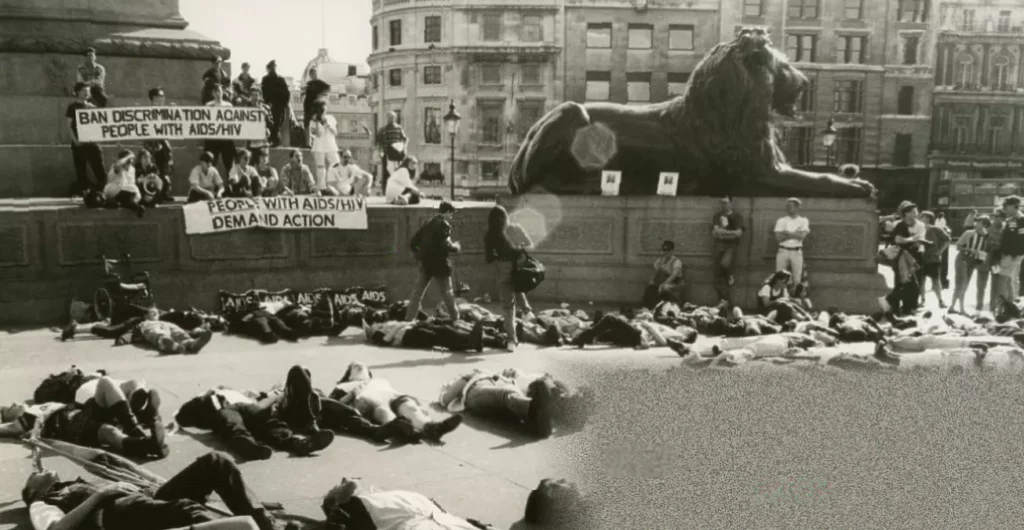
The exhibition’s opening section documents the 1990s London epidemic through photographs of mass “die-ins” in Trafalgar Square, where activists simulated death to dramatise the fatal consequences of government inaction. A documentary, Dancing Whilst Diagnosed, tells the story of the Landmark centre, a rare safe space where former staff and volunteers recall helping people cope with the violence, stigma and discrimination that came with an HIV diagnosis – but also the joy and solidarity that service users found there, including parties with DJs, drag queens and African music. Thompson said of the centre: “It was the only place that I felt really safe about my HIV. I didn’t have to disclose it to anybody. There was no guessing or hiding, so that really helped me navigate those early years of my own diagnosis.”
Challenging pharmaceutical profiteering
A cabinet in the exhibition addresses a controversial chapter in the Wellcome Trust’s own history. The trust then held a 75% stake in the pharmaceuticals company that produced AZT, the first successful HIV drug, which was priced prohibitively high for many patients. Photographs, press reports and posters detail the campaign by ACT UP (AIDS Coalition to Unleash Power) to bring down the cost.
Rob Archer, a co-founder of London and Edinburgh ACT UP, bought shares in the drug firm, enabling him and other activists to question the company chair at its annual general meeting in January 1989. Outside, others staged a picket holding placards that read “We££come AZT Profiteers” and “People Not Profits”. Archer recalled cross-examining the chair and chief executive about the company’s pricing policy and his attitude towards people with AIDS. “I was quite pleased I got under his skin,” he said. The campaign forced the company to slash the price of AZT.
Personal stories and the fight for dignity today
Also on display are photographs from Gideon Mendel’s series The Ward, which documents the care and daily lives of four young gay men – John, Ian, Steven and Andre – on the Broderip and Charles Bell wards at Middlesex Hospital. The Broderip Ward was the first dedicated AIDS ward in London, opened by Princess Diana in 1987. Mendel’s intimate portraits, which show patients, loved ones and staff hugging and touching, became iconic for humanising gay men with HIV at a time when tabloid photographers were rumoured to be using long lenses to photograph the ward. “They tried to make a place which was very emotionally supported. Staff were encouraged to hug the patients. Touch was really important,” Mendel said. “It was a particularly brave and powerful thing that those four young men did because there was a lot of stigma around.” Mendel, who describes his work as “mutated” photojournalism and now calls himself a “visual activist”, also co-founded Through Positive Eyes with David Gere, director of the Art & Global Health Center at UCLA, a project that supports people living with HIV to tell their own stories through photography. It has reached over ten cities in eight countries across five continents.
Among those featured in that project is Phindile, an AIDS counsellor at a clinic in Johannesburg, South Africa, who lost her job after the Trump administration cut funding that supported it. The cuts, which hit the President’s Emergency Plan for AIDS Relief (PEPFAR) – a US initiative that has saved millions of lives since 2003 – led to clinic closures and the loss of thousands of health workers across sub-Saharan Africa, raising fears of a resurgence of new infections and deaths.
The experiences of mothers with HIV are represented by a memory store created by Angelina Namiba, which includes a published diary of her pregnancy and her daughter’s framed handprint. In the early 1990s, pregnant women were encouraged to create these boxes for their children so they would have something to remember their mothers by if they died.
Elsewhere, the plushie body parts stitched by HIV-positive women are part of Catwalk4Power, an initiative that uses creative workshops – writing, performance, crafting, sewing – and catwalk events to improve body image and promote open discussion about sex, intimacy, sexual health, trauma and living with the disease. The project has connected women across the UK and internationally, launching a toolkit in April 2020.
Curator Adam Rose said the exhibition reflects how the demographics of HIV have shifted – “who’s most affected, which groups are more likely to come to contact or experience greater barriers to accessing treatment” – and is intended to connect the history of HIV protests and care in 1990s London to present-day campaigns worldwide, emphasising why this activism “continues to be so urgent, particularly in the context of ongoing cuts to HIV funding”.
Tenderness and Rage runs at the Wellcome Collection, London, until 30 May 2027.