

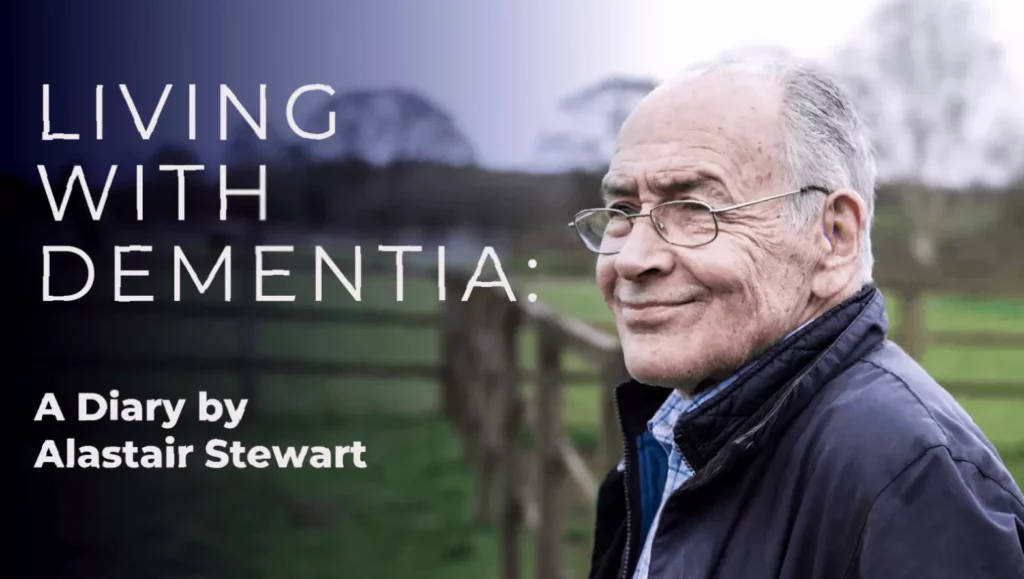
The side effects of dementia have made it increasingly difficult for the veteran broadcaster Alastair Stewart to communicate, as he described how a simple phone call from a former newspaper executive exposed the daily obstacles he now navigates. Stewart, who must wear hearing aids because of deafness, found that he could not use a landline telephone while wearing the devices. When Lord Charles Allen rang to ask how he was and to discuss what Stewart called “Labour’s shambles,” he had to switch to a mobile phone that receives calls directly via Bluetooth.
Personal Health Challenges
Stewart, who disclosed his diagnosis of vascular dementia in September 2023 after a career spanning nearly five decades, has spoken candidly about the subtle symptoms that preceded the diagnosis. He described experiencing a persistent feeling of being “discombobulated,” misjudging simple motor tasks, and arriving at work unusually early out of fear he would forget his shift. His wife, Sally, noticed he could no longer tell the time on an analogue clock. A GP referral for an MRI scan revealed a pattern of “mini-strokes” or “infarct strokes,” leading to the diagnosis. His short-term memory, he has said, is “tricky,” and his motor skills are “very tricky.”
Those challenges were underscored during a recent check-up with his GP, who remains concerned about a low blood count that will require further tests. Stewart reported additional falls and episodes of dizziness. The GP advised him to watch for “seeing stars or fuzzy vision,” a warning that underscores the ongoing management of his condition.
Despite these difficulties, Stewart noted an “upside”: the recent upheaval within the Labour Party brought back memories “with reassuring clarity,” as did the State Opening of Parliament, an event he has always enjoyed for its blend of politics and regal ceremony.
Political Turmoil and the State Opening
The State Opening went ahead even as the threat of a challenge to Prime Minister Sir Keir Starmer grew. Stewart recalled the ceremonial elements with trademark enthusiasm: the Cap of Maintenance and the Great Sword of State, “forever now associated with Penny Mordaunt,” were paraded, and the King wore his Crown. He and the Queen were preceded by Pursuivants and Heralds in their colourful Tudor regalia, prompting a memory of the late broadcaster Alastair Burnet, who once said they “looked like a deck of cards walking backwards.”
The King’s Speech is followed in the Commons by debate beginning with the “Humble Address” thanking the monarch, moved and seconded by government MPs expected to be witty and clever. Stewart recalled Mordaunt’s own speech in 2022, full of double entendres and implied naughtiness, describing it as “worth a listen even today.” This year, the task fell to Naz Shah, MP for Bradford West, and Chris Vince, MP for Harlow. Vince, Stewart noted, manages to get “Harlow” into his speeches as many times as possible. Both were witty, but Shah made the point that it was an honour for a Muslim woman to participate, and she condemned both anti-Semitism and Islamophobia as “stains on our society.”
The political landscape has shifted significantly since those speeches. Wes Streeting, the Health Secretary, resigned on Thursday – the day Stewart wrote his account – citing a loss of faith in Starmer’s leadership. Streeting, a former Cambridge and NUS president who was diagnosed with kidney cancer in 2021, urged a broad leadership contest. Stewart noted that during the debate after Shah and Vince spoke, Streeting became “the butt of many jokes and digs,” with Tories shouting “Just do your job.” The best line came from Kemi Badenoch, who said of the baying Labour MPs: “They want to run the country, but they can’t even organise a simple coup.”
The spectre of senior figures vying for position looms large. Angela Rayner, the former Deputy Prime Minister, has been cleared by HMRC over unpaid stamp duty on a property purchase – a probe that led to her resignation from the cabinet in September 2025. She has said she wants to “play my part” and has not ruled out running. Andy Burnham, the Mayor of Greater Manchester, is seeking a return to Parliament. Stewart pointed out that Burnham is “not even an MP yet,” noting that Starmer and the Labour National Executive made sure of that. Leeds MP Clive Betts said he would step down for Burnham, but victory is not guaranteed in any Labour seat for him. A suggested announcement was cancelled. Stewart observed that Rayner “would certainly keep them busy” if she entered the contest.
A wave of Parliamentary Private Secretary resignations was followed by junior ministers receiving more coverage than usual. Stewart was amused by their briefs – housing, victim support and safeguarding, even defence – given Starmer’s “gloomy prospects.” “You could not make it up,” he wrote.
Turning to legislative matters, Stewart highlighted the European Partnership Bill, part of Starmer’s effort to inch the UK closer to, or even back into, the European Union. Some Labour MPs and the Liberal Democrats are already calling for another referendum on EU membership. Stewart also recalled his friend Charles Clarke’s efforts as Home Secretary to merge smaller police forces, only to discover that the public “rather like our own county constabularies.” The Police Reform Bill, he noted, reminded him of that episode.
Concerns on the World Stage
Stewart’s reflections extended beyond Westminster. He noted that Donald Trump went to Beijing, which reminded him of his own visit to China in 2008 – a trip he remembers especially well. He recalled being fascinated by the Forbidden City ever since watching Bernardo Bertolucci’s film The Last Emperor, still one of his all-time favourites. The film tells the story of the young Emperor Pu Yi, whose apartments and playthings are preserved in the Forbidden City. After the revolution, Stewart wrote, hardliners wanted to destroy the imperial site, but Mao Zedong resisted because he saw it as a monument to China’s greatness.
Watching Trump and President Xi Jinping “do their thing,” Stewart could not help wondering how Streeting or Rayner would fare on the world stage. “I am not sure they, or any other candidate, are up to it,” he wrote. “We really do live in diminished times when it comes to the political class.”